
Skip to content
Search

Latest Stories

The United States will no longer play global policeman, and no one else wants the job. This is not a G-7 or a G-20 world. Welcome to the GZERO, a world made volatile by an intensifying international battle for power and influence. Every week on this podcast, Ian Bremmer will interview the world leaders and the thought leaders shaping our GZERO World.

Presented by

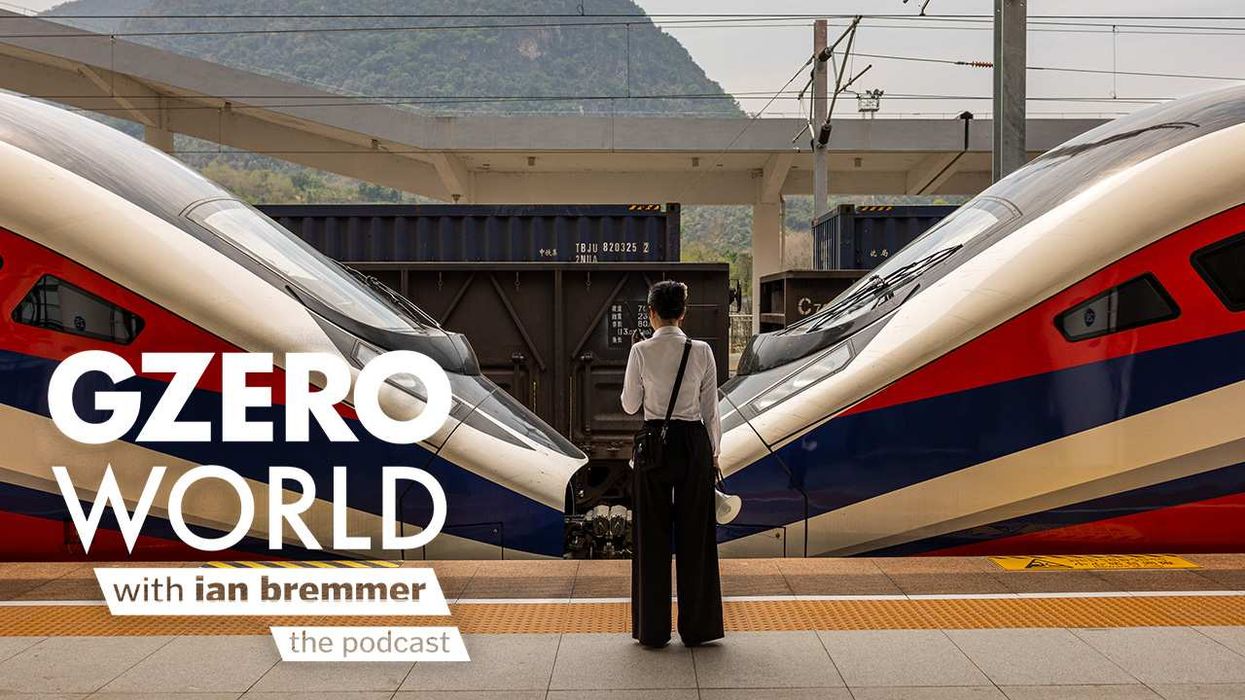
A woman in China standing in front of two high-speed trains with the GZERO World Podcast logo superimposed on top.

China has become an "engineering state," with Dan Wang

Author and tech analyst Dan Wang joins Ian Bremmer on the GZERO World Podcast to talk about the similarities between the US and China, and what Washington can learn from Beijing’s race to build the future.

What can the US learn from the benefits–and perils–of China’s quest to engineer the future? Tech analyst and author Dan Wang joins Ian Bremmer on the GZERO World Podcast to discuss his new book "Breakneck," China’s infrastructure boom, and the future of the US-China relationship. Over the last two decades, China has transformed into what Wang calls an “engineering state,” marshaling near unlimited resources to build almost anything–roads, bridges, entire cities overnight. That investment has created astounding growth, but also domestic challenges and soaring debt.


It’s also led to a stubborn belief within the Chinese government that society itself can be engineered from the top down, where the state treats its people like a building material that can be tweaked or destroyed if necessary. Wang and Bremmer dig into all things US-China—the future of the relationship, the surprising similarities between the two countries, and whether Washington can learn from Beijing’s example without repeating its mistakes.

“The Chinese are able to build a lot of things that meet the material needs of the people, namely homes, solar, wind, nuclear, coal plants, roads, bridges, high-speed rail,” Wang says, “And that is something that I want Americans to have as well.”

Subscribe to the GZERO World Podcast on Apple Podcasts, Spotify, Stitcher, or your preferred podcast platform, to receive new episodes as soon as they're published
listen on:

More from GZERO World Podcast

Three years after October 7, with Aaron David Miller


Three years after October 7, Gaza remains locked in conflict, Israel is heading into a pivotal election, and its relationship with the US is under growing strain. Former US Middle East negotiator Aaron David Miller joins Ian Bremmer to discuss what comes next for Israel and a rapidly changing Middle East.

Gaza remains divided and without a clear path forward. Hamas has been severely weakened militarily but retains significant influence, while Palestinians continue to face difficult humanitarian conditions and little prospect of a political breakthrough.

On the GZERO World Podcast, Ian Bremmer sits down with former US Middle East negotiator Aaron David Miller to take stock of Israel and the region three years later. They discuss why Hamas has proven so difficult to dislodge, what Israel’s October 27 election could actually change, and why a new government may look different at home without dramatically changing Israel’s approach to Gaza, Lebanon, and Iran.

They also examine the changing US-Israel relationship as bipartisan support erodes, Israel’s shifting image among Americans, and a regional balance increasingly shaped by Israel, Turkey, and Iran. Miller argues that changing leadership could improve Washington’s relationship with Israel – but that the broader Middle East remains deeply fragmented, with few signs of an easy way out.

Subscribe to the GZERO World Podcast on Apple Podcasts, Spotify, or your preferred podcast platform, to receive new episodes as soon as they're published
Three years after October 7, Gaza remains locked in conflict, Israel is heading into a pivotal election, and its relationship with the US is under growing strain.... More >

The great US-China superpower rivalry, with Elizabeth Economy


President Trump and China’s Xi Jinping traded handshakes, toasts, and pandas at a diplomatic summit at the White House last week, but beneath all the pageantry, the rivalry between the world’s two most powerful countries is only getting more intense. Hoover Institution Senior Fellow Elizabeth Economy joins Ian Bremmer on the GZERO World Podcast for a look at what’s really driving the relationship between the US and China right now, where each side has leverage, and whether the US is falling behind in the race for global influence and technological dominance.
Keep reading...Show less

No relationship matters more to the world than one between the US and China. Can the two superpowers keep it stable despite a deep divide between Washington and Beijing? Elizabeth Economy of the... More >

The UN at a crossroads, with Secretary-General António Guterres

This week on the GZERO World Podcast, Ian Bremmer sits down with UN Secretary-General Antonio Guterres on the sidelines of the General Assembly for the final time in his official capacity as UN chief. After a decade as the UN’s top diplomat, the former Portuguese Prime Minister is leaving his position at a moment of great global instability. Wars grind on in Ukraine and Iran with no end in sight. Humanitarian crises in Gaza and Sudan have exposed how little leverage the international system has when powerful states and their partners act with impunity. With faith in global institutions at an all-time low, does the world’s most ambitious experiment in multilateralism still have a place?

Keep reading...Show less

This year’s UN General Assembly took place against a backdrop of escalating conflict, fears of runaway AI, and deep divisions over international cooperation. UN Secretary-General António Guterres... More >

Bioweapons, AI, and the end of the world, with Annie Jacobsen

For decades, nuclear war has represented the ultimate doomsday scenario. But investigative journalist and author Annie Jacobsen says biological warfare may pose an even greater overall threat. Unlike nuclear weapons, which require tightly controlled materials, enormously expensive delivery systems, and specialized expertise, the barriers to developing biological weapons can be far lower. And artificial intelligence could lower them further.

Ian Bremmer sits down with Jacobsen to discuss how AI is changing the landscape of catastrophic risk. As increasingly powerful models make sophisticated scientific knowledge easier to access, they could allow bad actors to bypass years of specialized training and dramatically shorten the path from an idea to a potentially dangerous capability.

They also explore the struggle to govern a technology developing faster than regulators can respond, the gaps in existing AI safeguards, and what governments and tech companies could do to identify dangerous vulnerabilities before they are exploited. And they step back to a larger question at the heart of Jacobsen’s work: Why does humanity keep developing technologies with the potential to threaten its own survival – and can our ability to manage those risks ever catch up with our ability to create them?

AI is rapidly lowering the barriers to knowledge and expertise that once kept some of humanity’s most dangerous capabilities out of reach. Investigative journalist Annie Jacobsen joins Ian Bremmer to... More >

GZERO Podcasts

Three years after October 7, Gaza remains locked in conflict, Israel is heading into a pivotal election, and its relationship with the US is under growing strain.... More >

Listen: What does global energy transition look like in a time of major geopolitical change, including rebalancing of trade? In this special episode of "Energized: The Future of Energy,” host JJ... More >

Creating artificial human retinas in zero gravity. Mining rare minerals on the moon. There seems to be no limit to what could be possible if we continue to take our more important industries to... More >

Three years after October 7, Gaza remains locked in conflict, Israel is heading into a pivotal election, and its relationship with the US is under growing strain.... More >

In this episode of The Ripple Effect: Investing in Life Sciences, host Dan Riskin speaks with Patrick Horber, President of Novartis International, and David Gluckman, Vice Chairman of Investment... More >