
Skip to content
Search

Latest Stories

The United States will no longer play global policeman, and no one else wants the job. This is not a G-7 or a G-20 world. Welcome to the GZERO, a world made volatile by an intensifying international battle for power and influence. Every week on this podcast, Ian Bremmer will interview the world leaders and the thought leaders shaping our GZERO World.

Presented by

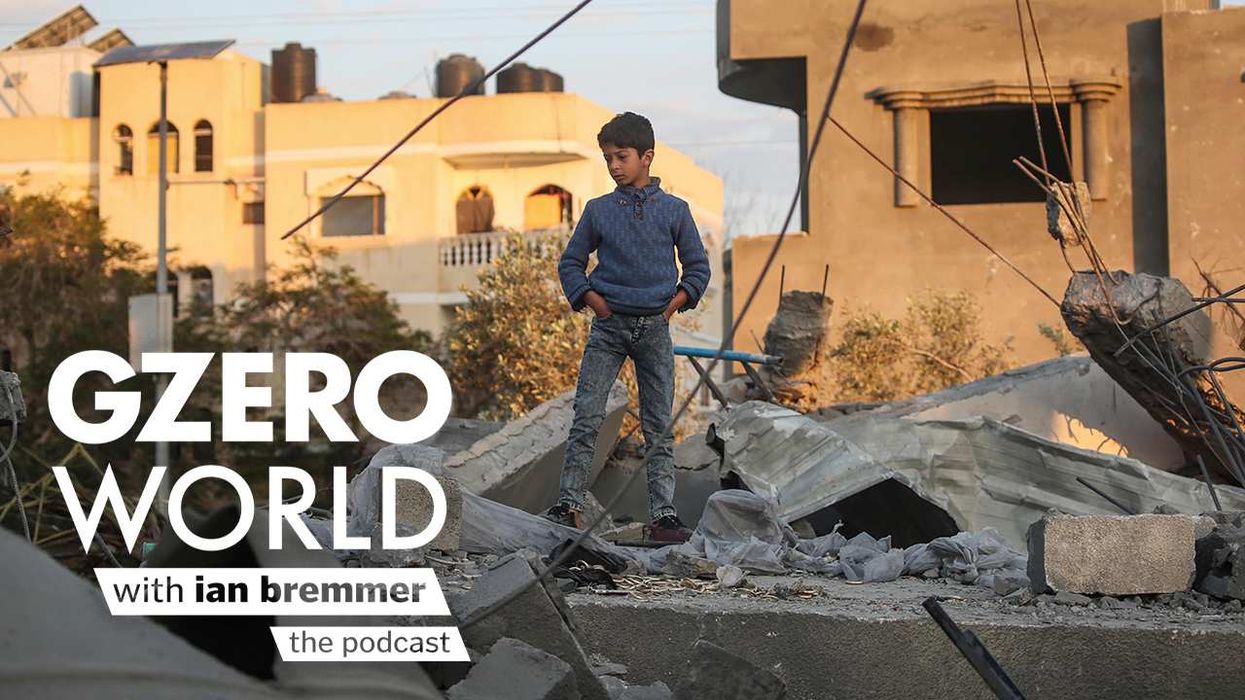
Photo of a young Palestinian boy in Gaza with the GZERO World Podcast logo superimposed on top.

War and Peace in 2025, with Clarissa Ward and Comfort Ero

Global conflict was at a record high in 2025, will 2026 be more peaceful? Ian Bremmer talks with CNN’s Clarissa Ward and Comfort Ero of the International Crisis Group on the GZERO World Podcast.

This week, instead of zooming in on a single conflict, the GZERO World Podcast looks back on 2025 and takes stock of a world increasingly defined by conflict. Ian Bremmer sits down with CNN Chief International Correspondent Clarissa Ward and Comfort Ero, President and CEO of the International Crisis Group to look at some of the biggest crises of 2025–-both the headline making wars and the ones the world overlooked.


Gaza and Ukraine captured the world’s attention this year. But at the same time, around 60 other armed conflicts and struggles have been raging around the world. It’s the most active period of conflict since the end of World War II. Some are decades-long battles, like Myanmar’s devastating civil war. Others are more recent, like the surge of terrorist insurgent groups in Africa’s Sahel. But each is a symptom of a broader global order breaking down—driven by weakening institutions, regional rivalries, climate shocks, and failing states. Bremmer sits down first with Clarissa Ward, to discuss her reporting from war zones around the world and then with Comfort Ero, for a global perspective on the conditions that have created so much strife.

“I think it's important not to stop talking about Ukraine and Gaza because what happens there in those two conflicts set the precedent for other places,” Ero tells Bremmer.
Subscribe to the GZERO World Podcast on Apple Podcasts, Spotify, Stitcher, or your preferred podcast platform, to receive new episodes as soon as they're published

listen on:

More from GZERO World Podcast

The UN at a crossroads, with Secretary-General António Guterres

This week on the GZERO World Podcast, Ian Bremmer sits down with UN Secretary-General Antonio Guterres on the sidelines of the General Assembly for the final time in his official capacity as UN chief. After a decade as the UN’s top diplomat, the former Portuguese Prime Minister is leaving his position at a moment of great global instability. Wars grind on in Ukraine and Iran with no end in sight. Humanitarian crises in Gaza and Sudan have exposed how little leverage the international system has when powerful states and their partners act with impunity. With faith in global institutions at an all-time low, does the world’s most ambitious experiment in multilateralism still have a place?

Keep reading...Show less

This year’s UN General Assembly took place against a backdrop of escalating conflict, fears of runaway AI, and deep divisions over international cooperation. UN Secretary-General António Guterres... More >

Bioweapons, AI, and the end of the world, with Annie Jacobsen

For decades, nuclear war has represented the ultimate doomsday scenario. But investigative journalist and author Annie Jacobsen says biological warfare may pose an even greater overall threat. Unlike nuclear weapons, which require tightly controlled materials, enormously expensive delivery systems, and specialized expertise, the barriers to developing biological weapons can be far lower. And artificial intelligence could lower them further.

Ian Bremmer sits down with Jacobsen to discuss how AI is changing the landscape of catastrophic risk. As increasingly powerful models make sophisticated scientific knowledge easier to access, they could allow bad actors to bypass years of specialized training and dramatically shorten the path from an idea to a potentially dangerous capability.

They also explore the struggle to govern a technology developing faster than regulators can respond, the gaps in existing AI safeguards, and what governments and tech companies could do to identify dangerous vulnerabilities before they are exploited. And they step back to a larger question at the heart of Jacobsen’s work: Why does humanity keep developing technologies with the potential to threaten its own survival – and can our ability to manage those risks ever catch up with our ability to create them?

AI is rapidly lowering the barriers to knowledge and expertise that once kept some of humanity’s most dangerous capabilities out of reach. Investigative journalist Annie Jacobsen joins Ian Bremmer to... More >

The enduring legacy of 9/11, with former Defense Secretary Mark Esper


This week marks 25 years since 9/11—the deadliest terror attack the world has ever seen and a defining moment in American history. The attacks transformed US politics and national security. The war on terror became the organizing principle of American foreign policy. Former Secretary of Defense Mark Esper joins Ian Bremmer on the GZERO World Podcast to reflect on the day that forever changed how Americans thought about national security, and how the United States wielded its enormous power around the world.
Keep reading...Show less

Former Defense Secretary Mark Esper reflects on 25 years since 9/11, the lessons of America’s forever wars, and the biggest threats to US national security today... More >

The race to build humanity's future in space, with Chris Hadfield

More than half a century after humans last walked on the Moon, the next era of space exploration is taking shape. Getting there is cheaper, private companies are playing a much bigger role, and discoveries like vast reserves of lunar water have made the prospect of establishing a permanent presence on the Moon far more realistic.

Ian Bremmer sits down with Canadian astronaut Chris Hadfield to talk about what this new space age could look like. They discuss the growing competition between the US and China, whether rivals can cooperate on the lunar surface, and who gets to write the rules as governments and companies begin looking beyond simply planting a flag.

Hadfield also breaks down the practical challenges of living on the Moon – from powering a settlement through long lunar nights to the unanswered question of whether humans can develop normally in low gravity. He explains how private companies are turning space into a commercial marketplace, why regulation will inevitably struggle to keep pace, and why robots alone can never satisfy humanity’s drive to explore Mars.

And drawing on nearly six months aboard the International Space Station, Hadfield reflects on the surprisingly wonderful experience of sleeping in zero gravity, circling Earth 2,600 times, and how seeing the planet from above fundamentally changed his perspective on humanity and our place in the universe.

The race to the Moon is back – but reaching it is only the beginning. Astronaut Chris Hadfield joins Ian Bremmer to explore how cheaper technology, private industry, and growing US-China competition... More >

GZERO Podcasts

This year’s UN General Assembly took place against a backdrop of escalating conflict, fears of runaway AI, and deep divisions over international cooperation. UN Secretary-General António Guterres... More >

Listen: What does global energy transition look like in a time of major geopolitical change, including rebalancing of trade? In this special episode of "Energized: The Future of Energy,” host JJ... More >

Creating artificial human retinas in zero gravity. Mining rare minerals on the moon. There seems to be no limit to what could be possible if we continue to take our more important industries to... More >

As AI adoption expands around the world, a new Gallup-Microsoft survey reveals a striking divide in how people feel about the technology.... More >

In this episode of The Ripple Effect: Investing in Life Sciences, host Dan Riskin speaks with Patrick Horber, President of Novartis International, and David Gluckman, Vice Chairman of Investment... More >