
Skip to content
Search

Latest Stories

The United States will no longer play global policeman, and no one else wants the job. This is not a G-7 or a G-20 world. Welcome to the GZERO, a world made volatile by an intensifying international battle for power and influence. Every week on this podcast, Ian Bremmer will interview the world leaders and the thought leaders shaping our GZERO World.

Presented by

Wikipedia Cofounder

Why we still trust Wikipedia, with cofounder Jimmy Wales

We can't really agree on anything, except for Wikipedia.

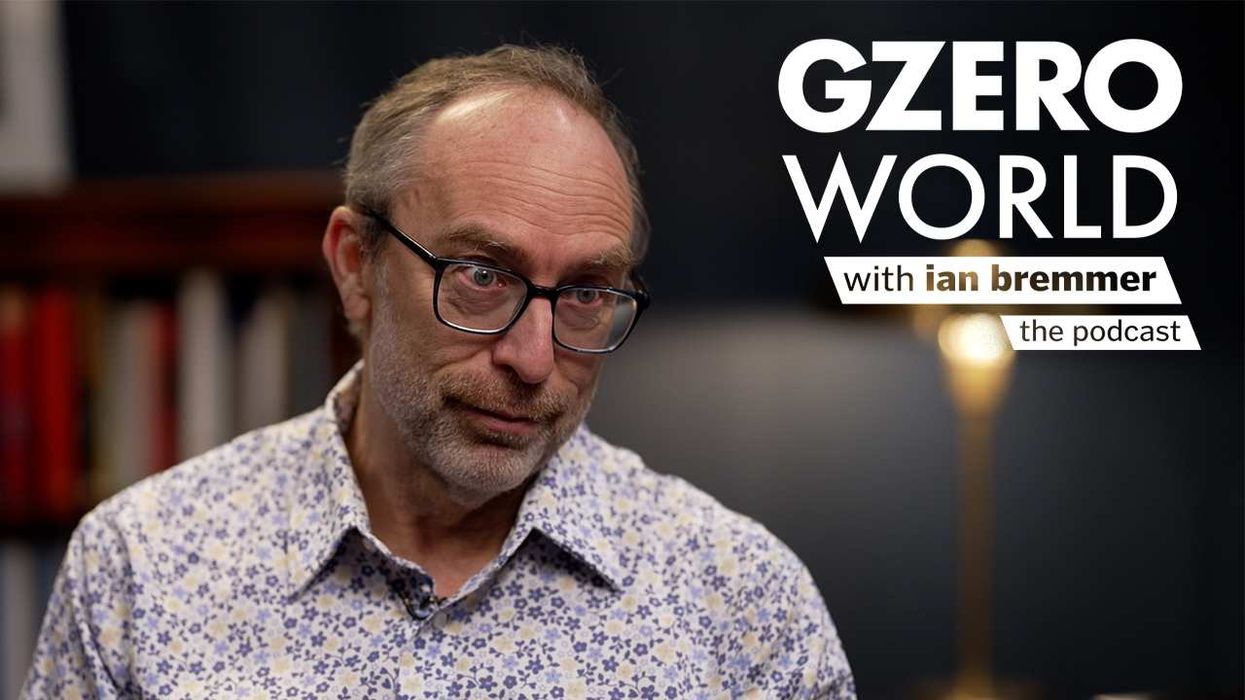
At a moment when Americans can’t agree on much of anything, one unlikely institution still commands broad trust: Wikipedia. On the GZERO World podcast, Ian Bremmer sits down with Wikipedia cofounder Jimmy Wales to ask why the crowdsourced encyclopedia remains one of the most visited and relied-upon sites in the world, even as trust in media, government, and tech companies continues to collapse.


That trust, Wales argues, comes from Wikipedia’s decentralized model and its refusal to speak with a single authoritative voice on contested issues. “We don’t try to answer the question or take a side,” Wales says. “What we do is describe the debate.” But that principle is under strain. Wales addresses recent backlash over Wikipedia’s handling of politically sensitive topics, including Gaza, where he says the site crossed an important line by adopting language that lacked broad consensus. “For Wikipedia to speak in its own voice requires an extremely high bar,” he explains.


Bremmer and Wales also explore how artificial intelligence is reshaping the information ecosystem. While AI systems are already trained on Wikipedia’s content, Wales says the platform is moving cautiously, prioritizing transparency, open source tools, and independence over partnerships with big tech. “Wikipedia’s biggest liability is also its biggest strength,” Wales says. “No one owns it.” In an internet increasingly dominated by centralized platforms and opaque algorithms, Wales makes the case that Wikipedia’s model, messy, imperfect, and community-driven, may be more necessary than ever.


Subscribe to the GZERO World Podcast on Apple Podcasts, Spotify, Stitcher, or your preferred podcast platform, to receive new episodes as soon as they're published
More from GZERO World Podcast

Cuba's Trump standoff and economic crisis with Michael Bustamante

This week, Ian Bremmer sits down with University of Miami historian and Cuba expert Michael Bustamante to make sense of the US-Cuba standoff.

Keep reading...Show less

Historian Michael Bustamante joins Ian Bremmer to discuss Cuba's economic freefall, Trump's end game, and the hopes of Cuban Americans.... More >

North Korea's nuclear gamble pays off, with the WSJ's Jonathan Cheng

The Kim dynasty has outlasted every threat for 80 years. Wall Street Journal's Jonathan Cheng explains how, and why the Iran war just made Kim Jong Un seem untouchable.

Keep reading...Show less

None... More >

Assessing the Iran War's "structural damage" with Harvard economist Gita Gopinath

Rising energy prices, higher inflation, and growing economic uncertainty — a Harvard economist says the fallout from the Iran war is already being felt.

On the GZERO World Podcast, Ian Bremmer sits down with Harvard economist and former IMF Deputy Managing Director Gita Gopinath to unpack how the conflict is rippling through the global economy. As oil and gas prices surge, inflation is climbing, adding new costs for households and businesses and putting pressure on growth worldwide.

Keep reading...Show less

On the GZERO World Podcast, Ian Bremmer sits down with Harvard economist and former IMF Deputy Managing Director Gita Gopinath to unpack how the conflict is rippling through the global economy. As... More >

Viktor Orbán's last stand, and the future of Europe's far right with Ivan Krastev

For sixteen years, Viktor Orbán has dominated Hungarian politics, rewriting rules, consolidating power, and positioning himself as Europe's leading nationalist and Donald Trump's closest ally on the continent. But with parliamentary elections approaching on April 12th, his aura of invincibility is finally cracking. Opposition candidate Péter Magyar, a conservative former Orbán insider, is polling ahead by double digits, and the Trump administration is scrambling to help keep its favorite European in office.

Keep reading...Show less

Ian Bremmer sits down with Ivan Krastev, Chairman of the Centre for Liberal Strategies and political scientist, to discuss Hungary's consequential upcoming election and what it means for the far... More >

GZERO Podcasts

Historian Michael Bustamante joins Ian Bremmer to discuss Cuba's economic freefall, Trump's end game, and the hopes of Cuban Americans.... More >

Listen: What does global energy transition look like in a time of major geopolitical change, including rebalancing of trade? In this special episode of "Energized: The Future of Energy,” host JJ... More >

Creating artificial human retinas in zero gravity. Mining rare minerals on the moon. There seems to be no limit to what could be possible if we continue to take our more important industries to... More >

Microsoft is advancing its efforts to eliminate single-use plastics across its global packaging portfolio through material innovation and design changes across products like Surface and Xbox. By... More >

In this episode of The Ripple Effect: Investing in Life Sciences, host Dan Riskin speaks with Patrick Horber, President of Novartis International, and David Gluckman, Vice Chairman of Investment... More >