
Skip to content
Search

Latest Stories

Economy

Global economy news and analysis from GZERO Media

Presented by

Podcast: Is a second Great Depression coming?

Podcast: Is a second Great Depression coming?

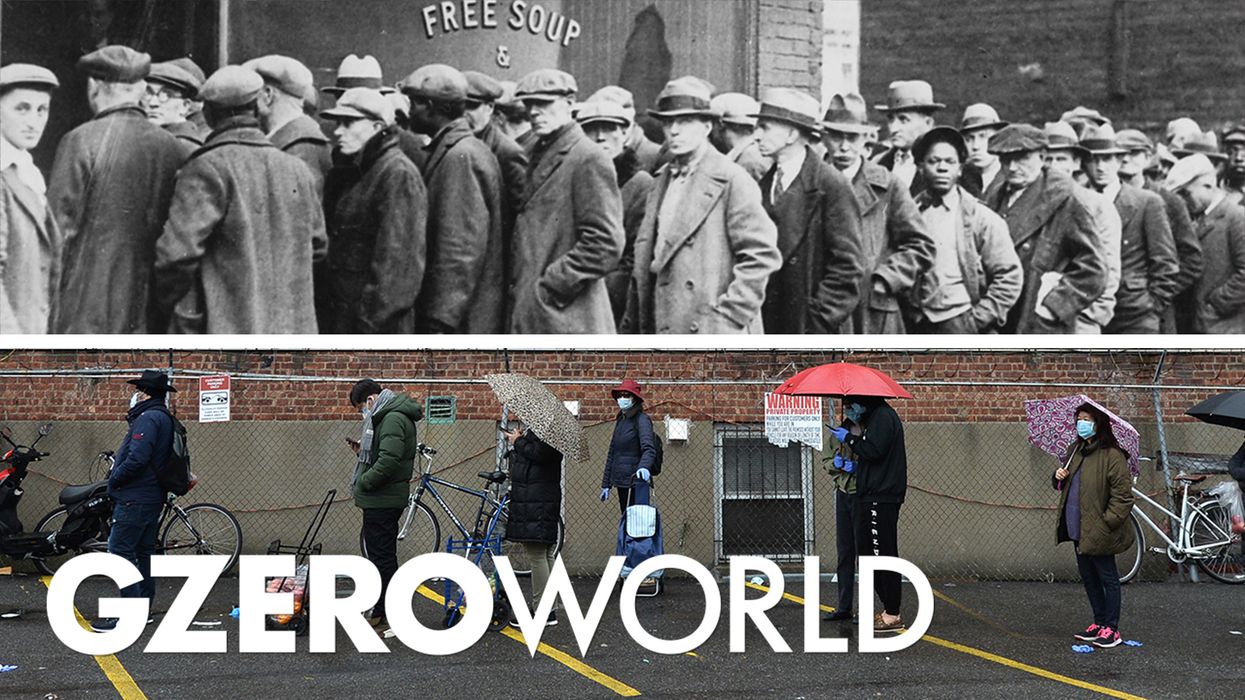
Listen: Most of us are familiar with recession, and experienced the major economic impact of one from 2008-2010. It turns out, the definition of a "depression" is harder to articulate, even for economists, because the US hasn't had one since the 1930s. But as unemployment rises and lockdowns threaten the existence of businesses here and around the world, it's time to ask the question: Is another depression a possibility, and what would that look like today? On the latest episode of GZERO World, Ian Bremmer poses this question to leading economic historian and author Adam Tooze. The two discuss the strength of the US and global economies before and during the COVID-19 pandemic, and realistic timeframes for when the financial outlook will improve.

Transcript

Listen: Most of us are familiar with recession, and experienced the major economic impact of one from 2008-2010. It turns out, the definition of a "depression" is harder to articulate, even for economists, because the US hasn't had one since the 1930s. But as unemployment rises and lockdowns threaten the existence of businesses here and around the world, it's time to ask the question: Is another depression a possibility, and what would that look like today? On the latest episode of GZERO World, Ian Bremmer poses this question to leading economic historian and author Adam Tooze. The two discuss the strength of the US and global economies before and during the COVID-19 pandemic, and realistic timeframes for when the financial outlook will improve.

Subscribe to the GZERO World Podcast on Apple Podcasts, Spotify, Stitcher, or your preferred podcast platform, to receive new episodes as soon as they're published.
Next Page

More from GZERO World Podcast

How AI offsets Trump’s tariffs...for now

AI may be doing more than driving hype—it’s helping prop up the US economy. Harvard economist and former IMF Deputy Managing Director Gita Gopinath says a surge in AI investment helped offset the economic drag from tariffs. “The positive effect that came from AI offset the negative effect that came from tariffs,” she explains, noting that the two were “almost equivalent.”

As part of a larger conversation in the latest episode of GZERO World, Gopinath cautions that the longer-term impact is still uncertain. While US productivity has been strong, there’s no clear, economy-wide evidence yet that AI is driving those gains. Adoption remains early, and the path to profits is still unclear.

The takeaway: AI may be cushioning the economy for now—but its lasting impact is still an open question.

Did the AI boom counteract the economic fallout of Trump's tariffs? And how long can that last?... More >

The US economy has avoided the brunt of the Iran war...for now

As part of a larger conversation in the latest episode of GZERO World, Harvard economist and former IMF Deputy Managing Director Gita Gopinath breaks down the economic impact of the Iran war—and why the US is relatively insulated.

So far, she says, the shock is modest compared to past crises. Global growth is expected to drop by about 0.3 percentage points—a fraction of the damage seen during the pandemic.

But the impact isn’t evenly felt. While rising energy prices are pushing inflation higher worldwide, the US economy is less exposed than most. Gopinath estimates the hit to US growth at just 0.1 to 0.15 percentage points, thanks in part to domestic energy production.

That doesn’t mean Americans are immune. Higher prices are still adding hundreds of dollars in costs for households. But compared to more energy-dependent economies, the US is better positioned. The takeaway: the Iran war is a global economic shock—but not a balanced one.

How much is the Iran war hurting the global economy—and why is the US less affected?... More >

Can anyone actually dethrone the dollar?

For 80 years, the US dollar has been the world's reserve currency. Its dominance was built on US economic strength, institutional trust, and the post-World War Two Bretton Woods system, which pegged global currencies to the dollar rather than gold. But today, the greenback is under pressure. The dollar shed about a tenth of its value in the first year of Trump's second term. Tariffs, White House pressure on the Federal Reserve, and rising debt have all shaken confidence.

Xi Jinping has made renminbi internationalization a top priority. Vladimir Putin has repeatedly called on BRICS nations to ditch the dollar. But for all the talk of de-dollarization, when uncertainty hits, the dollar is still what people reach for. Foreign investment in US assets actually climbed in the second half of 2025.

The reason: TINA, there is no alternative. Until another currency offers the depth, liquidity, and institutional backing of the dollar, the greenback isn't going anywhere. Trump's policies are accelerating efforts to diversify, but dethroning the dollar requires a replacement, and no one has one ready.

The dollar has ruled the world economy for 80 years. Yet, tariffs, debt, and political pressure are all chipping away at it. Ian Bremmer explains what it would actually take to bring it down.... More >

Where US tariffs stand one year after Liberation Day

US President Donald Trump rattled the global economy when he announced tariffs on around 90 countries on “Liberation Day” one year ago today, but probably not in the way either supporters or critics first imagined. At its peak, the tariffs the US imposed were the highest in nearly a century, yet tariffs haven’t broken the global economy. They haven’t triggered the kind of all-out collapse many feared.

Tariffs didn’t “deglobalize” the world overnight, as some feared. Instead, they rewired how companies think. Businesses now assume politics is a permanent cost of doing business with the US. Supply chains are no longer built just for efficiency; they want redundancy, flexibility, and political safety. That means more rerouting, more stockpiling, more friend-shoring, and, inevitably, adjusting to more friction.

Keep reading...Show less

US President Donald Trump rattled the global economy when he announced tariffs on around 90 countries on “Liberation Day” one year ago today, but probably not in the way either supporters or critics... More >

GZERO Podcasts

Bloomberg reporter Katrina Manson joins Ian Bremmer to discuss Project Maven, the program that brought AI to the heart of US warfare, and the risks that come with it.... More >

Listen: What does global energy transition look like in a time of major geopolitical change, including rebalancing of trade? In this special episode of "Energized: The Future of Energy,” host JJ... More >

Creating artificial human retinas in zero gravity. Mining rare minerals on the moon. There seems to be no limit to what could be possible if we continue to take our more important industries to... More >

Xi Jinping will welcome Donald Trump with lots of pomp and circumstance. The summit, though, will be short on substance.... More >

In this episode of The Ripple Effect: Investing in Life Sciences, host Dan Riskin speaks with Patrick Horber, President of Novartis International, and David Gluckman, Vice Chairman of Investment... More >