Four years ago, Colombia tried a new tack, electing a left-wing president for the first time. Since taking office, Gustavo Petro has raised income taxes for top earners, halted new oil exploration in a bid to phase out fossil fuels, expanded access to government services like education in rural areas, and hiked the country’s minimum wage by 23%. He has also tried to deal with the country’s powerful armed groups via negotiations, rather than brute force, using a flagship policy branded as “Total Peace.”
On Sunday, Colombians will have their say on this left-wing agenda, as they head to the polls to vote in the first round of the presidential election.
Leading the race is Petro’s anointed successor, Senator Iván Cepeda, who is left of the term-limited president on certain policy issues. Educated in Soviet-era Bulgaria as a teenager, Cepeda leads the latest polls, but falls short of the 50% required to avoid a June runoff, or “balotaje.”
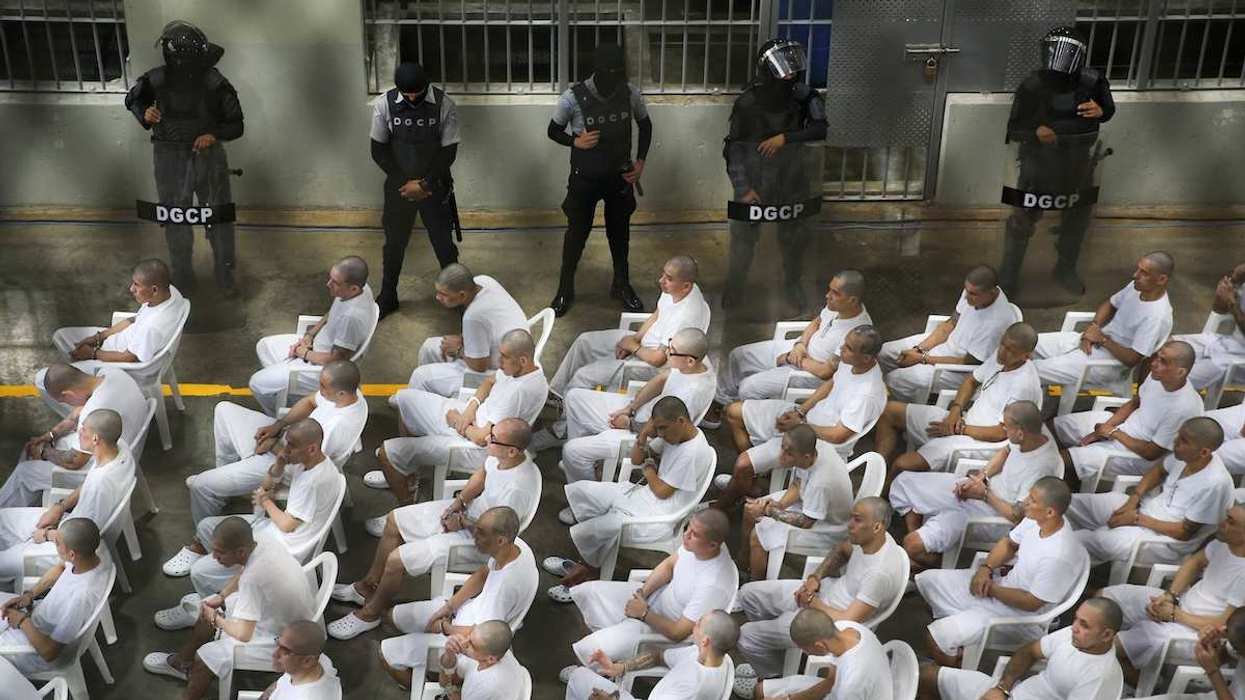
His likely runoff opponent will be one of two right-wing candidates: Senator Paloma Valencia, a traditional conservative, and Abelardo de la Espriella, a hard-right populist lawyer who often uses sensationalist stunts to gain traction – he once clutched his crotch when asked why he appeals to female voters. Valencia’s proposals, which include adding 30,000 new soldiers to tackle gangsters and anti-government rebels, put her firmly on the right. But she looks like a relative centrist compared to de la Espriella, who has pledged to build 10 superprisons as a way to deal with the country’s surging rates of violence – an increasingly popular idea among Latin America’s right-wing leaders.
What are the main issues for voters? Amid the country’s left-turn on economic policy and the surge of violence, the economy and security are top of voters’ minds, Atlantic Council’s Colombia expert Enrique Millán-Mejía told GZERO. But, he added, what matters most is the economy.
“Colombians are going to the polls to decide what type of socioeconomic model they want for their economy,” said Millán-Mejía. “[They’ll decide] if they want to keep an economy that is open market and open to free enterprise, or if they want to continue with a model that has shown a path of making some radical transformations.”
When it comes to Petro’s policies, there are aspects of his left-wing agenda that have proved to be popular. The minimum wage hike was a “key factor behind the rise in Petro’s approval ratings this year,” said Eurasia Group’s regional expert Maria Luisa Puig – the president’s ratings jumped to close to 50% in February, up 10 points from the prior poll from last November. His ability to provide services to people in poor, rural areas, who had previously lacked access, has also been a laudable achievement, according to Millán-Mejía. The economy has also grown, and the labor market is strong.
But those gains have also come at a price for the government purse.
“The minister of finance [Germán Ávila] has been irresponsible in terms of the type of loans he’s taking in the international market, paying high interest on those loans,” said Millán-Mejía. “What you see is that the economy is going to be really constrained in the next four years.”
As Petro’s chosen successor, Cepeda is advocating for a continuation of these policies. The son of a communist politician who was assassinated by far-right paramilitaries in 1994, Cepeda wants to give land to victims of internal conflict, expand income support for elderly and young people alike. At times, he even wants to go beyond Petro: he has pledged to prohibit the central bank from raising interest rates.
De la Espriella – who goes by the nickname, “El Tigre” – also espouses a populist agenda, but of a very different ilk. Much like Argentina’s Javier Milei, he has promised to take a proverbial chainsaw to the size of government, pledging to cut its spending by 40%. He would do this, in part, by dismantling government agencies like the Ministry of Equality, created under Petro to boost economic inclusion.
Valencia, by contrast, is pitching a traditional conservative economic agenda. Alongside boosting oil and gas production and exports (“El Tigre” also advocates for this), she wants to cut taxes, give workers greater access to credit – especially those in the informal economy – and improve child literacy rates. She has labeled these policies “common sense,” and derided the populist proposals of de la Espriella as “cinematic.”
Security returns to the fore. In the years immediately following the 2016 peace deal between the government and the Revolutionary Armed Forces of Colombia (FARC), which ended a 52-year armed conflict, security had fallen down the list of priorities for voters.
But since Petro came into power, violence has skyrocketed. The number of homicides has jumped. Kidnappings have spiked. Forced displacements are at a 10-year high. Cocaine production is at a record high. All of this came to a head last year when a teenage gunman assassinated conservative presidential candidate Miguel Uribe in Bogotá, reviving memories of the 1980s and 1990s when political violence was commonplace in the country. Petro’s “Total Peace” policy was, in the words of Millán-Mejía, a “complete disaster.” Much as it has across Latin America, security has since become a top priority for Colombians.
This helps explain some of de la Espriella’s burgeoning appeal. He regularly appears on social media wearing a bulletproof vest, helping him to amass a large online following, and has suggested using mass trials for gang members. His pledges for more prisons – as well as his beard – have prompted comparisons to El Salvador’s President Nayib Bukele, though de la Espriella denies the link. His challenge, should he advance to a runoff, will be winning support from centrists.
Cepeda, meanwhile, has defended Total Peace, which might prove to be an error of judgement – both in terms of politics and policy.
“The political left has vowed continuity with the idea of negotiations,” International Crisis Group’s Deputy Director Elizabeth Dickinson, who is based in Bogotá, told GZERO. “But one of the critical lessons of Total Peace has in fact been that it is fundamental to coordinate the negotiation strategy with the defense [military] strategy.”
Colombians will have their say on the matter on Sunday.