Podcast: Surviving on Dragonflies- A North Korean Defector's Story with Yeonmi Park
Listen: Seeing dead bodies on the street was a part of everyday life." Growing up in North Korea, Yeonmi Park says she survived the great famine of the 1990s by foraging for grasshoppers and dragonflies. Today she is a human rights activist living in Chicago. How she got from there to here is the story of a lifetime. And it's the subject of this special edition of GZERO World.
TRANSCRIPT: Surviving on Dragonflies- A North Korean Defector's Story with Yeonmi Park
Yeonmi Park:
The first thing my mother told me was, "Don't even whisper because the birds and mice can hear me."
Ian Bremmer:
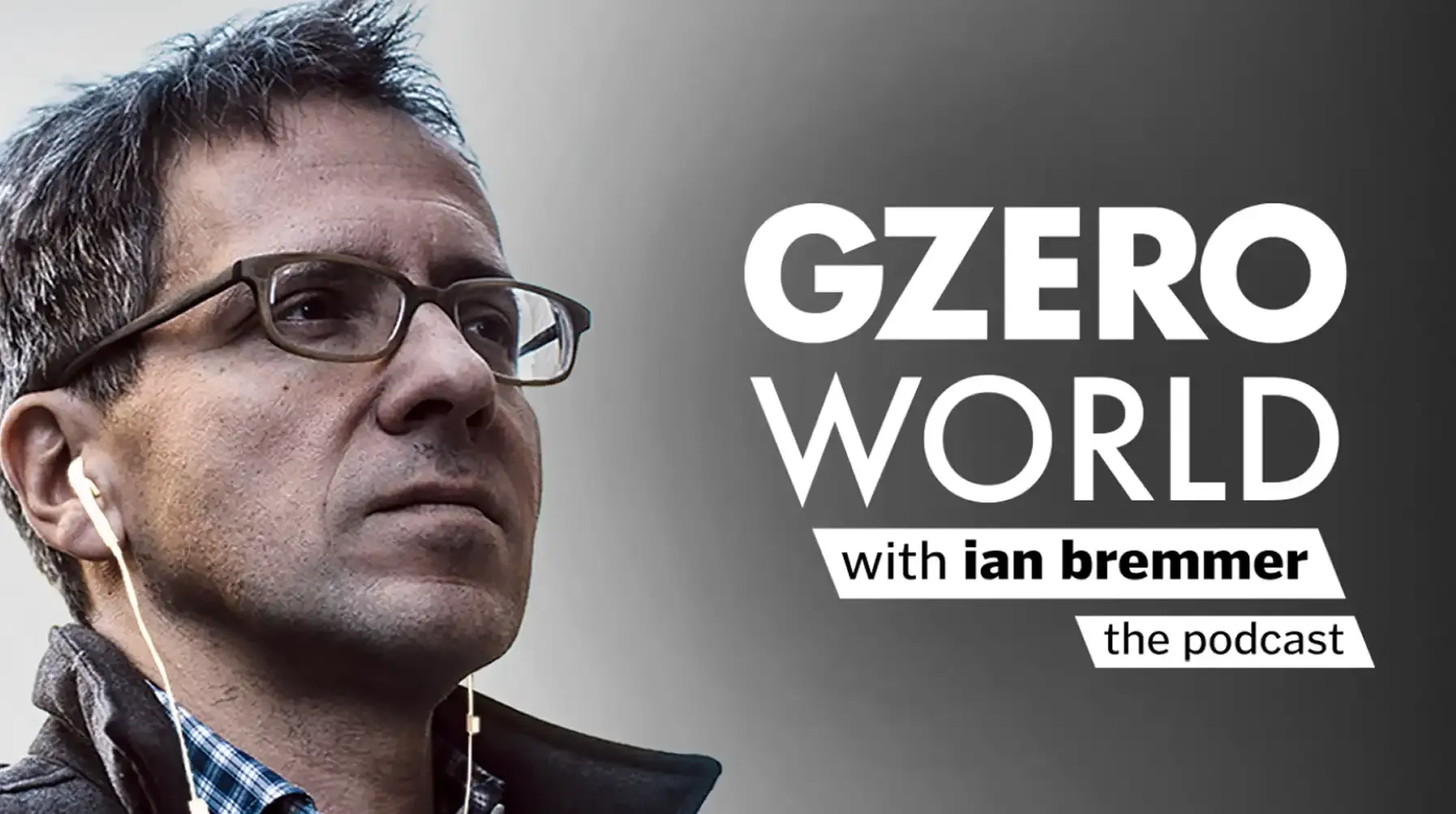
Hi, I'm Ian Bremmer and welcome to the GZERO World Podcast, an audio version of what you can find on public television where I analyze global topics, sit down with big guests and make use of little puppets.
Ian Bremmer:
This week I sit down with North Korean defector and human rights activist Yeonmi Park. She'll recount her harrowing escape from the totalitarian regime that involves crossing a frozen river into China and subsisting on dragonflies. Let's get to it.
Announcer:
The GZERO World is brought to you by our founding sponsor, First Republic. First Republic, a private bank and wealth management company. Imagine a bank without teller lines where your banker knows your name and its most prized currency is extraordinary client service. Hear directly from First Republic's clients by visiting firstrepublic.com.
Yeonmi Park:
I was born in 1993 in the northern part of North Korea. There was a river that divided China and North Korea and I was right there in the northern part in the border area.
Yeonmi Park:
My day would be going to school in the morning and I had to bring work clothes because, in North Korea, we don't really say, "Someone's minor, they cannot do labor work," even the seven years or eight years or they all have to work because we are revolutionaries.
Yeonmi Park:
Our existence is only for the party. It's not for ourselves or for anything else. We just live for the party. They never teach us what critical thinking is. All I learned was revolution history about our dear leaders, how great they were. What kind of miracles they can make, and how they were protecting us from our enemies, we choose Americans.
Yeonmi Park:
If you look at the picture with the Kim Jong Il, the previous Kim, with the other people in North Korea, he is literally the fattest guy in the picture, he's pretty big. But in North Korea they taught us in schools everywhere that Kim is starving for us. He's working so hard to keep us safe from our American enemies and he's starving and I believe in North Korea. So a lot of them are brainwashed in North Korea right now, even to this day. But the ones who are not still have no resources to do anything about it.
I was never able to call Americans, Americans. I had to call them "American bastards". Even in my math class, when they taught us the math problem, the teachers tried how to learn numbers. It was like, "There are four American bastards, you kill two of them, then how many Americans you left to kill?" And as a child, I say, "Two American bastards." So education, everything in the society, the songs that I sang, the books that I read, the movies that I watched, everything that was about dear leader and propaganda.
After all the class ends in the afternoon, we go to construction sites or we go to where the flood happened, we go help the farmers out. And while we are doing all those labor, we just try to look for things to eat, even if there's some, after the harvest, some few grains left there. We already trying to find that to eat. So what I always really remember was being hungry.
Because I was in a countryside, not in the capital, seeing dead bodies on the streets was everyday life.
As a child for myself, I was going to mountains eating flowers, plants, eating dragonflies or eating grasshoppers. And that's how I barely survived. But my case, I was lucky because I'm here today, I survived all that, but so many millions of my neighbors, friends, my relatives and Northern people just die during their time for just nothing, for not having food.
Yeonmi Park:
As a child, when someone asks me what would they want to be, what's my dream was? My dream was having a one bucket of bread because I never knew that... I never tested my stomach that I could be feel full. And hunger means here is hunger. But in North Korea, hunger means death.
Yeonmi Park:
You're starving in your household. And what do you do? You got to go somewhere in the alley or somewhere and you sell one of your spoons, you sell one of your clothes, you sell one of your blankets, a trading we do with one pounds of corn, one pound of rice. And that's how it began initially.
Yeonmi Park:
And then people learned, "I can make rice cake at home. I can could go temporary at home, I'm going to sell in those alleys." So there was no certain location that was people allowed to trade. Those people were, we call a "grasshopper market" that people had to be keep running away from the officials who were trying to catch them. In the northern parts of North Korea, they are a lot selling drugs to China or they're selling a lot of different natural resources from North Korea. We sell them gold, we sell them copper, for the trading that China give to them what they ask for. And those, a lot of times, are foreign information like DVDs or USB sticks with the American Hollywood movies in it.
My father did engage in a black market and when we said "black market", it's not like you are selling drug or guns, anything bad. He was literally selling sugar, rice, clocks, and all the daily things that you need. And then, eventually, he tried to sell metals like a silver, copper, nickel. And that was a crime because he was trading, and he was sentenced to prison and tortured and he was sentenced more than 10 years. And if my father is a criminal, they say that my blood is tainted, that I am a criminal's daughter.
The term "distant" doesn't exist in North Korea. It's unlike Venezuela, it's unlike Iran or unlike other authoritarian government or Russia. The distance doesn't exist because there is a zero tolerance by the government. If you say something wrong, not only yourself being publicly executed, that three generations of your family being affected because of you. So if I do something today in North Korea saying, "I don't like the regime," then my mother, my son, my husband, and my husband's family, my mother's family, everyone around me is being affected.
North Korea have a public execution and there's no concept of minor. If there's a public execution, as a child, as an elder, anybody, have to go there to see a person getting killed. And people disappeared all the time in North Korea. And my mother saw a man, young man, who was getting executed because he ate a cow, he had a TB and he ate a cow. And that was a crime because all the cows were owned by the government. So our lives are not even as value as cows that North Korea has.
Titanic Movie Clip [Jack Dawson]::
All right, open your eyes.
Yeonmi Park:
When I watched Titanic, as a young girl, in the beginning, I just watched the movie and I was so confused. First of all, I just couldn't understand why anyone is making a movie out of such a shameful story. In North Korea, as a child, I did not learn about Shakespeare. I don't know what Juliet Romeo was as a child. And also in the movie, they don't talk about anything about the revolution or the party.
Yeonmi Park:
So that was confusing, like a movie can actually be dedicated for human feelings. And in North Korea, no one told us our feelings were important or anything. I never seen my father was telling my mother that he loved her. My mother never told me that she loved me. The word that we have "love" is only the word that we can use to express our feelings towards the leader or the party.
Yeonmi Park:
In daily life, we don't have this vocabulary like "human rights, freedom, liberty, love". It's almost like George Orwell's 1984. In his book he talks about the importance of words. If you know the word that means you know the concept, and in North Korea, the regime purposefully remove this words in our daily life. So we don't know the concept. And this movie is bringing all this different concept that we, North Koreans, never knew before. A person can die for the other person. We don't have to become all revolutionaries.
Yeonmi Park:
I think all these things do inspire a lot of, especially young people, young generation. And I do think this is a revolution, a quiet, silent revolution. But this awareness is not enough to change this powerful dictator, because it is a free word that we cannot do anything about this monstrous dictator. How a person in North Korea are so vulnerable can do anything about this regime? So I think even though this revolution is only getting bigger and stronger, but I don't think, at any point right now, this awareness going to overthrow the regime because they don't have the resources to do so.
My sister, she was 16 years old, she escaped with her friend. I wanted to escape with her, but I couldn't because I have really bad stomach ache. My mother took me to the hospital and in North Korea we don't have x-rays or electricity to figure out what's wrong with me. Just simply, doctor rub my belly and he said that I have appendix that it has to be removed right away. So that afternoon he removed my appendix without any painkiller. And then when they opened, it was just like malnutrition infection that I was experiencing.
In the hospital we saw so many dead bodies just scrambled in the middle of the way to go into the bathroom. And my mother simply asked to nurse, "Why are you not taking those bodies? Because we could see where rats were eating humans and humans are hungry, so we eat those rats back." And the nurse was saying, "We just don't have gas to drive them away." And that's like we knew that we got to get out of there, unless we are going to be one of those people were eating by rats. Oh, that was 2007, end of March.
Yeonmi Park:
We found the people who wanted to send us to China, they helped us to cross the frozen river to China. Normally, there are guards with the machine guns standing there every 10 meters and try to shoot people who crosses illegally. And the brokers that had a connection and they safely sent us to China.
Yeonmi Park:
As soon as we arrived in China, my mother and myself, the first thing was my mother being raped by the broker in China. And they told us, because of the one-child policy that China had, there are not enough women in China and they need additional North Korean women as a brides, and they sell us like animals to Chinese men.
Yeonmi Park:
We are sold to brothers. We are sold to men with mental illness, anywhere that anybody who has money to buy us. And I was 13 at the time, they told me that I had to be separated from my mother. I had to be also sold as a bride. And that's how my mother and I both been human trafficked in China.
Yeonmi Park:
After being bought by a man, we was another broker who supposedly finding me a husband who was going to buy me, he told me that he wanted me to become his mistress and I was 13. I wanted to kill myself. I couldn't take it. And when I was trying to kill myself, he told me that if I become his mistress, he would bring my mother and bring my father to me. So I did become his mistress and he bought my mother from a farmer, who bought my mom, and he brought my sick sick father from North Korea.
Yeonmi Park:
After being in China for two years, he somehow let me go with my mother. But during that time, my father already passed away from his colon cancer he caught in the prison camp, and that was after Beijing Olympic in 2008.
Yeonmi Park:
My mother and I found the missionaries in China from South Korea. They were helping us to go to South Korea where we could become safe. And they told us if we believe in God, if we believe in Christianity, they were going to help us. So we had to study Bible, we had to become believers. And they told us to go into South Korea, we had to basically walk across the Gobi Desert from China to Mongolia. If some miracle happens then if we safely arrive in Mongolia, then we have to find the soldiers and they would help us to South Korea. And that's what we did in 2009, in February, I think.
Yeonmi Park:
It was minus 40 degrees in the desert in Mongolia, we walked across the Gobi Desert just following a compass in our hand. And after we crossed many wire fences, we did arrive in Mongolia, we found the guards and they helped us to reach South Korean counselor. And few months later they took us to South Korea from Mongolia. And from South Korea I was there. And few years ago I started working as a human rights activist and moved to America.
Yeonmi Park:
After I went public with my story and tried to defy the regime. The North Korean regime made these YouTube videos featuring all my relatives, all my neighbors, and to denounce me, that I'm the proponent puppet of the West. [foreign language]. And I was so afraid after leaving, I escaped, that Kim can read my thoughts, I was literally believed that Kim have ability with my minds like Gods.
Yeonmi Park:
Some people like in Bible or other religions say, "God knows how many hair you have, God knows what you think right now." North Korean regime is one of the religions in the world. They taught us religion that they never die. Their body dies, but their spirits are with us forever. And they even know what we thinking in our head.
Yeonmi Park:
It is marvelous. We have everything that we need to be grateful in this world. But when I was living in New York and I had a lot of friends who was actually going to therapy, and when I tried to go out to the restaurant, my friends is like, the first thing they go look it up is like reviews. And I always thought the food was about the quantity, it was never about the quality. And a lot of people, it was about the quality.
Yeonmi Park:
I think it's a wonderful thing, but I think I didn't quite understand yet, back then, that having too much can be also problem. So many people in America struggling with obesity and they try to stay healthy and all that. So I think just sometimes to me understanding also this modernity and abundance, this can be also hard for some people, was difficult. And it just took some time for me to understand there is struggles even in this abundance.
Nicolas Bidault:
We are very concerned with the situation of food security, nutrition in North Korea. What is clear is that the succession of bad drought, heat wave and floods this year has badly impacting the crop production.
Michelle Bachelet:
Some 10.9 million people, nearly half of the population of North Korea, are undernourished and suffer from food insecurity. One in five children under five are stunted. So these are extraordinary appalling figures. You rarely find this level of deprivation even in war-torn countries.
Han Tae-Song:
It's manageable, but the problem you see, UN sanctions. We can't traject for importing the food through banking systems.
Ian Bremmer:
That's our show this week. We'll be right back here in next week, same place, same time. Unless you're watching on social media, in which cases, wherever you happen to be. Don't miss it. In the meantime, check us out at gzeromedia.com.
Announcer:
The GZERO World is brought to you by our founding sponsor, First Republic. First Republic, a private bank and wealth management company. Imagine a bank without teller lines where your banker knows your name. And its most prized currency is extraordinary client service. Hear directly from First Republic's clients by visiting firstrepublic.com.