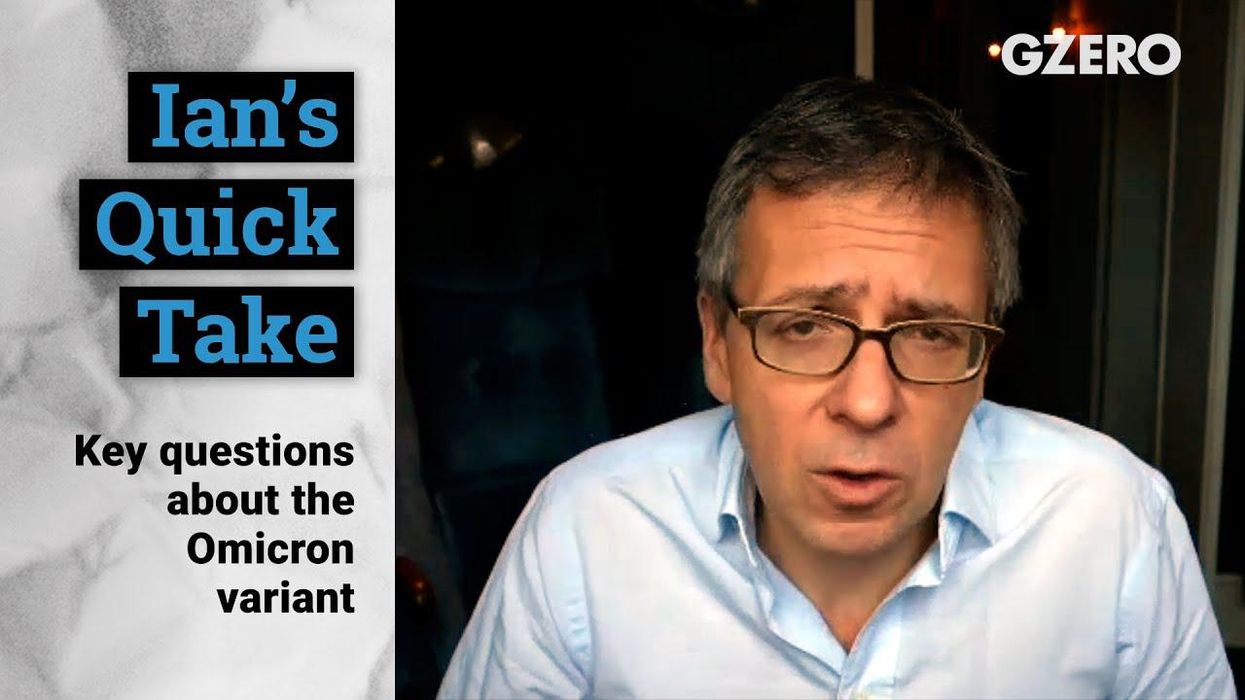
Key questions about the omicron variant
November 29, 2021
Global Stage LIVE from United Nations WATCH REPLAY
Ian Bremmer, political scientist and president of Eurasia Group and GZERO Media, shares insights on global political events.
Presented by

Ian Bremmer's Quick Take:
Good morning everybody and I hope everyone is okay this Monday. I hope you had a happy Thanksgiving, those of you that celebrate. Of course, pretty difficult news over the weekend, and even this morning, the World Health Organization, referring to the new variant omicron of COVID as a very high global risk. And when I hear those words, obviously we get moving at Eurasia Group, a firm very much concerned about that. And indeed, this is in terms of new news about this pandemic that we've all been living with now for almost two years, this is some of the most concerning new headlines that we've seen thus far.
There are some things we know and some things we don't know, there are three things we need to know, if you want to really assess what the omicron risk represents for us and for the world: rates of infection, sickness and mortality and vaccine effectiveness. We only have strong answers about the first, which is we know that this is a lot more infectious as a variant than Delta has been, which itself was much more infectious than the original virus. And that is a very serious problem. I've spoken with a lot of the epidemiologists we know about this over the weekend, they're all extremely concerned about that.
But we certainly don't know much at all about how lethal the disease is. For example, it could be that this disease is extremely infectious and less lethal than the delta variant. And if that was the case and it became the dominant variant, it would actually not just be a non-story, it would be extremely important and good news, because it would mean a whole bunch of people would be getting infected would be developing antibodies as a consequence and wouldn't be getting very sick, especially if it turns out that also didn't mean long COVID, which again, you're not going to know for quite some time. That's the problem with dealing with a disease that we've never heard of before.
But so far, the cases that we know about are overwhelmingly from South Africa and it's a population in terms of those that have tested positive that are mostly under 30, they don't have preexisting conditions and therefore they wouldn't be likely to get sick in any case. And so you're not learning anything. Turns out most of them still have sense of smell, that's a little unusual. Most of them more exhausted, have muscle pain, that's a little unusual, but nobody that's focusing on the cases that we have information on so far have a good sense. We probably won't have a good sense for about two more weeks.
Secondarily, the people making the vaccines feel pretty confident that these vaccines will be somewhat less effective than versus delta variants, simply because this variant is so different, but how less effective, they don't know. And they won't know that again for at least a couple of weeks. That's a problem too. So what we do know though, is that there is a relatively low level of vaccination still globally. There are plenty of places that have significant anti-vax and vaccine hesitancy sentiment, including my own United States, including Russia, including most of Eastern Europe. And there are also a lot of people that are immunocompromised, which means that even if this disease isn't a risk to you as a fully vaccinated person with a booster, it's still going to lead to lots of people getting hospitalized and dying, if it turns out that this is the same level of lethality as Delta.
So we'll find that out in relatively short order. And what that means is in the near-term, you're going to have a lot more risk aversion in travel. You're going to have a significant reduction in consumer demand. That'll take inflation off in the near term, it'll reduce prices at the pump for example. What happens over the next month to three depends completely on the answer to those two questions. And if this really is a dangerous, dominant global variant, as it well could be, it's kind of like a coin flip right now, then you're going to see all sorts of additional lockdowns, you'll see problems with supply chain, which will lead to more inflation again. It will be economic contraction and all of this will particularly be felt on the backs of poorer people and lower developed countries.
A big point here is that the mRNA vaccine producers, Pfizer, Moderna, can reformulate these vaccines to respond to Omicron variant within a matter of a few weeks. They can get them approved and then roll out major distribution in the course of a few months. So by end of first quarter next year, if you're in a wealthy country, you have access to mRNA vaccines, you'll be able once again, to protect yourself, protect your loved ones.
Having said that, the mRNA vaccines are available mostly to the wealthy countries. And this is yet one more accelerant of a big gap driving wedge between wealthy countries and poor countries. It's a big problem for China, which has to maintain their zero COVID policy. Maybe they can't even hold the Olympics. This is a bad scenario, they probably can't. They are trying to develop their own indigenous mRNA capabilities. They will have them at some point over the course, probably mid 2022, and then they will start producing and rolling them out. So again, bigger economic problems for China and particularly for those countries that aren't vaccinated yet that don't have the ability to get mRNA themselves. And also don't have the money to be able to respond to the economic scarring that occurs with all of these stop, start pandemic impact on the economy, they're going to be facing the absolute worst case scenarios here. And so that's the developing world, those are the emerging markets.
One final thing I would say here is Africa, there's a lot of people that are from South Africa that are very embittered by the fact that we're putting these travel restrictions on anyone from South Africa and a number of other countries of concern that of course are countries of concern in large part because they have virtually none of their population vaccinated, very low percentages. And in the case of South Africa, they do an awful lot of testing. They're pretty good at that. And that has allowed them to find out about the spread of the Omicron variant far earlier than we otherwise would've. So yes, they are being punished.
But what's really, horribly, both ironic and sad is that of the eight African countries that the Americans have put full travel restrictions on, five of them have actually refused recent additional exports of vaccines because they are worried about their existing stockpiles expiring. Why would that happen? Number one, too much vaccine hesitancy on the ground in those countries. Number two, too many difficulties in actually distributing the vaccines across countrysides that have very, very poor infrastructure indeed. So these countries are getting hit in every which way and just sending them vaccines by itself isn't going to fix the problem. We're going to need to do much more education on vaccinations. We're going to need to improve infrastructure and distribution capacity on the ground. Heck, in South Africa you have a huge immunocompromised population because of the AIDS epidemic, which is so large still there and in many countries in Sub-Saharan Africa, which means even if they take the vaccines, their body is not able to produce the kind of immunity, the kind of antibodies that would allow people to respond effectively and not get sick and die from COVID.
You remember Colin Powell who had suffered cancer and as a consequence had been taking drugs that really reduced his immune system. He was fully boosted and older and died from catching COVID. And there's really nothing we can do about that kind of thing until we stop spread and you're not going to stop spread until the entire global population is effectively vaccinated up to speed with full antibodies.
So that's where we are, not great news. Really hoping, as I'm sure everyone is, that we'll have better news over the course of the next couple weeks, as we learn much more about this new variant. Everyone be safe and I'll talk to you soon.




Keep up with what’s going on around the world - and why it matters.