Hard Numbers: Former South Korean President sentenced to life, New insurgent group in Nigeria, Air power build up in the Middle East, and Bankers need sleep too

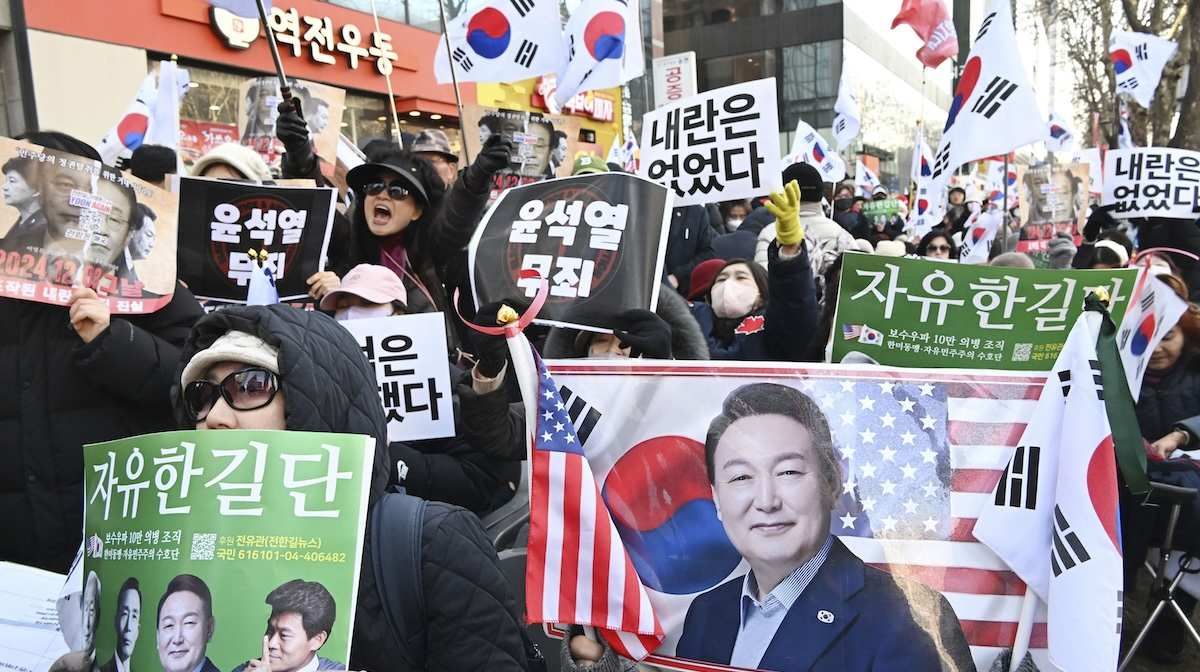
​People in support of former South Korean President Yoon Suk Yeol rally near Seoul Central District Court in Seoul on Feb. 19, 2026. The court sentenced him to life imprisonment the same day for leading an insurrection with his short-lived declaration of martial law in December 2024.

People in support of former South Korean President Yoon Suk Yeol rally near Seoul Central District Court in Seoul on Feb. 19, 2026. The court sentenced him to life imprisonment the same day for leading an insurrection with his short-lived declaration of martial law in December 2024.

Kyodo
65:The age of former South Korean President Yoon Suk Yeol, who was sentenced to life in prison on Thursday after being found guilty of plotting an insurrection when he declared martial law in 2024. When deciding whether or not to give him the death penalty, the judge said he took into account his age and the fact that no lethal force was used under martial law.

34: The number of people killed in coordinated attacks on northwestern Nigerian villages this week. Authorities suspect a new insurgent group, Lakurawa, is responsible, amid a security crisis in the country.

2003: The last year in which the US’s concentration of air power in the Middle East was as high as it is today. The US has sent dozens of planes and two aircraft carriers to the Gulf as it weighs possible strikes on Iran.

9: The number of hours an investment banker is arguing she should be entitled to sleep a night in a trial set to go to court next week in New York. The plaintiff, whose health condition requires her to sleep nine hours, sued her former employer after they said they could no longer accommodate her needs. The case is sparking debate about healthy work-life balances in corporate culture.
More For You

U.S President Donald Trump, U.S. Vice President JD Vance, and U.S. Secretary of State Marco Rubio pose for a family photo with other representatives participating in the inaugural Board of Peace meeting, at the U.S. Institute of Peace in Washington, D.C., U.S., February 19, 2026.
REUTERS/Kevin Lamarque

Argentina, Armenia, Belarus, Egypt, Indonesia, Jordan, Pakistan, Paraguay, Vietnam – to name only a few.

How people in G7 and BRICS countries think their policies will effect future generations.
Eileen Zhang

Does skepticism rule the day in politics? Public opinion data collected as part of the Munich Security Conference’s annual report found that large shares of respondents in G7 and several BRICS countries believed their governments’ policies would leave future generations worse off.