Argentina, Armenia, Belarus, Egypt, Indonesia, Jordan, Pakistan, Paraguay, Vietnam – to name only a few.
The eclectic group could pass for the roster of a niche Olympic sport. In fact, it is part of the membership roll of US President Donald Trump’s newly-minted Board of Peace, which meets today for the first time in Washington, D.C.
Despite a logo that only highlights parts of the Western Hemisphere – a visual nod to Trump’s “Donroe Doctrine” – the Board’s members span the globe. What unites them is something more pragmatic, according to Elliott Abrams, the Middle East expert at the Council on Foreign Relations.
“They are unified by a desire to avoid offending President Donald Trump,” Abrams told GZERO, “and the thought that maybe they would gain something by being on the Board of Peace.”
The group was initially unveiled last month as a “transitional administration” to oversee the redevelopment of Gaza. But its mission has already expanded. Trump now casts the Board’s ambitions in broader terms – as a body tasked with maintaining international peace, and has indicated he believes it could rival the United Nations. It’s a sweeping mandate for a group held together by proximity to one man whose time in power is limited.
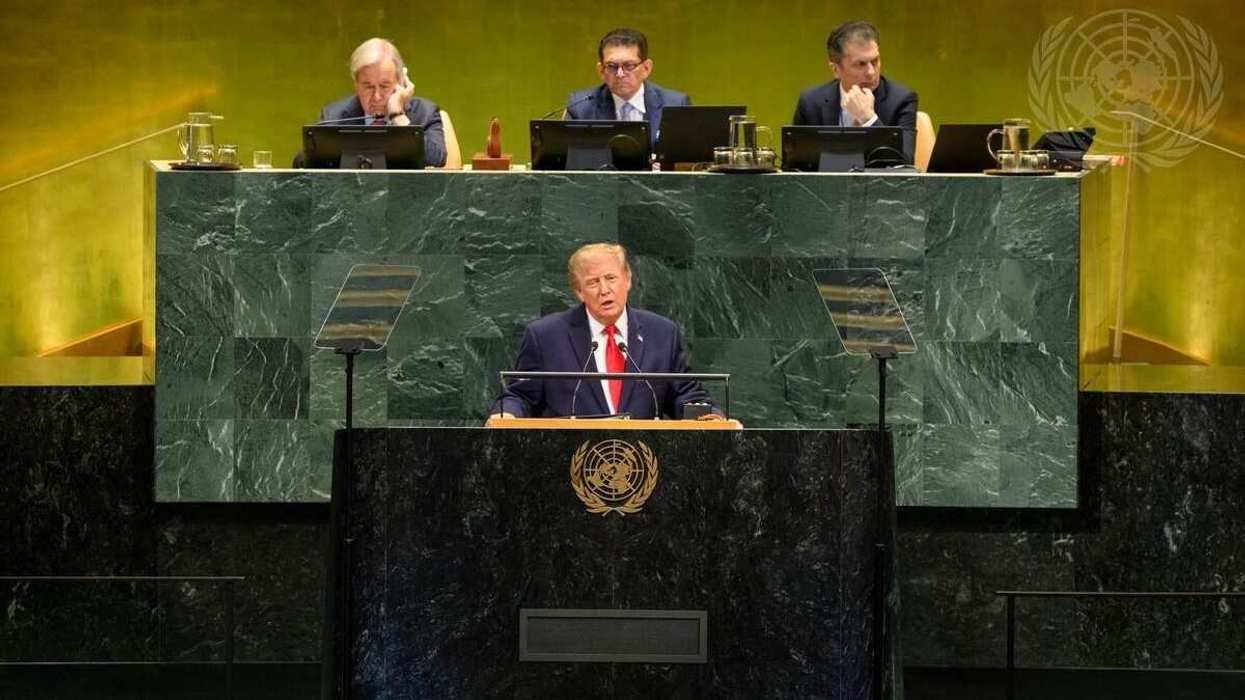
"This is a tremendous group of powerful people and brilliant people," Trump said at the meeting today, "and I think that we can do things a lot of other people would not be able to even conceive of or think of."
Trump has appointed himself the group's lifelong chairman, even as his presidential term has just three years remaining. As chair, he holds the unilateral authority to veto decisions, approve the agenda, and select his own successor. That structure means the group is operating under a time constraint if countries want to work with the current US president while he’s still in office. The limitation is hardly ideal when it’s trying to administer peace in a war-torn enclave like Gaza.
There are also already signs that it is colliding with the UN. On Wednesday, the UNSC held a high-level meeting on Gaza in New York, originally scheduled for today but moved up because it coincided with the Board’s inaugural meeting and would complicate travel plans for members planning to attend both.
The gathering today comes amid questions around the scope of its mission and its potential effectiveness. Many of the US’s longstanding European allies have since refused to join, in part because Trump invited Russian President Vladimir Putin to participate, though the Kremlin has yet to sign on. This week, the Vatican also declined to join the Board.
In their place stands a patchwork group of nations, each making different pledges to the group. The United Arab Emirates, for example, committed $1 billion to the initiative to maintain a permanent seat – an amount even the highest paying countries have not reached in UN dues. Other members, like Indonesia, are preparing to lend thousands of troops to the Board’s International Stabilization Force, which aims to secure Gaza’s streets. As it happens, Indonesian President Prabowo Subianto is hoping to leave Washington this week with a US trade deal in hand.
What, then, can the Board realistically achieve? The task in Gaza is gigantic. Over 60 million tons of rubble need to be cleared — the equivalent of around 162 Golden Gate Bridges. But Abrams is optimistic that the Board can make a “real contribution” in Gaza. For example, if the Board can empower the National Committee for the Administration of Gaza (NCAG), a technocratic Palestinian group, to hire engineers and other qualified people to work on public services, like water, sewage, schooling, and roads, that would mark a massive achievement for the Board.
Securing lasting peace in Gaza is a tougher goal to reach, said Abrams. The International Stabilization Force is taking on this task, but achieving it, Abrams says, relies on Hamas’ disarmament. That’s something the militant group – as well as its political arm – has refused to do. Countries being asked to commit troops to the peacekeeping forces have themselves ruled out attempting to complete this task.
“Security is not provided by school crossing guards,” said Abrams. “Either Hamas is going to give up its arms, or the IDF may take them away, but not to this Force.”
What say you, history? Examples of transnational groups acting as transitional administrators serve as a cautionary tale. In the 1960s, the UN temporarily assumed control of West New Guinea to oversee a transfer from Dutch to Indonesian rule. But the group paid little attention to long-term governance and failed to resolve disputes over self-determination in the territory among the Indigenous population. A more recent example is in the early 2000s: After the invasion of Iraq, a US-led coalition purged former Ba'ath Party members from public life – a move that created a vacuum for extremist groups, and is widely regarded as one of Washington’s biggest foreign policy errors.
Even the successes have come with caveats: NATO’s military intervention in Kosovo in the late 1990s in response to ethnic cleansing by Serbians was widely regarded as a triumph, but reviews of the UN peacekeeping mission installed in the Balkans thereafter were mixed.
Time is of the essence. A US official told reporters that a future president could appoint a representative to the Board. But whether a Republican or Democrat replaces Trump, according to Abrams, neither will want an ex-president interfering with their foreign policy. As such, the Board’s lifespan is tied to Trump’s presidency, meaning it only has three years to bring long-term peace and prosperity to Gaza, or anywhere else.
“I think beyond Gaza, it’s not a serious institution. It's not going to replace the UN,” said Abrams. “It will fade away on Jan. 20, 2029.”
To use an Olympic metaphor: can the Board win gold before then?