Today, we examine how China has sought to diminish Taiwan’s position from the outside in, report on how the US is trying to keep a lid on hantavirus, and celebrate David Attenborough’s 100th birthday – with the help of our Puppets.
- The Daily Crew
When US President Donald Trump and Chinese President Xi Jinping meet in Beijing on Thursday, Taiwan will be top of Xi’s mind.
But it’s not an invasion that he seeks, according to Ian Bremmer – at least not yet.
What Xi wants, Ian explained in a recent episode of “ask ian,” is “for the Americans to change the status quo.” In other words, the Chinese leader will ask Trump to change America’s decades-long policy of strategic ambiguity toward Taiwan. It’s not a bad bet for Xi: the US leader has shown that the rules-based international order carries little weight for him.
“If you’re Xi,” Ian explains, “it would be a dereliction of duty not to give that a shot.”
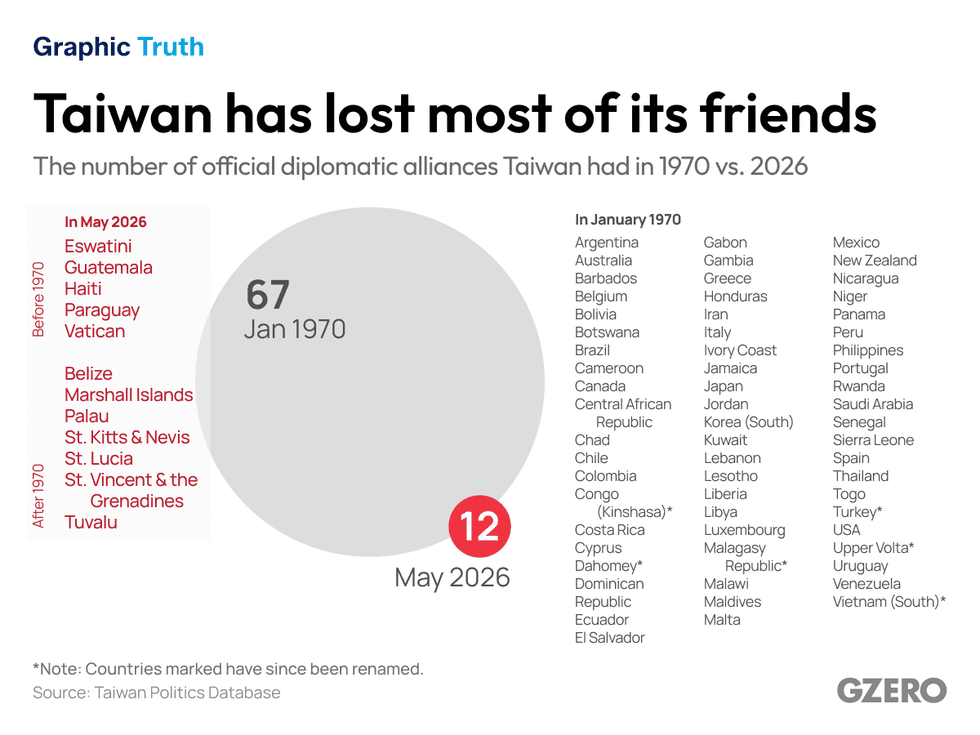
China has sought to bring Taiwan under mainland control ever since the island established its own government in 1949. But Beijing’s strategy has not centered on plans for a large-scale invasion. Instead, it has sought to cut Taiwan off from the outside world, offering economic aid and investment to developing countries in return for severing diplomatic ties with the self-governing island. It’s a policy that’s been going on for decades. The result has been a slow, deliberate, diplomatic war of attrition aimed at isolating Taiwan internationally.
As our Graphic Truth shows, Taiwan has lost dozens of diplomatic allies since 1970, one year before the United Nations recognized the People’s Republic of China and booted Taiwan out as the holder of China’s “seat” in the organization. Countries like Japan, Australia, and the United States all switched their recognition from Taipei to Beijing in that time, though many, like the US, maintain official ties.
Today, Taipei maintains official diplomatic ties with just 12 countries, most of them small states in the Caribbean, Latin America, and the Pacific – an odd predicament for a place that produces more than 60% of the world’s semiconductors, the essential components powering a range of crucial tech goods, from smartphones to space stations.
As China’s economic clout has expanded, so too has its diplomatic leverage. China is now the top import partner for roughly 40% of countries worldwide, including nearly all of Asia and much of Africa and Latin America. When China joined the World Trade Organization in 2001, five countries listed China as their top source of imports. Beijing can (and does) use its economic influence to persuade countries to abandon Taiwan.
In Latin America, support for Taiwan has steadily dwindled as more governments accept the “One China” policy. Honduras, which cut ties with Taipei in 2023, said it made the decision because it was “drowning” in debt and wanted access to investment opportunities from China. Paraguay, which recently reaffirmed ties with Taiwan, is now the only South American country that still recognizes the island.
In Africa, China has also invested heavily in infrastructure projects on a scale Taiwan cannot match. In 2024, Beijing’s foreign direct investment on the continent topped $3 billion, up from $320 million two decades earlier. Eswatini is now the only African nation that recognizes Taiwan, and China nearly blocked Taiwan’s leader from flying there recently.
When Trump and Xi meet in Beijing on Thursday, Taiwan will undoubtedly loom large in the background — not because Xi appears poised to invade, but because he sees an opportunity to reshape America’s longstanding approach to Taipei, a major step toward leaving it truly on an island by itself.
What We’re Watching
PA via Reuters
UK’s Starmer tries to save his bacon
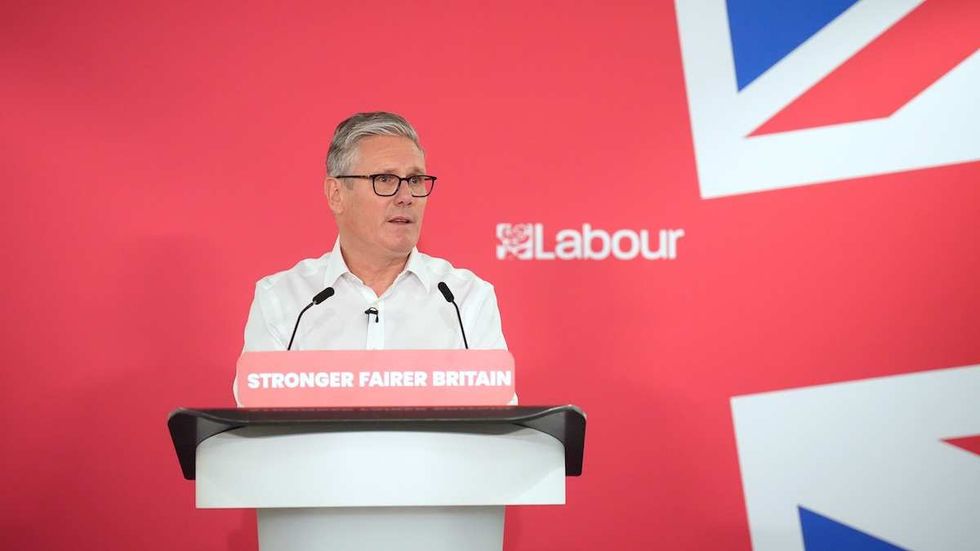
After the Labour Party’s disastrous performance in the local elections last Thursday, one that was fully expected, Prime Minister Keir Starmer is clinging onto his position by a thread. In a bid to shore up support, the PM delivered a “relaunch speech” in London on Monday morning, acknowledging voters’ desire for quicker change while reiterating that he won’t stand down. Yet the wolves are out to get him. Labour MP Catherine West on Sunday briefly threatened to challenge Starmer if no Cabinet minister does so. Former Deputy PM Angela Rayner, who resigned from Starmer’s team amid a tax scandal last year, criticized his premiership on social media. Meanwhile, Health Secretary Wes Streeting, who has been one of Starmer’s top allies, reportedly told him that he’s ready to lead should the PM step down. However, given that the process for ousting a Labour leader is notoriously difficult, Starmer could live to fight another day.
For more on whether Starmer can survive, watch this video from GZERO’s Carl Bildt, Sweden’s former prime minister.
Hantavirus arrives in US – but poses little threat
Seventeen Americans who were aboard the hantavirus-hit cruise ship, including one who tested positive for the virus, have now returned to the US mainland. To mitigate the threat of further spread, the passengers have been quarantined in a specialist high-risk unit in the sparsely populated Midwest state of Nebraska. Any headline that references both a cruise ship and a virus may immediately prompt people to fearfully cast their minds back to the COVID-19 pandemic, a time when health was the top concern worldwide. However, hantavirus – a fatal virus that is typically transmitted via rodent droppings – doesn’t pose a major risk to the wider public, according to the World Health Organization, largely because it doesn’t typically spread between humans.
The red and the black: is Thailand’s military draft legal?
The nation’s top court will rule on Tuesday in a case that could upend a military conscription system that has been in place for decades. Currently, upon turning 18, all men must either volunteer for military service or present themselves at a draft center, where they draw cards at random from a small jar — a black card sends you home, a red one puts you in the military for two years. Volunteers have surged by more than 20% over the past year, reflecting a nationalistic mood amid tensions with neighboring Cambodia and a sluggish economy, which has boosted the appeal of the military’s regular pay and board. But the draft’s critics say it creates disruption and uncertainty for young people and their families. In addition, hazing and abuse of conscripts is reportedly widespread. In the case before the court, an activist has argued that conscription violates the constitution’s protections for freedom of belief.
US-Iran update: talks at a standoff
“TOTALLY UNACCEPTABLE.” That’s how US President Donald Trump described Iran’s response to the latest ceasefire proposal on social media on Sunday, as talks over whether to reopen the Strait of Hormuz continue to hit an impasse. Oil prices rose 3% on Monday morning. Meanwhile, Israel’s Prime Minister Benjamin Netanyahu told CBS News that the war with Iran is “not over.” Whether this means the bombing will resume is another matter entirely.
Inside the Pentagon's AI war machine
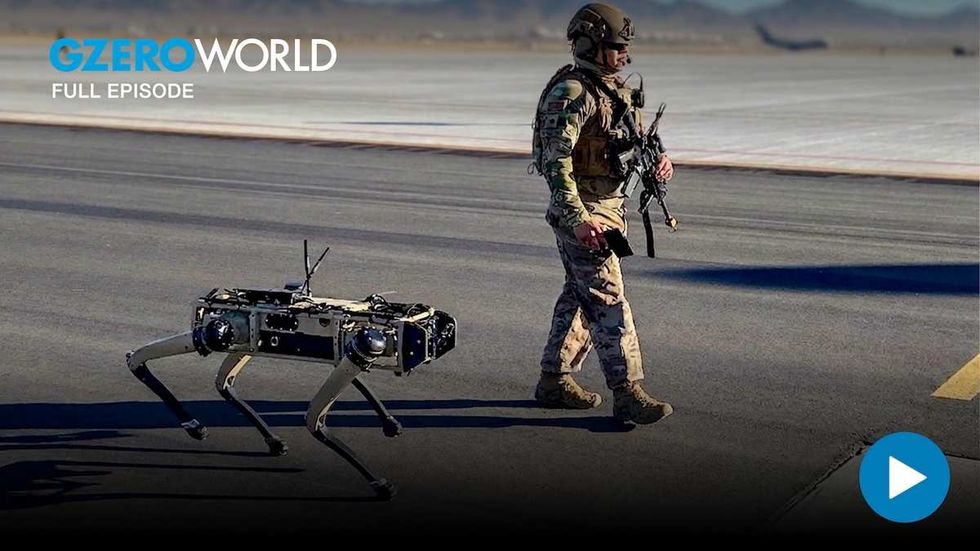
The Pentagon has poured billions into AI warfare, from drone footage analysis to autonomous targeting. On this week’s episode of GZERO World, Katrina Manson, a Bloomberg reporter and author of “Project Maven: A Marine Colonel, His Team, and the Dawn of AI Warfare,” joins Ian Bremmer to trace how AI went from a computer experiment to key technology for the Pentagon, and why some risks and moral stakes remain unresolved.
The US military’s AI shift started in 2017 with Project Maven, a public-private effort to bring artificial intelligence into Pentagon operations, says Manson. What began as a narrow program to analyze drone footage has grown into something far larger. Today, AI helps identify targets, speed up strike decisions, and support operations from Iran to Venezuela.
The tech is already showing real limits and raising ethical questions. Algorithms trained in one environment fail in another. Operators are increasingly clicking “accept” without visibility into what the machine is surfacing or why. And as Manson puts it, “the US military is aware” of AI’s susceptibility “to sycophancy, to escalation, to bias and hallucination,” but “they do not yet have sufficient fixes.” Together, they also get into the Anthropic fallout, the US-China AI race, and what happens when commercial AI ethics collide with military requirements.
Watch the full episode here.
PUPPET REGIME: A wild tribute to Sir David Attenborough

Predators. Prey. Rituals of dominance. Clashes over territory. Is this National Geographic, or National Geopolitics? To honor the 100th birthday of the great nature documentarian Sir David Attenborough, the REGIME presents a short nature film about the global politics of our time. Which of today’s world leaders is the Saffron-bellied Hugger? How about the Eastern Red-backed Aspirant? And here comes “Workinggruppus interminus.” Plunge into the wild with the latest Puppet Regime episode on Instagram here, or on YouTube here.
Hard Number: US eyes Cuba, literally
Natalie Johnson
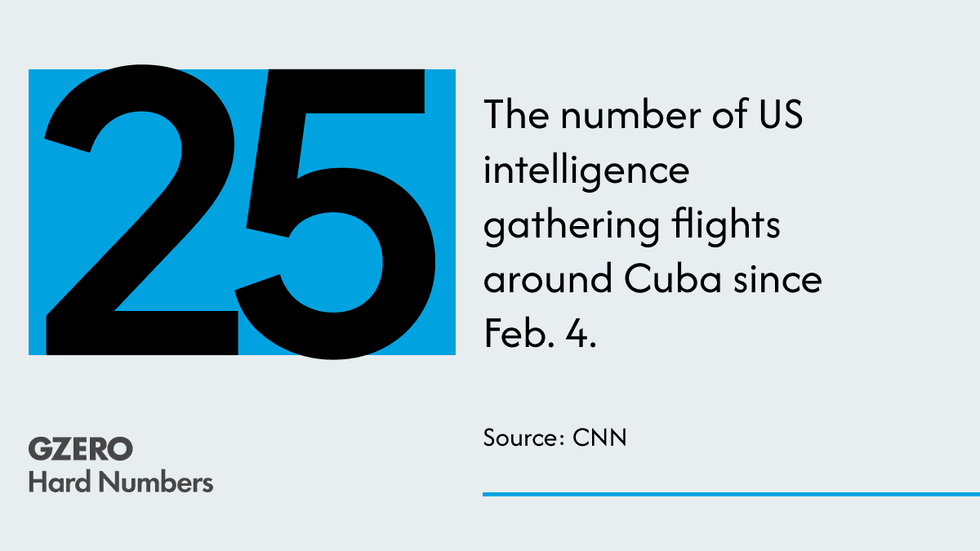
The US military is reportedly increasing surveillance missions over Cuba, mostly around the country’s two biggest cities, Havana and Santiago de Cuba. Flights of this ilk were previously rare in this area. Meanwhile, US President Donald Trump is reportedly growing impatient that the Cuban regime hasn’t fallen, despite a de facto US oil blockade on the island – his team says the regime will fall by year’s end, but he’s looking for a faster turnaround. Might this have something to do with the US’s issues in Iran?
Join the conversation
Want to discuss anything you've read in the news today? Join us over at the official GZERO Community platform! Chat with fellow readers, debate your favorite topics, start a poll, or share the articles you can't stop thinking about. Connect directly with Ian Bremmer and ask him your hardest-hitting policy questions—and you just might get featured in our next edition of Ask Ian!
Sign up using this link to get started, then download the GZERO app.
We want to hear from you! Take our quick 2-minute survey to share your feedback on GZERO’s reporting.
Quote of the Day
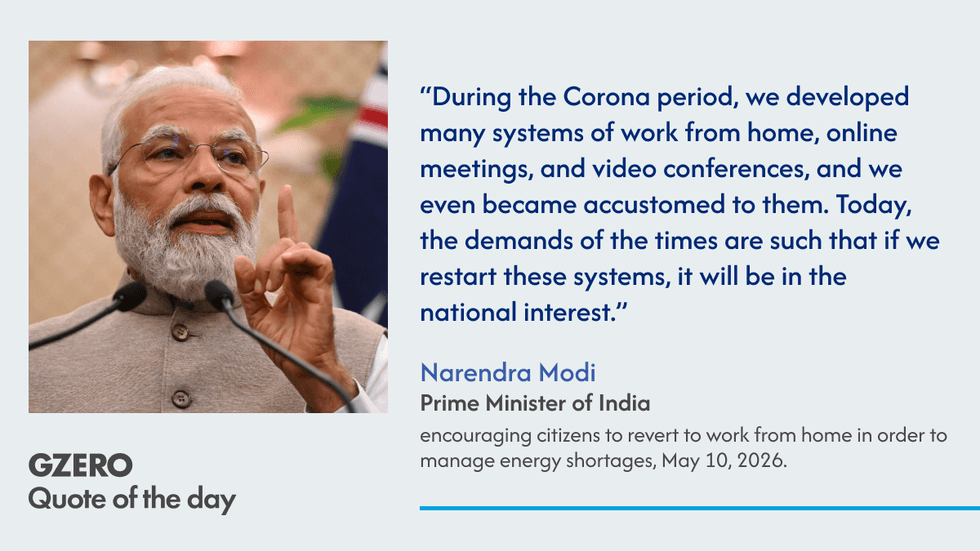
Energy shortages resulting from the closure of the Strait of Hormuz has Modi calling for his country’s 1.5 billion citizens to work from home. India’s not the only one: several Asian countries are urging their citizens to stay home while energy supplies are tight. India, the world’s third biggest oil importer and consumer, relies on the Strait for roughly 50% of its crude imports, 60% of its liquefied natural gas, and almost all of its petroleum gas. After Modi’s announcement, Indian stocks fell on Monday and the rupee saw its steepest single-day drop since March 27.
This edition of GZERO Daily was produced by Zac Weisz, Alex Kliment, and Natalie Johnson. The Graphic Truth was designed by Eileen Zhang.