When US President Donald Trump and Chinese President Xi Jinping meet in Beijing on Thursday, Taiwan will be top of Xi’s mind.
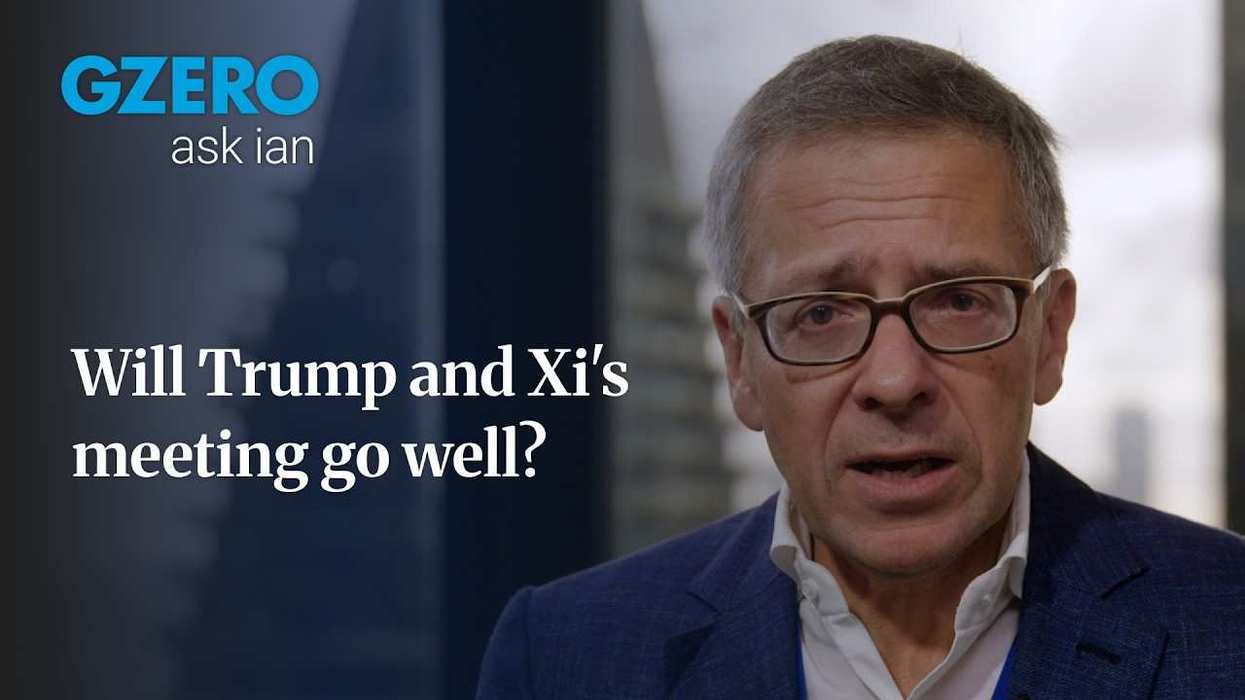
But it’s not an invasion that he seeks, according to Ian Bremmer, at least not yet.
What Xi wants, Ian explained in a recent episode of “ask ian,” is “for the Americans to change the status quo.” In other words, the Chinese leader will ask Trump to change America’s decades-long policy of strategic ambiguity toward Taiwan. It’s not a bad bet for Xi: the US leader has shown that the rules-based international order carries little weight for him.
“If you’re Xi,” Ian explains, “it would be a dereliction of duty not to give that a shot.”
China has sought to bring Taiwan under mainland control ever since the island established its own government in 1949. But Beijing’s strategy has not centered on plans for a large-scale invasion. Instead, it has sought to cut Taiwan off from the outside world, offering economic aid and investment to developing countries in return for severing diplomatic ties with the self-governing island. It’s a policy that’s been going on for decades. The result has been a slow, deliberate diplomatic war of attrition aimed at isolating Taiwan internationally.
As our Graphic Truth shows, Taiwan has lost more dozen diplomatic allies since 1970, one year before the United Nations recognized the People’s Republic of China and booted Taiwan as the holder of the China “seat” in the organization. Countries like Japan, Australia, and the United States all switched their recognition from Taipei to Bejiing in that time, though many, like the US, maintain official ties.
Today, Taipei maintains official diplomatic ties with just 12 countries, most of them small states in the Caribbean, Latin America, and the Pacific – an odd predicament for a place that produces more than 60% of the world’s semiconductors, the essential components powering a range of crucial tech goods, from smartphones to space stations.
As China’s economic clout has expanded, so too has its diplomatic leverage. China is now the top import partner for roughly 40% of countries worldwide, including nearly all of Asia and much of Africa and Latin America. When China joined the World Trade Organization in 2001, five countries listed China as their top source of imports. Beijing can (and does) use its economic influence to persuade countries to abandon Taiwan.
In Latin America, support for Taiwan has steadily dwindled as more governments adopt the “One China” policy. Honduras, which cut ties with Taipei in 2023, said it made the decision because it was “drowning” in debt and wanted access to investment opportunities from China. Paraguay, which recently reaffirmed ties with Taiwan, is now the only South American country that still recognizes the island.
In Africa, China has also invested heavily in infrastructure projects on a scale Taiwan cannot match. In 2024, Beijing’s foreign direct investment on the continent topped $3 billion, up from $320 million two decades earlier. Eswatini is now the only African nation that recognizes Taiwan, and China nearly blocked Taiwan’s leader from flying there recently.
When Trump and Xi meet in Beijing on Thursday, Taiwan will undoubtedly loom large in the background — not because Xi appears poised to invade, but because he sees an opportunity to reshape America’s longstanding approach to Taipei, a major step toward leaving it truly on an island by itself.