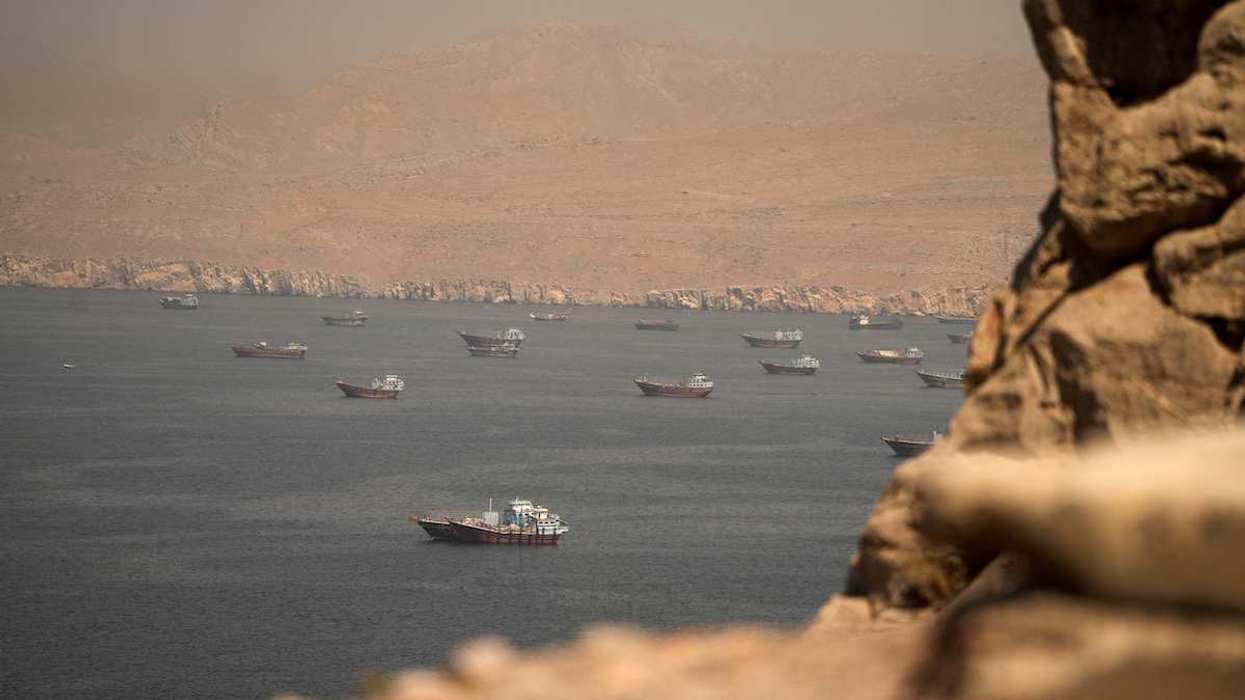
Well, that didn’t last long. President Trump unveiled “Project Freedom,” an initiative to escort ships and restore traffic through the Strait of Hormuz, on Sunday. By Tuesday evening, he had unceremoniously suspended it by Truth Social post, shortly after Secretary of State Marco Rubio told reporters how committed the administration was to it.
The US Navy did manage to bring two destroyers and two American-flagged commercial ships through the waterway during that time. Alas, the administration had set a significantly higher bar for success. “What we’re demonstrating with Project Freedom,” Defense Secretary Hegseth said, “is that they don’t control the strait.” Within hours of Trump’s announcement, Iran fired on vessels attempting passage and launched missiles and drones at the UAE. The Strait promptly cleared out. Hegseth and General Dan Caine took pains to explain that none of this – not the UAE strikes, not the ship attacks, not the dozen-plus times Iran has fired on US Navy vessels in the past month – crossed the White House’s threshold for resuming major combat operations. “We’re not looking for a fight,” the man who insists on being called Secretary of War said with a strait face. Project Freedom was downgraded to mine-mapping, information-sharing, and calling for other countries to help before being “paused” – supposedly to allow time for talks, really because neutral commercial shippers weren't willing to transit while Iran was actively shooting.
The good news from this short-lived episode is that the “ceasefire” is still on, at least as far as President Trump is concerned. The bad news is the Strait remains decidedly closed. Iran has demonstrated once again that it is prepared to escalate to preserve its leverage even at the risk of returning to hot war, and Trump’s lackluster response has only bolstered its confidence that it has the upper hand.
It should be clear by now that barring regime change (which Trump is learning is easier said than done), the Strait reopens only through Iranian agreement or a naval deployment massive enough to force it open – one that would require a significant ground presence to hold. There is no secret third option.
Yet every week the Strait remains closed, the economic costs continue to compound … and we aren’t just talking about rising gas and diesel prices anymore. Jet fuel inventories are drawing down toward critical levels. Chemical tankers that had been slipping eastbound through the shallow southern edges of the Strait were the primary cargo making it out before the latest attacks, most of them carrying fertilizer to South Asia ahead of the approaching sowing season. That pipeline is now largely cut off again. Add the gas tankers critical for cooking fuel across South and Southeast Asia and the energy exports with no alternative route out, and the pain we’ve seen so far will look like a warm-up once actual shortages start to show up and prices rise enough to destroy demand.
So how does Trump get out of this?
He’d prefer to avoid a significant military escalation that draws the United States deeper into the conflict. The month-long truce (however tenuous) and the constant search for offramps make that clear. Structurally, both sides still have incentives to eventually reach a negotiated end to the war. But both sides have thus far been too certain that they have the advantage – Tehran believing it can outlast Trump politically, Trump believing Tehran is on the verge of surrender – to make any major concessions and agree on terms. Talks have accordingly been deadlocked.
Reports this morning suggest the White House believes they are nearing a deal along the lines of Iran’s preferred phased framework: ending the war and opening the Strait first, nuclear talks later down the road. Trump himself confirmed he believes an agreement is within reach … provided that Iran actually agrees to it. A big if, especially since the US is apparently still pushing Tehran to hand over its stockpile of highly enriched uranium to Washington – a non-starter for Iran. It wouldn’t be the first time the administration has publicly expressed optimism about an imminent deal despite the sides still being far apart. Today may be different. It’s encouraging that the US and Iran are still exchanging proposals despite the elevated tensions, and a breakthrough may be closer than it’s been. But it’s likely not as close as the headlines suggest.
Until then, Trump can keep the blockade going and hope it creates enough pressure to make Tehran more pliant. But Project Freedom was an implicit admission that the blockade isn’t working as well or as fast as the administration expected. Yes, it’s causing economic pain, but Iran is still loading crude at its export terminals and selling it to China, its oil infrastructure can handle shut-ins with less durable damage than advertised, and the regime isn’t close to capitulating.
Hence why people close to the US president – and regime insiders on the Iranian side who are engaging with the administration – increasingly believe that Trump is inching closer toward restarting the war. If Trump feels negotiations aren’t moving enough, he could at any point decide to start striking again with no warning and no credible ultimatum, having blown through all of those already. More so after the latest Iranian attacks.
The problem is that military escalation is unlikely to accomplish much other than raise the stakes and increase the costs of the conflict. Target what’s left of Iran’s leadership and instead of opening a path to a deal, you remove the few interlocutors (like parliamentary speaker Mohammad Bagher Qalibaf) still willing to negotiate with the Americans at all. Order broader strikes on Iranian infrastructure – Kharg Island, its gas fields – and you risk retaliation against major energy facilities, desalination plants, and power grids across the Gulf. The Iranians have done little of this despite retaining more than half of their pre-war missile stockpile, thousands of drones, and plenty of launchers. That’d mean market panic, a sudden exodus from Gulf states, and an economic shock that makes the current fallout look contained – all without reopening the Strait or producing Iranian capitulation. Even a limited military response to this week’s violence, no matter how calibrated in American eyes, risks spiraling into uncontrolled escalation.
Alternatively, Trump could declare victory and end the war unilaterally – cutting America’s losses while leaving other countries to negotiate Hormuz passage directly with Iran, which loses leverage over time once the shooting stops anyway. Every major economy in the world has more direct economic exposure to a closed Strait than the United States does, and most would move quickly to engage Tehran if Washington stepped back and gave them room. This wouldn’t look like a win for Trump, to be sure, but it is the least worst option on the table at this point.
Whether Trump is ready to take it is a different question. I’m not holding my breath. Gamblers would say he’s too pot committed to fold now – he’s staked too much political capital and (more relevant for a lame duck) too much of his legacy to walk away empty-handed. He knows gas is going over $5 a gallon no matter what. He knows most voters will blame him for it. He knows the midterms are lost in any case. Why accept a sure defeat when he can keep rolling the dice on the possibility of an outcome that feels like more of a win?
I don’t think such an outcome exists. There’s no silver bullet to the Iran problem: no decapitation strike that transforms the regime, no Persian Delcy to install, no military operation that magically unlocks an acceptable deal, no amount of pressure that forces Tehran to capitulate quickly at an acceptable cost to the US and the global economy. Then again, what matters isn’t what I think but what Trump thinks. And he appears more willing to absorb the costs of a longer and more escalatory war – acknowledging oil prices will go higher and counseling “patience” – than he is to walk away without a win he evidently believes is still to be found somewhere.
What’s most concerning is that the people best positioned to advise him against this course are the least likely to do it. Every conversation I hear about that people have with Trump starts the same way: how smart he is, how much he’s winning, how the Iranians are nearly broken and victory is at hand. Any pushback is careful and cushioned. That’s rational behavior for people who value access. It means he’s running this war on bad information, with no obvious mechanism for correction. Air strikes would topple the regime or degrade Iranian military capacity enough to force surrender; Iran wouldn’t dare close the Strait, and if it did the US military could easily reopen it; a blockade would bring them to their knees in short order. Each move built on a flawed premise about how Iran would behave – all proven wrong, none denting the president’s confidence or piercing his filter bubble. This war is already the largest foreign policy mistake of either of Trump’s terms, and the conditions that produced it keep making it worse.
As long as the sides are still talking, a deal to end the war and reopen the Strait remains possible. But as Trump himself acknowledged this morning, the war ends and the Strait reopens only if Iran agrees – “which is, perhaps, a big assumption.” And if it doesn’t: “the bombing starts, and it will be at a much higher level and intensity than it was before.” The likelihood that this ceasefire breaks down and leads to another round of serious fighting, in a global economy far more fragile than when this started, looks higher today than at any point since the ceasefire began.