President Donald Trump's drive to acquire Greenland, the territory of NATO ally Denmark, has thrown the transatlantic alliance into disarray.
The United States isn't trying to secure more military bases, increased troop presence, enhanced intelligence-sharing and security cooperation, or critical mineral rights. Denmark, a trusted NATO ally that fought alongside America in Afghanistan and lost as many soldiers per capita as the US did, would happily accommodate all that. But Trump has made clear that he’s not interested in negotiations; nothing short of the United States owning the territory outright will suffice. For self-governing Greenlanders, for Danes, and for much (though not all) of Europe and NATO, that is a red line.
Why does Trump want US sovereignty over Greenland? Most European leaders I've spoken with believe it's primarily about ego. Trump has told the New York Times that he wants to annex the island for personal, "psychological" reasons. He's framed it in legacy terms, too, about accomplishing what other presidents could not and putting his name on the map like he’s put his name on the Kennedy Center and countless buildings around the world. And in a letter sent to Norwegian Prime Minister Jonas Gahr Støre, he explicitly linked it to the Nobel Peace Prize he blames Oslo for not winning (never mind that Norway and Denmark are two different countries, that the Norwegian government has no control over the decision, and that the 2025 award was for 2024 actions).
That’s not to say there are no real security concerns in the Arctic. Russian hypersonic missiles would likely fly over Greenland en route to the United States. The Russians and the Chinese have been stepping up their naval activity in the Arctic as the ice melts. Moscow has dozens of Arctic bases and outposts; Washington only has two. But there’s no reason the US needs to own the island to address these issues when the 1951 Defense of Greenland Agreement already gives the US military a free hand, and when the Danes and NATO have made clear the Americans can have anything else they want; all they need to do is ask. Yet the Americans haven't actually made any asks of Denmark. Compare that to Ukraine, where Washington has made numerous demands and the Ukrainians and Europeans have acceded to nearly all of them.
The only credible argument for US sovereignty I've heard from the Trump administration is about deterrence: That the US commitment to defend Greenland from Russia and China would be more credible if the territory were actually part of the United States. Certainly, most Europeans feel that the US commitment to NATO’s defense, of which Greenland is currently part, isn't as credible as its commitment to its own defense. But that’s also a circular argument. The reason it's most true is that Trump has taken it upon himself to weaken America’s commitment to NATO, including through this very threat to Greenland and Denmark’s sovereignty. Under this perverse self-fulfilling logic, the more Trump undermines NATO’s credibility and collective security, the stronger the case for outright ownership becomes.
If Trump got his way, it would mark the end of the world's most powerful military alliance. NATO cannot survive America coercing a member state into surrendering territory. When asked in a recent interview whether he'd choose his territorial ambitions over preserving the alliance, Trump's answer was blunt: "It may be a choice."
The good news is that if Greenlanders won’t vote to cede control to the United States – and everything suggests they are implacably opposed – there’s no legal mechanism for Trump to take Greenland short of invasion even if Denmark agreed to it. While Greenland's prime minister had told his people to prepare for war, earlier today Trump ruled out military action (which was never really on the table). What Trump can do, however, is destroy trust in the US-Europe alliance – and on that front, he has made plenty of progress.
Just as this column was going to press, Trump announced he'd reached a "framework" for a future deal over Greenland with NATO's Secretary General and would suspend planned tariffs on Europe. Whether this represents a genuine climbdown from a domestically unpopular position – the Greenland push polls worse for Trump than the administration’s handling of the Epstein files (!) – or tactical maneuvering to calm markets before resuming pressure once negotiations hit a wall remains to be seen. Either way, it’s worth unpacking why Trump may have retreated – and what made him pick this fight in the first place.
When asked what constrains his power on the global stage, the president’s answer was: "My own morality. My own mind. It's the only thing that can stop me." That's certainly what he'd like the world to look like. The United States is the most powerful country in the world. It can get away with a whole lot. But Trump isn't the world's most powerful leader. He has three years left and then he's done, Trump '28 hats notwithstanding. He contends with an independent judiciary, a federal system where states hold significant authority, a professional military, and free elections. None of that applies to Xi Jinping or Vladimir Putin. Or even, to the same degree, to leaders in democracies like India's Narendra Modi. The centralization of executive power is considerably stronger in many countries than in the United States.
The real constraint on American use of power under Trump is how much leverage other countries have relative to the US and how willing they are to use it. Think of it as a spectrum of how Trump views countries' capacity and willingness to resist him – and therefore how far he can push them – from FAFO (eff around and find out) to TACO (Trump always chickens out). If you're FAFO, you’d better make Trump happy and avoid conflict at all costs – and if conflict proves unavoidable, capitulate quickly while protecting what you can. If you're TACO, Trump is much less likely to pick a fight with you – but if he does, you can afford to wait the Americans out or punch back.
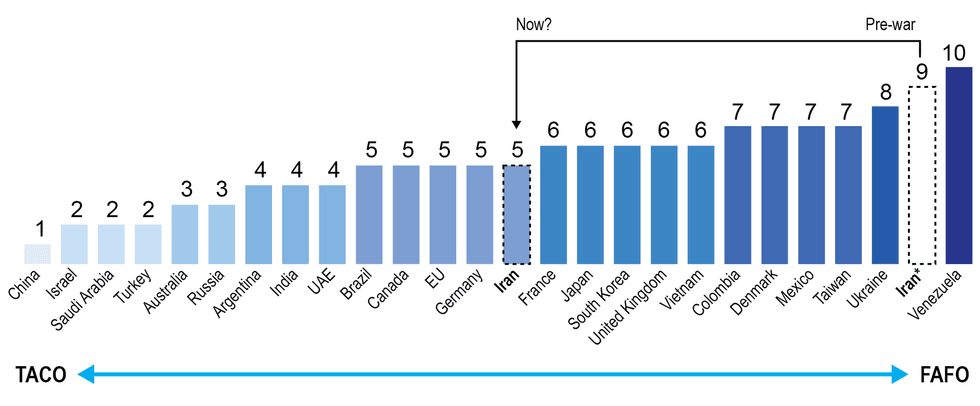
The clearest cases sit at the extremes. Venezuela’s Nicolas Maduro thought he was TACO. He believed Trump was bluffing about deposing him by force, that he could stand up to the American president – even mock him in televised rallies – and Trump would eventually cut him a deal. Turns out he was FAFO. Now he’s sitting in a Brooklyn jail cell while his ex-cronies dance to Washington’s tune and funnel Venezuelan oil revenue to accounts controlled by Trump.
China is on the opposite end. Trump initially thought Beijing was FAFO and his tariffs would force President Xi Jinping to capitulate. He was quickly proven wrong. Not only did Xi have the strategic patience to avoid picking up the phone, but he also had the tools to give as good as he got on reciprocal tariffs and on rare-earth restrictions, which threatened to shut down huge chunks of the American economy. Trump accordingly backed down and is now set on maintaining the détente he negotiated with Xi in South Korea.
Ukraine is seen as FAFO, which is why Trump pressures Kyiv to capitulate while going easier on Moscow. Iran is FAFO too, especially after the US struck their nuclear sites with minimal backlash. The Saudis, Emiratis, and Israelis sit closer to TACO – not because they're nearly as powerful as China, but because they can direct massive investments and political support toward people and projects of particular interest to the president.
And then there’s Europe. The Europeans may see themselves as the most important ally of the United States, but Trump perceives them as firmly in FAFO territory: A collection of small, disjointed vassals asymmetrically dependent on America’s security umbrella, technology stack, and support for Ukraine, with no ability to overcome its internal divisions and domestic political constraints to credibly become TACO. And after spending a few days with European leaders at Davos, I’m not sure he’s wrong.
Despite having real leverage, Europeans’ instinct is always to accommodate and de-escalate, not deter and retaliate. Treasury Secretary Scott Bessent captured the administration's contempt when he said that Europe's most “forceful weapon” is a “working group.” Any displays of weakness and division make it easier for Trump to pick off individual countries and embolden him to double down.
It doesn’t have to be this way. Europe would be much closer to TACO if it acted as a single bloc, effectively pooling its leverage and decision-making authority to present a united front. The Greenland pursuit, which is opposed by a large majority of Americans, was as good a time as any to start. If the Europeans had pushed back hard, this would have been the rare issue where we might have even seen Republicans in Congress break publicly from the president.
Unless Europeans demonstrate they can consistently act as a bloc going forward, they will continue to be treated as FAFO. And Trump has shown he's willing to keep escalating against those he perceives as unable or unwilling to hit back. He may have blinked on Greenland. But if Europe doesn't find a way to make itself more TACO, the transatlantic alliance may not survive the next test.