
Skip to content
Search

Latest Stories

popular

Presented by

Podcast: Dr. Larry Brilliant Explains How to End the COVID-19 Pandemic

Podcast: Dr. Larry Brilliant Explains How to End the COVID-19 Pandemic

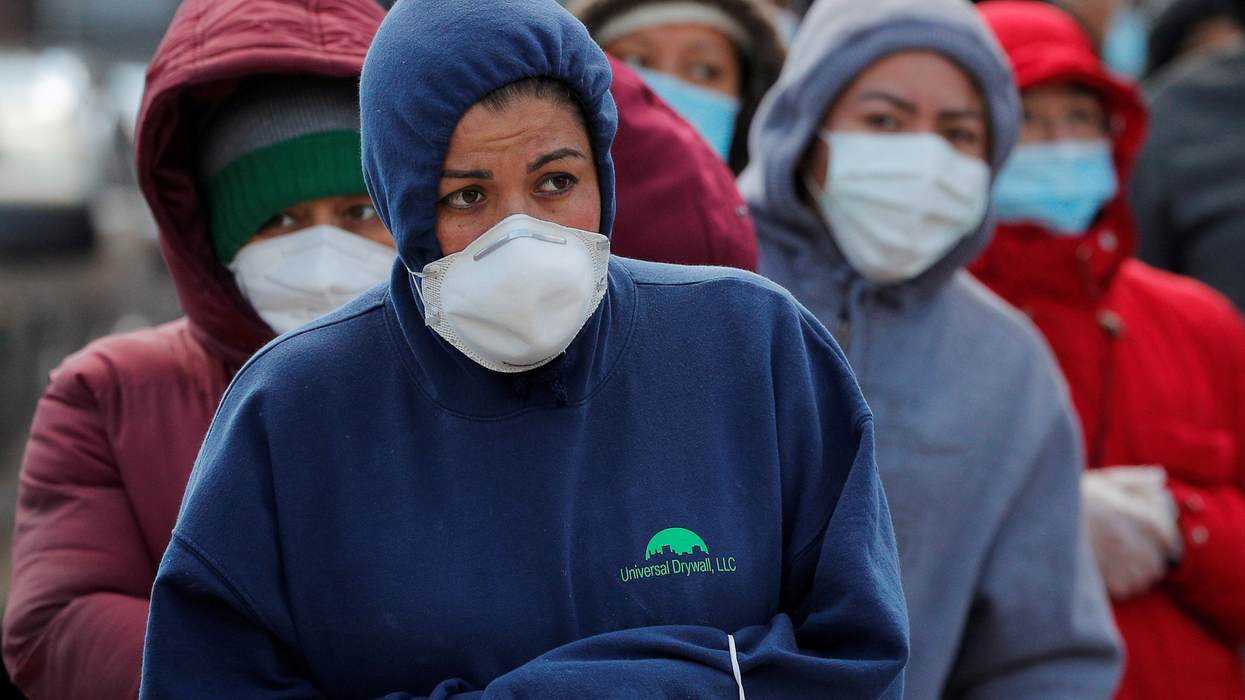
Listen: Epidemiologist Dr. Larry Brilliant, whose work helped eliminate Smallpox forever, explains the steps necessary to eradicate the COVID-19 virus from the world. Brilliant methodically details a three-tiered approach to combating this health threat: Vaccination and herd immunity, proper protection to prevent spread including masks and gloves, and the technology tools that can track illness and infection.


Transcript

Listen: Epidemiologist Dr. Larry Brilliant, whose work helped eliminate Smallpox forever, explains the steps necessary to eradicate the COVID-19 virus from the world. Brilliant methodically details a three-tiered approach to combating this health threat: Vaccination and herd immunity, proper protection to prevent spread including masks and gloves, and the technology tools that can track illness and infection.

Subscribe to the GZERO World Podcast on Apple Podcasts, Spotify, Stitcher, or your preferred podcast platform, to receive new episodes as soon as they're published.
Next Page

More from GZERO World Podcast

The genocide no one talks about any more

Remember Xinjiang?

There was a time, not long ago, when China’s crackdown on the Uyghurs, a Muslim minority group living in Xinjiang province in Northwestern China, was a hot topic – in the media, among human rights activists, and even among the world’s most powerful governments and international organizations.

In 2021, the first Trump administration, in one of its final acts, declared China’s treatment of the Uyghurs a “genocide.” A year later, the UN alleged “crimes against humanity.”

On both sides of the Atlantic, governments slapped human rights sanctions on China, and imposed restrictions on the import of products believed to have been made with forced labor in Xinjiang. Some of the most prominent Western brands were blasted for using Xinjiang products.

But these days the attention has faded. Have a look at this chart showing the share of media articles about the Uyghurs in major US and global English language media:

High profile leaders in the US and Europe have said little about this issue in many months. Other Muslim majority nations that once spoke out – such as Turkey and Indonesia – have gone silent on the issue as well.

How did the lights go down on this story?

First, a refresher: A decade ago, the Chinese government began a severe crackdown on Xinjiang, in response to the rise of a Uyghur separatist movement that had ties to international jihadists. After a knife-wielding separatist killed dozens at a Xinjiang train station in 2014, President Xi Jinping visited the region, telling officials to use “the tools of dictatorship” to ensure stability and calm.

As many as one million Uyghurs people were thrown into an archipelago of “re-education camps,” many for offenses as mild as observing Muslim holidays, praying, or speaking with relatives in Muslim-majority countries abroad. “Campers” were cut off from their families and language, ordered to renounce Islam, and forced to pledge loyalty to the Communist Party. Many were sent to labor camps. Survivors told of torture, sexual abuse, and forced sterilizations.

Meanwhile, Xi’s government used the region to test advanced new surveillance tools, social control technologies, and social credit schemes. Ethnic Chinese from elsewhere in the country were brought in to dilute the Uyghur population. The government invested billions in infrastructure – Xinjiang lies along key “Belt and Road” trade routes linking China to Central and Western Asia.

While Beijing initially denied the existence of the camps, it later said they were merely vocational schools. Around 2019, it promised to close them altogether. Still, hundreds of conventional prisons remain open, and as many as half a million Uyghurs are still held in them according to a recent report by the United States Holocaust Memorial Museum.

Why is so little of this in the headlines these days?

Experts point to several reasons.

First, there has been more competition for what Georgetown scholar James Millward calls “atrocity attention.”

Millward, who has written extensively on Xinjiang, says the wars in Ukraine and Gaza – rife with their own human rights violations, and far easier to cover than remote, tightly-controlled Xinjiang – have drawn the eyes of the world’s journalists and activists away from Northwestern China.

Second, China has successfully reframed the global perception of Xinjiang in a kinder, gentler way, relying on surveillance technologies rather than overt policing to control the population, inviting in travel influencers to post videos of carefully orchestrated Uyghur cultural festivals and breathtaking natural vistas, all while using China’s economic heft to dissuade foreign governments from speaking out.

Lastly, experts point to changes in US foreign policy which have rippled throughout the world.

The Trump administration’s de-emphasis of human rights, coupled with moves to rework long-standing US trade relationships in line with the “America First” approach, have raised the stakes for speaking about Xinjiang – after all, if the world’s number one economy is suddenly seen as an unreliable trade partner, other countries are less willing to press the world’s number two economy, China, on human rights issues.

“I think we are unfortunately at a moment historically,” says Maya Wang, Deputy Asia Director at Human Rights Watch in Washington, DC, “where human rights are just falling out of the foreign policy agenda entirely.”

Remember Xinjiang?There was a time, not long ago, when China’s crackdown on the Uyghurs, a Muslim minority group living in Xinjiang province in [...]

More >

You vs. the News: A Weekly News Quiz - December 5, 2025

Think you know what's going on around the world? Here's your chance to prove it. [...]

More >

Why won’t the right unite in Western Europe?

After months of rumors, Nigel Farage has reportedly said the quiet part out loud: the Reform UK leader told donors that he plans for his far-right party to join forces with the center-right Conservative Party, according to the Financial Times. If the two parties strike such a deal, it will likely mean the British right will return to power at the next election, which will happen no later than May 2029.

It would be the first time in recent memory that the establishment center-right party of a major European country agreed to share power with a far-right populist upstart.

Keep reading... Show less

After months of rumors, Nigel Farage has reportedly said the quiet part out loud: the Reform UK leader told donors that he plans for his far-right [...]

More >

The Ukraine peace push is failing. Here's why.

Nearly four years into Russia's invasion of Ukraine, the push to end the war is intensifying. The past few weeks produced not one but two proposals. Summits convene near daily. American envoys are shuttling between Kyiv and Moscow. Public displays of applause for President Trump's efforts to stop the bloodshed while everyone scrambles to shape the terms.
Keep reading... Show less

Nearly four years into Russia's invasion of Ukraine, the push to end the war is intensifying. The past few weeks produced not one but two proposals. [...]

More >

GZERO Podcasts

Computer scientist and Nobel laureate Geoffrey Hinton joins Ian Bremmer on the GZERO World podcast to talk about artificial intelligence, the [...]

More >

Listen: What does global energy transition look like in a time of major geopolitical change, including rebalancing of trade? In this special episode [...]

More >

Listen: Creating artificial human retinas in zero gravity. Mining rare minerals on the moon. There seems to be no limit to what could be possible if [...]

More >

Behind every scam lies a story — and within every story, a critical lesson. Anatomy of a Scam, takes you inside the world of modern fraud — from [...]

More >

Transcript Listen: “The equivalent of what we spent in World War II was spent in the course of a year and a half to support the US economy, and that [...]

More >

Listen: Investing in health and science research isn’t just about curing diseases. It has huge impacts across society, from creating jobs to driving [...]

More >

Listen: As populations grow and communities evolve, transportation authorities and urban infrastructure are seeking ways to modernize.In this episode [...]

More >