
Al Gore's take on American democracy, climate action, and "artificial insanity"
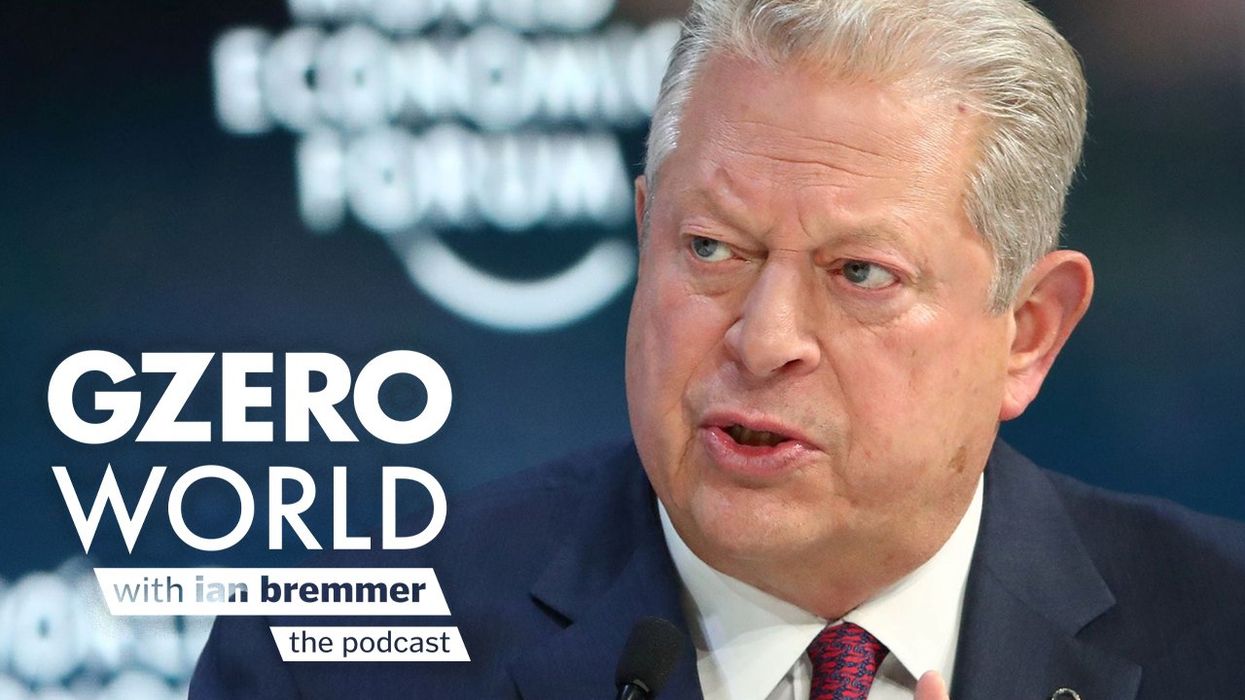
Listen: In this episode of GZERO World podcast, Ian Bremmer sits down with former US Vice President Al Gore on the sidelines of Davos in Switzerland. Gore, an individual well-versed in navigating contested elections, shared his perspectives on the current landscape of American politics and, naturally, his renowned contributions to climate action.
TRANSCRIPT: Al Gore's take on American democracy, climate action, and "artificial insanity"
VP Al Gore:
Our democracy is threatened now for sure. There's a new number one threat and that is misinformation and disinformation, and I think that's intimately connected to the threat we now face in American democracy.
Ian Bremmer:
Hello and welcome to the GZERO World Podcast. This is where you'll find extended versions of my interviews on public television. I'm Ian Bremmer, and today I am coming to you direct from Davos Switzerland site of the 54th World Economic Forum. The theme for this year's gathering, Rebuilding Trust in a Fractured World and for sure confidence in major institutions like governments, churches, and the media is at historic lows. It's not the best backdrop for a year that will test democracy like none we've seen when as many as 70 elections will take place around the world and none will be more watched, whether here, in Davos or in Des Moines than the U.S. presidential election. As Donald Trump barrels toward the GOP nomination, the election itself poses serious risks. And here at the forum, I sat down with a man who is no stranger to contest the U.S. elections, former Vice President Al Gore, to get his take on the current state of American politics and of course, the work he is now best known for climate action. Let's get to it.
Speaker 3:
The GZERO World Podcast is brought to you by our lead sponsor, Prologis. Prologis helps businesses across the globe scale their supply chains with an expansive portfolio of logistics real estate, and the only end-to-end solutions platform addressing the critical initiatives of global logistics today. Learn more at prologis.com.
This podcast is also brought to you by the feature film One Life. One Life tells the incredible true story of Nicholas Nicky Winton, a young man who helped rescue hundreds of predominantly Jewish children from Czechoslovakia in a race against time before Nazi occupation closed the borders on the verge of World War II. 50 years later, Nicky played by Sir Anthony Hopkins is haunted by the fate of those he wasn't able to bring to safety. Also starring Helena Bonham Carter, and Jonathan Price. Variety calls One Life stirring, a testament to the power of good and the Daily Beast says Hopkins gives us stunning performance. Only in theaters, March 15th.
Ian Bremmer:
Vice President Al Gore, thanks so much for joining us.
VP Al Gore:
Thank you for inviting me. So
Ian Bremmer:
I want to talk to you of course about global climate, which is such an important critical part of the agenda here. But before I do, go back to home for U.S. democracy. So 2,000 elections were incredibly divisive, determined by a partisan vote of the Supreme Court, political vote, but nonetheless, we had a free peaceful transfer of power. We did not have that in 2020, and it looks increasingly like we're not necessarily going to in 2024. What happened?
VP Al Gore:
Well, we had a candidate who refused to accept the verdict of the American people. That's what happened. And the alleged crimes that he committed may be adjudicated in court if as many expect the US Supreme Court rejects his claim of total immunity that he's able to, he would be able to assassinate his political opponents with impunity and total immunity, which is of course completely absurd.
Ian Bremmer:
His lawyers tried to skirt that I saw, yeah.
VP Al Gore:
Well, yeah, but the lawyers were put in a tough spot by their clients' desires there. But in any case, our democracy is threatened now for sure. And here at Davos, every year they compile this list of the greatest threats, much as you do of course. And on the Davos list this year, there's a new number one threat and that is misinformation and disinformation. And I think that's intimately connected to the threat we now face in American democracy because knowledge freely available to free people is the basis on which we can engage in democratic discourse and challenge one another's views and reason together and come to a shared conclusion as to what is more likely than not to be true and then use that as the basis of decisions. But the undermining of the law journalism when we have probably the best generation of journalists overall in human history, it's really quite remarkable, I think, and the refusal to accept the fair elect results of elections that have been studied very carefully and found not to have any significant issues.
Ian Bremmer:
Plenty of judicial cases.
VP Al Gore:
Correct.
Ian Bremmer:
All thrown out, exactly.
VP Al Gore:
Correct. That undermines the authority of knowledge and puts wind in the sails of this authoritarian populist wave that is now a global wave and there are many other causes for it, but the misinformation and disinformation goes hand in hand with the dictator wannabes who want to overturn the authority of knowledge and put their will in the driver's seat.
Ian Bremmer:
If we don't have facts, it's hard to have democracy.
VP Al Gore:
Correct.
Ian Bremmer:
So Mr. Vice President, if you don't mind, let's turn to an issue that's been very close to your heart for a very long time. I come here to the World Economic Forum, and I see hundreds of billions of dollars being invested in transition energies. I see renewable energies cheaper today than fossil fuels in many places around the world. It feels like we have come a very long way. I want to see a future of decentralized, inexpensive, abundant, sustainable energy. Do you see that future? Are we on path for that future?
VP Al Gore:
We're not on that path, at least not the way we should be. We have seen significant progress, there's no question about it. And there is a lot of good news. Cost of solar declined again year-on-year in 2023 another 50%. It's really quite remarkable. It's now the cheapest electricity in the history of the world. Wind is not far behind, and if you look at the newly installed electricity generation capacity around the world, 80% of it's now annually solar and wind. However, the installed base of fossil fuel energy is so large and the overall energy consumption continues to grow with population and with new energy hungry technologies like artificial intelligence, for example. We are seeing a continuing rise in the emissions from the burning of fossil fuels. This is the heart of the problem, Ian, the climate crisis is a fossil fuel crisis.
Today, we will put another 162 million tons of manmade heat trapping pollution into the thin shell of atmosphere surrounding the planet. That thin blue line you sometimes see in the pictures from space, it's blue because that's where the oxygen is, and it's thin enough that if you could drive a car at interstate highway speed straight up in the air, you get to the top of that blue line in about five to seven minutes. You could walk it in an hour.
And when you get to the top of that blue line, all of the greenhouse gas pollution is below you and it lingers there. On average, each molecule stays about a hundred years, and so it builds up and it's been building up. And the total amount there now traps as much extra heat in the Earth's system as would be released by 750,000 Hiroshima class atomic bombs exploding on the Earth's surface every day. That's a ridiculously huge amount of energy, and that's what's heating up the oceans and disrupting the water cycle and melting the ice and creating the giant rain bomb downpours and the floods and mudslides and melting the ice and raising the sea.
Ian Bremmer:
We just had the hottest year in history, and 2024 is expected to be that yet again. We can't normalize this. I completely agree. Having said all of that, 10 years ago, 15 years ago, I've read a lot of books from people, a lot of articles talking about we might be hitting 4, 5, 6 degrees of warming before we're able to actually hit carbon neutrality and start taking carbon out of the atmosphere, methane too. I now hear people saying more like, "Well, we think it's more like we're blowing through 1.5, but we're more likely to be 2, 2.2, 2.5." Now, the difference between those things is massive, and I'm not trying to excuse or apologize for it, I'm just trying to ask you, are we changing the nature of the curve? In other words, do you think, not that we can stop worrying about it, but rather are there more reasons for hope today than there were 10 years ago?
VP Al Gore:
Oh, sure, sure. And your questions are spot on, and it's really difficult to get clarity on the amount of progress we have made versus the amount that we must make in order to avoid catastrophe. You're right that the worst case projections a decade ago were much worse than the worst case projections now. Unfortunately, the more optimistic worst case projections now are way bad enough to create utter catastrophe for the future of humanity. We are now at roughly 1.2 degrees Celsius above the pre-industrial average, and it's creating chaos in many parts of the world. This year in 2023, half of all the days saw us rise above the 1.5 threshold. And in November of this past year, we had two days that were above two degrees. So one of the problems that is not given enough attention regularly is that we are kind of going through a metaphorical minefield.
We are in danger of crossing some negative tipping points that could unspool the stability of the system, the climate system that has given rise to the flourishing of humanity. I'll give you two examples. The Gulf Stream, which is part of a larger ocean current system linked all around the world, the leading scientists say that has now slowed by 30%. If it flipped, if it stopped, which some scientists are seriously concerned about, because that did happen in the ancient 12, 14,000 years ago without going into those details, Europe went back into an ice age for another thousand years. The consequences of disrupting that ocean current system would be incalculable another.
Ian Bremmer:
We're experimenting in real time on humanity's future.
VP Al Gore:
Correct. At the end of the last ice age, we settled into this stable climate pattern, which led to the agricultural revolution, the building of the first cities and the emergence of the civilization we enjoy now all of which has been conditioned upon the set of climate and environmental parameters that we have adapted to. We're in danger of radically changing those. And we are also in danger of triggering a runaway phenomena because one-third of the land mass in the Northern Hemisphere is made up of frozen soils embedded in which are massive amounts of dead plants and dead animals. If that is allowed to thaw, it releases both CO2 and methane and could create a feedback loop. Now here's the good news. Here's the good news.
Ian Bremmer:
I was waiting for it.
VP Al Gore:
If we get to true net-zero and stop incrementally adding to the amount of heat-trapping gas that's there, the temperatures will stop going up almost immediately with a lag of as little as three to five years. Now that's new science, it's well confirmed now. They used to believe that it would keep going even after we reach net-zero, but no, it will not. And the even better news is that if we stay at true net-zero, then half of all the human-caused CO2 and methane will fall out of the atmosphere in as little as a quarter of a century.
Ian Bremmer:
Really?
VP Al Gore:
25 to 30 years, yes. And the long healing process will begin. But there's a big if in that sentence is-
Ian Bremmer:
You have to hit it.
VP Al Gore:
We have to hit it.
Ian Bremmer:
You have to hit it.
VP Al Gore:
Now, the good news again, continues in that we have the technologies we need to reach true net-zero and stay there. And the even better news is they're cheaper sources of electricity. They don't have the co-pollution, the particulate pollution that kills almost 9 million people a year every year from the-
Ian Bremmer:
That's why China started moving is because they had a problem with air pollution.
VP Al Gore:
Correct. And India is now not far-
Ian Bremmer:
They're facing.
VP Al Gore:
... behind. Last year, 93% of all the new electricity generation in India was solar and wind, which is a remarkable achievement.
Ian Bremmer:
Part because India and Pakistan have some of the worst air conditions in the world in their cities.
VP Al Gore:
Of course.
Ian Bremmer:
People can't live.
VP Al Gore:
And there are a range of other technologies and batteries, electric vehicles, 20% of all the new cars this year worldwide were EVs, 50% of all the new two-wheeled. Yeah, China dominated that statistic, but it's spreading worldwide. And 50% of the two-wheelers are new ones are electric.
Ian Bremmer:
India too?
VP Al Gore:
Yes. Yes. It's coming on very rapidly. And that's part of the good news, green hydrogen is coming along. But we face a major, two major obstacles in really getting on the path that we need to be on. First of all, access to capital for the installation of green technologies is not available in the developing world. India's an outlier and the foreign exchange risk, corruption risk, rule of law risk, and other risks in developing economies make it almost impossible to get the private capital that's needed. All that new solar and wind, 86% of the money came from the private sector. But with the home bias, that capital stays mostly in the places it originated and the developing economies are walled off from it. The second obstacle, and this is really important and connected to the democracy narrative that we got into at the beginning, the fossil fuel industry and the petro-states have been engaged in a massive campaign to block the progress that would phase out fossil fuels.
Of course, some of the large fossil fuel companies like ExxonMobil for example, have engaged in massive dishonest fraud for decades, and it's all documented very, very thoroughly. I mean, they took the blueprint from the tobacco industry when the Surgeon General's report alerted us to the dangers from smoking cigarettes. They hired actors and dressed them up as doctors and put them on camera to say, "Hi, I'm a doctor and there's no health problem at all involved with cigarettes," and a hundred million people died as they conducted that campaign worldwide. Well, they're doing essentially the same thing on fossil fuels. In fact, the American Petroleum Institute just announced a brand new $100 million advertising campaign last week designed to convince the American people that a transition away from fossil fuels is impossible and must be slowed down if not stopped altogether.
Ian Bremmer:
So what I'm hearing is-
VP Al Gore:
That's true greed.
Ian Bremmer:
... a fundamental challenge to American democracy and to humanity's future, disinformation.
VP Al Gore:
Yeah, absolutely. And it runs very deeply because the vast majority of the American people want to ban assault weapons, but the Congress is pathetically unable to do it because of misinformation and disinformation and AstroTurf, false grassroots movement, scaring the hell out of elected officials so they won't vote the way the American people want them to. The vast majority of the American people want to see bold action on climate, and we finally got the IRA, but where we ought to have a carbon tax. I mean a carbon tax and a two state solution in the Middle East have one thing in common. We've known for decades that's what.
Ian Bremmer:
What you need-
VP Al Gore:
... most important solution. But the political figures have given up on pushing it. I think we will get to a carbon tax by way of a carbon border adjustment mechanism, which is controversial in and of itself, but I think that's coming. We also need-
Ian Bremmer:
I think we'll get there faster than we will at two-state solution, by the way.
VP Al Gore:
Well, I hope we get to both of them. And I don't claim expertise on the ongoing negotiations in the Middle East, but I would not give up hope on a large solution that involves Saudi Arabia. And anyway, I think that we may be reaching a point where big changes are becoming obviously necessary. Rudy Dornbusch was a friend of mine and the last century, and he had Dornbusch's Law stated simply, he said, "Things take longer to happen than you think they will, but then they happen faster than you thought they could." I think we're on the cusp of getting to where we need to be on climate, and I dearly hope that we will make progress on Israel-Gaza on Ukraine, and on the other challenges that exist alongside the climate crisis-
Ian Bremmer:
On our democracy, Vice President Al Gore. Thank you so much-
VP Al Gore:
Thank you.
Ian Bremmer:
... for joining us.
VP Al Gore:
Thank you.
Ian Bremmer:
That's it for today's edition of the GZERO World Podcast. Do you like what you heard? Of course you did. Why don't you check us out at Gzeromedia.com and take a moment to sign up for our newsletter. It's called GZERO Daily.
Speaker 3:
The GZERO World Podcast is brought to you by our lead sponsor, Prologis. Prologis helps businesses across the globe scale their supply chains with an expansive portfolio of logistics real estate, and the only end-to-end solutions platform addressing the critical initiatives of global logistics today. Learn more at prologis.com.
This podcast is also brought to you by the feature film One Life. One Life tells the incredible true story of Nicholas Nicky Winton, a young man who helped rescue hundreds of predominantly Jewish children from Czechoslovakia in a race against time before Nazi occupation closed the borders on the verge of World War II. 50 years later, Nicky played by Sir Anthony Hopkins is haunted by the fate of those he wasn't able to bring to safety. Also starring Helena Bonham Carter, and Jonathan Price, Variety calls One Life stirring, a testament to the power of good, and the Daily Beast says Hopkins gives a stunning performance. Only in theaters March 15th.