
Podcast: Can Europe Trust the US – Or Its Own Nations? German Diplomat Wolfgang Ischinger’s View
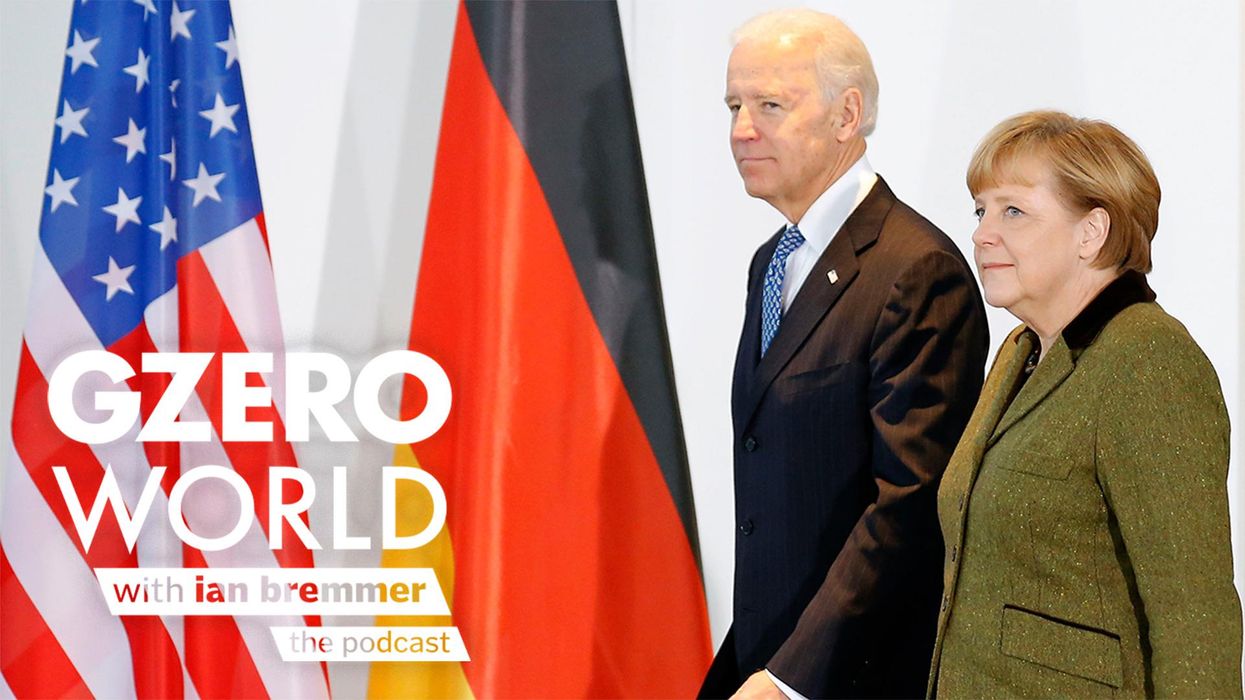
Listen: The GZERO World podcast examines the current state of transatlantic partnerships between the US and Europe following four years of Trump's presidency, and whether or not the incoming Biden Administration can restore trust that the US is a willing and reliable ally. Ian Bremmer's guest is one of Germany's most accomplished diplomats, Wolfgang Ischinger, who has served as ambassador to both the US and the UK. His new book, World in Danger: Germany and Europe in an Uncertain Time, explores the current state of the EU and its place in global affairs as the UK prepares for its "BREXIT" and China looms large in the geopolitical landscape.
TRANSCRIPT: Can Europe Trust the US – Or Its Own Nations? German Diplomat Wolfgang Ischinger’s View
Wolfgang Ischinger:
The four years of the Trump administration have, of course, created significant doubt. And this doubt is not going to go away completely because Europeans are not dumb.
Ian Bremmer:
Hello. And welcome to the GZERO World Podcast. Here you'll find extended versions of interviews from my show on public television. I'm Ian Bremmer. And today a look at the road ahead for the United States and Europe. Transatlantic relationships have been badly strained over the past four years, but President-elect Joe Biden, is promising America is back on the global stage. What does that actually mean in reality and how does China factor into the new geopolitical landscape?
I'm talking about all that and more with one of Europe's top diplomats, Wolfgang Ischinger. He's former German Ambassadors to the United States and currently Chairman of the Munich Security Conference. The title of his new book says it all, World in Danger. Let's get to it.
Announcer:
The GZERO World Podcast is brought to you by our founding sponsor, First Republic. First Republic, a private bank and wealth management company, places clients' needs first by providing responsive, relevant, and customized solutions. Visit firstrepublic.com to learn more.
Ian Bremmer:
And I'm here with Ambassador Wolfgang Ischinger. He's chairman of the Munich Security Conference and author of the new book, World in Danger: Germany and Europe in an Uncertain Time. Wolfgang, great to be with you.
Wolfgang Ischinger:
Great to be with you, Ian.
Ian Bremmer:
So let me start with the new administration. You were very quick to congratulate President-elect Biden, Vice President-elect Harris, on their win. Even extended an invite to him to the Munich conference. I know he's attended for many decades now. To what extent do you think this will really reflect a change in the trust that the Europeans do and don't have for the United States?
Wolfgang Ischinger:
I think there is an enormous, a wonderful, positive opportunity waiting to be seized now because, of course, we have had a really regrettable loss of trust in the transatlantic cooperation. I cannot think of anyone better equipped because of his longstanding personal relationship with so many European leaders. I cannot think of anyone better equipped than your future president to try to repair the trust thing.
So I think that's going to work very well. And I also believe that there are a number of what you would call, low hanging fruit, where quickly, symbolic activities, but also important, substantive activities can be developed. Just as one example, a return by the United States of America to the Paris Climate deal and future joint enterprises in the climate arena. I think that's going to produce a see change in the way Europeans look at America. And we will be so pleased if we are no longer being called a foe of America, but a partner. Maybe sometimes a difficult one, maybe sometimes not always an extremely pleasant one, but actually a good one.
Ian Bremmer:
Is it fair to say that there's going to be, there's likely to be an actual honeymoon, a transatlantic honeymoon for a period of time between the Americans and Europeans?
Wolfgang Ischinger:
I certainly believe so. But, there's a big but. Personally, I've been saying to my German and European friends, "Curb your enthusiasm. Don't now sit back and wait for President Biden and his future administration to bring all the goodies to Europe. That's probably not going to happen. We will have to bring something to the United States. We will have to talk about equitable burden sharing. We will have to talk and to make offers on such issues as trade and on how to best to deal with China." Such a long list.
So, "We should not sit back in a passive mode and wait for the United States, for the Biden administration to come to us. We should go to Washington and present our offer of comprehensive corporation." So I think that's very important. But, Ian, let me add one important point. There is one thing that will have changed over these last four years, and that's going to be difficult to repair in the transatlantic arena.
For five, six, almost seven decades European decision makers, the European elite had a good reason to believe that America was going to be present in Europe, was a European power and would continue to extend its protective umbrella, security umbrella, nuclear umbrella over Europe. And this would go on forever. The four years of the Trump administration have of course created significant doubt. And this doubt is not going to go away completely because Europeans are not dumb.
They're now thinking, and I hear them talk about it, "So we'll have this honeymoon with President Biden. Do we have a guarantee that four years from now the American voter may not vote into office someone like Donald Trump again, and then we would be back to square one maybe without the climate deal, without the Iran deal, without our joint security activities. Et cetera." In other words, there is an element of doubting the reliability of the American ally.
And that's going to be really hard to repair for any administration because this is new. And people will say, "Do we want to make our lives, our future dependent on what maybe 50,000 or 60 or 80,000 voters in Georgia or Arizona may wish to do four years from now?" That's the hard part. And that's different from previous decades.
Ian Bremmer:
Did Trump do that much? He said a lot of things that were deeply antagonistic to the Europeans. And he moved some troops out of Germany. We had some more forward deployments to Poland. The Russia sanctions are still kind of the Russia sanctions. How much of this is bark and no bite?
Wolfgang Ischinger:
Well, politics and international relations, of course, is about money. It's about military cooperation. It's about guarantees. It's about trade. But it is also about symbols. And it just so happens, and I'm saying this as a German, it just so happens that from a German viewpoint, America is not just any partner. America, the White House, represented to us in the post World War II period, the wisdom and the values of what we call the West. America was for us, and hopefully will again be, the leading power of the West representing these shared values of human dignity, et cetera.
And quite frankly, the last four years in the minds of many, many of my countrymen America lost the ability to lead the West. If you look at recent polls taken in Germany, taken in other European countries, the results have been rather devastating. I think that can be repaired, it will be repaired. The views of Europeans can change quickly again. But that has really affected in a very, very negative our relationship above and beyond the substantive issues, which are, of course, the core of the relationship. But symbols matter.
Ian Bremmer:
Another massive change in the last four years has been China's growing role in Europe, particularly in Eastern and Southern Europe. 10, 20 years ago, something we weren't talking about very much. Now, something we're talking about all the time that's not changing with the US election of President-elect Biden. How is that changing Europe, both its orientation in the world and its future?
Wolfgang Ischinger:
For decades, we in my country, in Germany, we tended to regard China as a market. Where we can sell the maximum number of Mercedes and Volkswagen's and BMWs and that was it. We've now started, over the last few years, to reflect about this relationship and to discover that if we want to defend our interests, we need to consider not only human rights issues, we need to consider intellectual property issues. We need to consider security issues, and we need to work with the United States on this.
So I think that actually we are, on the European side, we are interested and willing to try to coordinate with the United States. There is one big obstacle for us at this moment. We don't yet really have something which deserves to be called an EU China strategy. There is a French China strategy. There is, to some extent, a German strategy on China and maybe a British and Italian strategy on China. Putting this together and presenting to our American partner, something which deserves to be called an EU approach to China and consult with the United States about, where is overlap? Where can we work together? How can we develop joint initiatives on so many different issues in China? I think that's the big issue.
Ian Bremmer:
Do you think it is more true that the United States has been too hawkish on China or that the Europeans have been too dovish on China? Your personal view?
Wolfgang Ischinger:
My personal view is that in, as far as China is concerned, I would actually give a few bonus points to the Trump administration because by adopting this rather confrontational position on China that sort of had the effect of a wake-up call in Europe. We had to scratch our heads and say, "Well, maybe he has a point, Mr. Trump. And maybe we should think about this also in a more strategic and not only in a kind of trade and investment manner."
If the United States and Europe get together on this, we represent not quite 50%, but certainly way over 40% of world trade. We are very difficult to ignore even by China. So in that sense, I think we have lots of work ahead, but I am not entirely pessimistic about the opportunity of turning the Chinese issue into a positive transatlantic agenda item.
Ian Bremmer:
Did the EU get too big? Is this part of the problem is that now there's a difficulty in coordination and even existential questions about how Europe can function because you've integrated countries that can't really be integrated well?
Wolfgang Ischinger:
Look, when countries like Poland and Hungary and the Czech Republic, and then later on Romania, Bulgaria, the Baltic States, came to us, came the United States, came to NATO in the early 1990s and said, "We want to be part of your organization. We want to enjoy the same kind of security that the Germans, including the former GDR, are now enjoying. We want to be part of the West."
How could we have said no to that? What would've been the justification of saying no? So incorporating, inviting these countries, our direct neighbors into NATO and certainly also into the EU, was undoubtedly the right thing to do. And in those years, if you go back to the 1990s, these countries were totally Western. They wanted to be part of the West. What we have now seen over the last decade or so is a development in the United States with the Tea Party, with the developments in the Republican Party with the victory four years ago by Donald Trump.
We've seen Marine Le Pen, in France. Even in Germany, we have a right wing party, what we call the IFD. Which at times in certain parts of Germany scored way above 10, 15, almost close to 20% of the vote. So the Hungarians at the polls are not the only ones who have problems with populist movements, who even have populist parties that are now governing these countries.
My point is a very simple one. I think that the values of the European Union and the idea of integration will prevail. And I think that Prime Minister Orban, for example, of Hungary, he's not going to be the Prime Minister of Hungary forever, and ever, and ever. There will be elections in Hungary. There will be change again in Poland at some point.
So I am not in favor of kicking these countries, so to speak, in the butt and kicking them out of the European Union because they have a problem with certain principles of the rule of law or of the independence of the judicial system. I think we need to demonstrate a little bit of strategic patience. We need to put pressure on them. We need to demonstrate to the voters in Poland and Hungary that there is a better way, that there is a European way and there is, of course, opposition in these countries that is active.
So I'm not giving up hope. I'm actually quite optimistic that we will overcome this crisis within the European Union. Remember a few years ago, people were saying, "If the Brits leave the European Union, that will be the-
Ian Bremmer:
Death now.
Wolfgang Ischinger:
... the death of the EU." It will-
Ian Bremmer:
And indeed, you could argue it's been the opposite.
Wolfgang Ischinger:
Actually, the EU is, in terms of its governance and of its capabilities of its financial reach, it's in better shape today than was the case five, 10 or 15 years ago. We had what we call this so-called Hamiltonian moment last summer when the EU, as a consequence of the pandemic challenge, decided after many, many years of very difficult debate, the EU decided that, "Yes, we have to allow the European Union to go into debt." And that, of course, opens a new chapter in the history of the integration of the European Union. So the EU is actually not in bad shape in spite of Brexit, in spite of the challenges to the rule of law, et cetera, in couple of member countries.
Ian Bremmer:
Now, you could argue that in terms of pandemic response, the Europeans as a union have shown more strength and capacity to govern at an international level than anybody else.
Wolfgang Ischinger:
Yeah. But I'm still not happy. You know why? Because saving our countries from the consequences of the pandemic is one thing, that is of course, the number one challenge. But as we pour money into our own economies and societies in order to recover from the pandemic, we should not ignore the fact that other countries, I'm thinking of Africa, South of the Sahara, I'm thinking of the Middle East, I'm thinking of Asia and other countries. Almost half of the African countries are at risk now or will be at risk as a consequence of the pandemic challenge to be in the category of failing states or failed states.
And what kind of migratory pressures would that produce if these countries cannot feed their population and cannot demonstrate that they're capable of creating conditions of economic growth and prosperity. So we need to take a strategic look, not only at our own needs in Europe and in the United States, but at the needs of the rest of the globe.
And that again, is something where I would hope that with the incoming Biden administration, we would have a partner in Washington who understands that all of us will only be safe if everyone is safe, as the director of WHO has said.
Ian Bremmer:
The book is, World in Danger: Germany and Europe in an Uncertain Time Very handsome, Wolfgang Ischinger, on the cover. Always good to be with you, my friend. Look forward to seeing you soon, and I hope in person.
Wolfgang Ischinger:
Thank you so much.
Announcer 4:
That's it for today's edition of the GZERO World Podcast, like what you've heard, come check us out at gzeromedia.com and sign up for our newsletter, Signal.
Announcer 3:
The GZERO World Podcast is brought to you by our founding sponsor, First Republic. First Republic, a private bank and wealth management company, places clients' needs first by providing responsive, relevant, and customized solutions. Visit firstrepublic.com to learn more.
Subscribe to the GZERO World Podcast on Apple Podcasts, Spotify, Stitcher, or your preferred podcast platform, to receive new episodes as soon as they're published.