
Skip to content
Search

Latest Stories

The United States will no longer play global policeman, and no one else wants the job. This is not a G-7 or a G-20 world. Welcome to the GZERO, a world made volatile by an intensifying international battle for power and influence. Every week on this podcast, Ian Bremmer will interview the world leaders and the thought leaders shaping our GZERO World.

Presented by

Trump vs higher education, with Harvard's Noah Feldman

Trump vs higher education, with Harvard's Noah Feldman

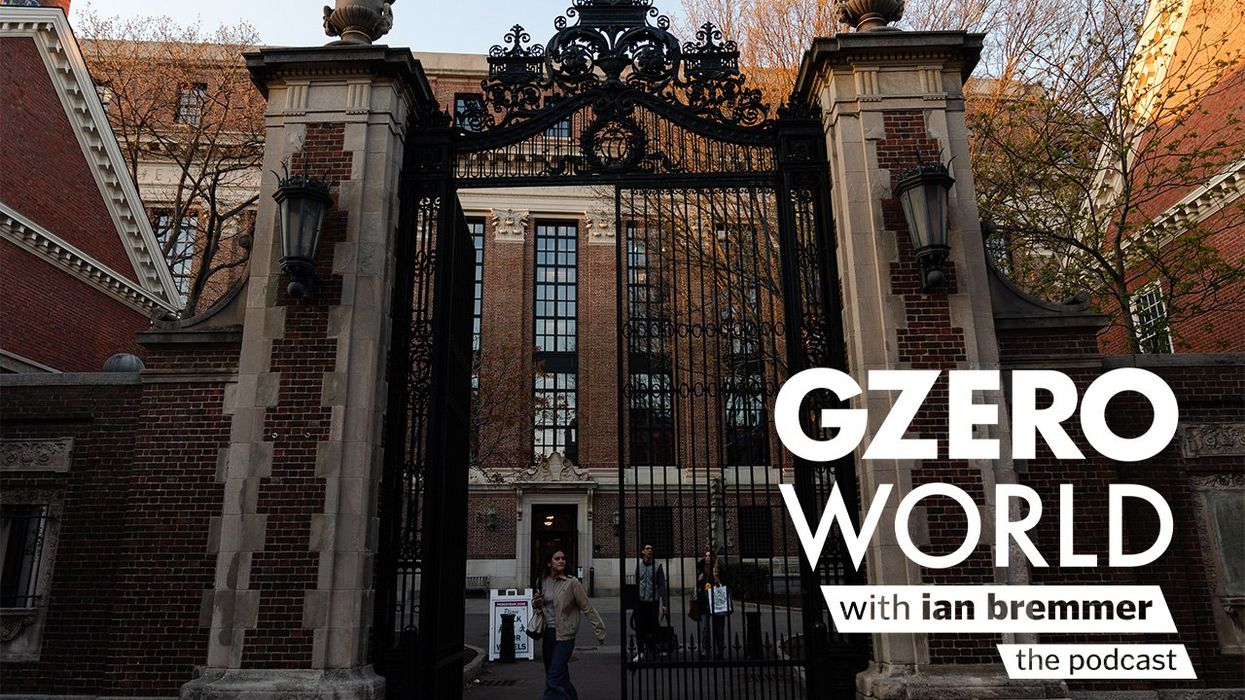
Harvard Law's Noah Feldman unpacks the Trump administration’s legal and political escalations with elite US universities.

From lawsuits and executive orders to funding cuts tied to antisemitism claims, the Trump White House is targeting institutions like Harvard and Columbia in what Feldman calls an effort to undermine independent centers of truth. “Trump's gone after universities, he's gone after media, and he's going after courts,” Harvard Law professor Noah Feldman tells Ian Bremmer in the latest episode of the GZERO World podcast. “Each in its own way is an independent institutional voice telling people, ‘This is the way things are.’”

Feldman explains why this isn’t just about cancel culture or campus politics—it's about whether universities will remain places where truth is pursued freely, or "knuckle" under political pressure. He discusses Harvard’s legal fight with the administration, growing antisemitism on and off campus, and the deeper risks for American democracy if academic independence erodes.

Subscribe to the GZERO World Podcast on Apple Podcasts, Spotify, Stitcher, or your preferred podcast platform, to receive new episodes as soon as they're published
More from GZERO World Podcast

The biggest geopolitical risks of 2026 revealed

Listen: With the global order under increasing strain, 2026 is shaping up to be a tipping point for geopolitics. From political upheaval in the United States to widening conflicts abroad, the risks facing governments, markets, and societies are converging faster—and more forcefully—than at any time in recent memory.

To break it all down, journalist Julia Chatterley moderated a wide-ranging conversation with Ian Bremmer, president of Eurasia Group and GZERO Media, and a panel of Eurasia Group experts, to examine the findings of their newly-released Top Risks of 2026 report.

Keep reading...Show less

Listen: With the global order under increasing strain, 2026 is shaping up to be a tipping point for geopolitics. From political upheaval in the [...]

More >

War and Peace in 2025, with Clarissa Ward and Comfort Ero

This week, instead of zooming in on a single conflict, the GZERO World Podcast looks back on 2025 and takes stock of a world increasingly defined by conflict. Ian Bremmer sits down with CNN Chief International Correspondent Clarissa Ward and Comfort Ero, President and CEO of the International Crisis Group to look at some of the biggest crises of 2025–-both the headline making wars and the ones the world overlooked.

Keep reading...Show less

This week, instead of zooming in on a single conflict, the GZERO World Podcast looks back on 2025 and takes stock of a world increasingly defined by [...]

More >

Why we still trust Wikipedia, with cofounder Jimmy Wales

At a moment when Americans can’t agree on much of anything, one unlikely institution still commands broad trust: Wikipedia. On the GZERO World podcast, Ian Bremmer sits down with Wikipedia cofounder Jimmy Wales to ask why the crowdsourced encyclopedia remains one of the most visited and relied-upon sites in the world, even as trust in media, government, and tech companies continues to collapse.

Keep reading...Show less

At a moment when Americans can’t agree on much of anything, one unlikely institution still commands broad trust: Wikipedia. On the GZERO World [...]

More >

The human cost of AI, with Geoffrey Hinton


Computer scientist and Nobel laureate Geoffrey Hinton joins Ian Bremmer on the GZERO World podcast to talk about artificial intelligence, the technology transforming our society faster than anything humans have ever built. The question is: how fast is too fast? Hinton is known as the “Godfather of AI.” He helped build the neural networks that made today’s generative AI tools possible and that work earned him the 2024 Nobel Prize in physics. But recently, he’s turned from a tech evangelist to a whistleblower, warning that the technology he helped create will displace millions of jobs and eventually destroy humanity itself.

Keep reading...Show less

Computer scientist and Nobel laureate Geoffrey Hinton joins Ian Bremmer on the GZERO World podcast to talk about artificial intelligence, the [...]

More >

GZERO Podcasts

Listen: With the global order under increasing strain, 2026 is shaping up to be a tipping point for geopolitics. From political upheaval in the [...]

More >

Listen: What does global energy transition look like in a time of major geopolitical change, including rebalancing of trade? In this special episode [...]

More >

Listen: Creating artificial human retinas in zero gravity. Mining rare minerals on the moon. There seems to be no limit to what could be possible if [...]

More >

Is China’s economic model reaching a breaking point? In GZERO’s 2026 Top Risks livestream, Cliff Kupchan, Chairman of Global Macro at Eurasia Group, [...]

More >

Transcript Listen: “The equivalent of what we spent in World War II was spent in the course of a year and a half to support the US economy, and that [...]

More >

Listen: Investing in health and science research isn’t just about curing diseases. It has huge impacts across society, from creating jobs to driving [...]

More >

Listen: As populations grow and communities evolve, transportation authorities and urban infrastructure are seeking ways to modernize.In this episode [...]

More >