Trending Now
We have updated our Privacy Policy and Terms of Use for Eurasia Group and its affiliates, including GZERO Media, to clarify the types of data we collect, how we collect it, how we use data and with whom we share data. By using our website you consent to our Terms and Conditions and Privacy Policy, including the transfer of your personal data to the United States from your country of residence, and our use of cookies described in our Cookie Policy.
{{ subpage.title }}
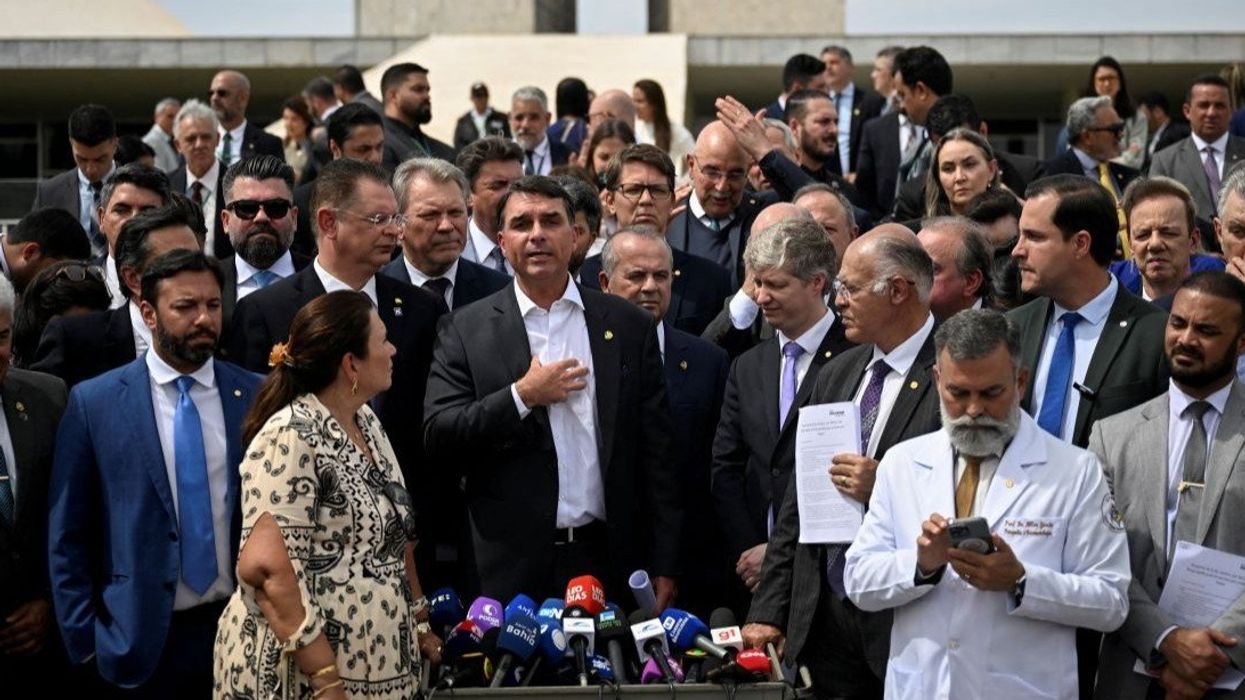
Senator Flavio Bolsonaro, son of former Brazilian President Jair Bolsonaro, speaks during a press conference, after Brazil's Supreme Court issued a house arrest order for his father, in Brasilia, Brazil, August 5, 2025.
Bolsonaro’s trial opens as Brazil braces for fallout
Brazil’s Supreme Court on Tuesday began the final phase of the historic trial of former president Jair Bolsonaro, who is accused of plotting a coup after losing the 2022 election. Prosecutors say he conspired with allies to overturn the result, sought military backing, and even weighed assassinating rivals. If convicted, he could face more than 40 years in prison.
The trial is expected to run about 10 days, following months of arguments and witness testimony. Bolsonaro himself skipped the opening session, with lawyers citing a debilitating bout of hiccups – a lingering complication from a 2018 stabbing.
Why it matters: For a country scarred by coups and dictatorship, prosecuting a former leader is a democratic stress test. Analysts expect a conviction, which would inflame Bolsonaro’s base and deepen political tensions.
“Some analysts and political leaders hope that the trial will reduce polarization and pacify the political landscape. However, that is wishful thinking.” says Eurasia Group Managing Director and Brazil expert Chris Garman. “Keep in mind that roughly 40% of the electorate still believes that Bolsonaro won the 2022 election, and a large share of voters are still likely to see the trial as political persecution.”
What remains of Bolsonaro’s movement? Banned from seeking office until 2030, Bolsonaro has left his populist-right movement alive but adrift. Supporters are planning nationwide protests on Sept. 7, Independence Day, and Garman says that the “anti-establishment sentiment that got Bolsonaro elected in 2018 will persist.”
“Despite already being ineligible to run in 2026, several polls show Bolsonaro as the strongest candidate to challenge President Lula in 2026. That means whoever he endorses to run in his place will have a good shot of making it to a run-off against Lula.”
But no clear successor has emerged. “Pressure is high for Bolsonaro to crown São Paulo Governor Tarcisio de Freitas as his heir, instead of a family member.” says Garman. “In the coming months, all eyes will be on Bolsonaro’s decision on who to support in 2026. His martyr status will cement his “kingmaker” role in next year’s electoral cycle.”
The US angle: Bolsonaro has found an ally in US President Donald Trump, who views the trial as an anti-democratic witch hunt. His administration slapped a 50% tariff on Brazil and sanctioned a Supreme Court justice handling the case. Garman expects “the conviction will trigger more US sanctions on Brazilian individuals,” and that, “the US may also classify Brazil’s organized crime groups as terrorist organizations, increasing compliance risks for financial institutions.”
If Washington escalates, President Luiz Inácio Lula da Silva – who has gained some political momentum thanks to Trump’s heavy-handed interventions – may pivot harder toward China, the Middle East, and the EU, where the long-stalled trade deal between the EU and South America’s largest trading bloc, Mercosur, is finally moving forward.