Hello and welcome to your Wednesday Signal. Today, we'll look at French politics after the Notre-Dame fire, examine a budding tech worker protest in China, and recount ballots in Istanbul. All that plus your usual dose of hard numbers, plus some must-see Cantonese opera, below.
Tell us what you think of Signal here, or sign up a friend here. Thanks for reading!
–Kevin (@kevinallison)The Politics of Notre-Dame: Playing with Fire
It's no wonder so many people across Europe and around the world felt shock and sorrow at images of Notre-Dame in flames. So many have been there. On an average day, 30,000 people step inside the cathedral to worship or soak in centuries of history. That's 14 million people a year. As French writer Bernard-Henri Levy wrote on Tuesday, Notre-Dame is "a treasure of civilization, for those who believe in heaven and for those who don't."
Of course, this loss is much more personal for citizens of France. Centuries ago, distances were calculated in many countries from "point zero," a marker embedded in a location that represents the heart of the nation. In France, point zero is found in the paving stones just outside the entrance to Notre-Dame. For many, Notre-Dame is the (still) beating heart of France.
It's inevitable that this fire, and reconstruction of the cathedral, will become a central reference point for French politics in the coming days and months, creating both risks and opportunities across the political spectrum.
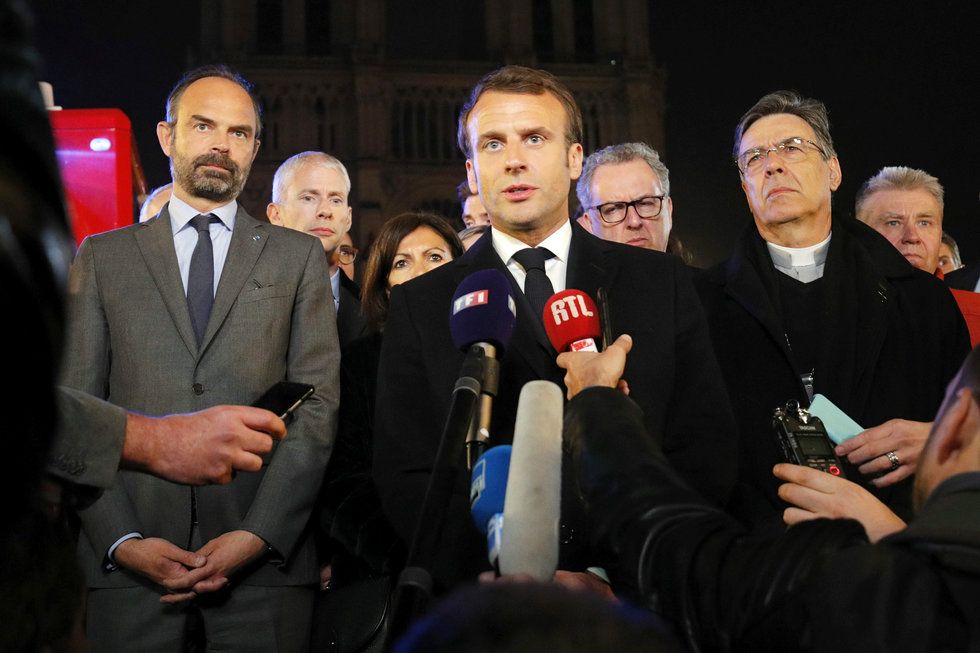
Critics of President Emmanuel Macron call him aloof and imperious. But outside the cathedral on Monday, he spoke with credible emotion about Notre-Dame's importance for France and the urgent need to rebuild. Last night, he called for the nation to mobilize and rebuild the cathedral "even more beautifully" within 5 years, saying it was up to "up to us to transform this disaster into an opportunity to come together."
The fire ignited just hours before Macron was to address the nation on the recent wave of "gilets jaunes" protests across France and what they've taught him. He now has an opportunity to strike a more personal tone and rally public support for the government. Tuesday's speech was a step in that direction, but Macron must be careful in the coming week not to inject politics into a story that's deeply personal for many in France.
The "gilets jaunes," a diverse collection of people from all age groups and political backgrounds, have earned considerable public support with protests aimed at unresponsive government. But critics charge the movement has been hijacked by people more interested in inflicting property damage than in political change. The disaster at Notre-Dame may poison attitudes toward property destruction, at least for a while.
Finally, this disaster lands in the middle of an election campaign for the European Parliament, and Marine Le Pen, leader of the far-right National Rally party, will look for every opportunity to draw votes from Macron and other opposition parties.
She may argue that the Notre-Dame fire is the predictable result of a negligent government that spends too much on immigrants and "European" projects while neglecting to protect symbols of the French nation.
Or, like Macron, she may find that using Notre-Dame to win votes is playing with fire.
Graphic Truth: The Destruction of Notre-Dame in Context
The partial destruction of Paris' Notre-Dame Cathedral is an incalculable loss for France and the world. But Notre-Dame is only one of the many important cultural monuments destroyed in recent years. Here's a look at other sites that have suffered serious damage and the total number of years they stood.
A Message From Microsoft
We're increasing our carbon fee as we double down on sustainability
Since 2009, Microsoft has made and met a series of commitments to reduce our carbon footprint. While we've made progress toward our goal of cutting our operational carbon emissions by 75 percent by 2030, the magnitude and speed of the world's environmental changes have made it increasingly clear that we must do more. And we are taking new steps to do just that.
This week we announced that we will nearly double our internal carbon fee, an internal tax, to $15 per metric ton on all carbon emissions.
Read how → Microsoft on the IssuesChina: Trouble in Workers' Paradise
Three small numbers are making big waves in China. The digits 9-9-6, a shorthand for 9am to 9pm, six days a week, have become a rallying cry for tech workers frustrated with their bruising work schedules. In recent weeks, what began as a discussion among a few programmers has morphed into a broader debate about working conditions in China's most important industry.
It's a fascinating story, not least because it's a rare example of a labor protest in China organizing and going viral despite the country's sophisticated government-backed censorship.
But the 9-6-6 debate also exposes deeper tensions within the Chinese system:
China's political ideals vs its capitalist growth engine: Under the Communist Party, China is meant to be a workers' paradise, but labor laws limiting work to 40 hours per week plus 36 hours of overtime per month are rarely enforced. China is the only country in the world that's come close to replicating the success of Silicon Valley, partly because of workers' willingness to submit to the grind. But life is short, and as living standards rise, it's inevitable that well-to-do tech workers with globally attractive skills will start to demand more free time.
Tech billionaires vs "worker bees": Leading Chinese tech entrepreneurs have pushed back against complaints about the 9-9-6 movement, effectively saying, "suck it up, slackers!" Jack Ma, the billionaire founder of e-commerce giant Alibaba (and a member of China's Communist Party), said tech workers should consider it a privilege to work such a tough schedule. Another Chinese billionaire, JD.com founder Richard Liu, warned the company's future would be in jeopardy if people were no longer willing to put in the time, saying "slackers are not my brothers."
But here's the problem: Both the Chinese government and industry bosses need obedient tech workers. China's technology industry is increasingly the engine of its economy. The government needs tech workers to keep living standards rising across the country and create new economic opportunities as growth starts to slow. Tech companies need their high-skilled workers to compete in a cut-throat industry. No wonder workers say they're feeling squeezed and that the status quo is unsustainable.
Upshot: If that's true, what does it say about the sustainability of the Chinese tech-led growth model?Indonesia’s Mammoth Election
193 million people across more than 17,000 islands vote in the world's largest single-day election. Watch our video explaining what's at stake.
What we are watching: An election do-over in Turkey, and al-Sisi's latest power grab
Istanbul's mayoral election rerun – In recent local elections, Turkish President Recep Erdogan's ruling AKP party narrowly lost the mayoralty of Istanbul for the first time in more than two decades. Erdogan, who started his career as mayor of Istanbul, was not happy. Yesterday, the AKP cried "do over!" submitting a formal request to re-run the election. The first go-round was decided by less than 15,000 votes in a city of 15 million, but it's a risky strategy for the AKP – there's no guarantee that a fresh election will return a better result, and it might just serve up a worse one.
Al-Sisi's plans to hang out for a while – Egypt's autocratic President Abdel Fattah al-Sisi has opened the way to stay in office for another eleven years. The country's rubber stamp parliament has approved constitutional amendments that extend the presidential term and expand executive control over the judiciary. We're watching the upcoming popular referendum on the changes, but only to see how comically high the YES vote is in a country where the president rang up 97 percent in the last election. That said, note: holding on to power forever is a great plan until it isn't, as al-Sisi's recently deposed neighbors in Algeria and Sudan can attest.
What we are ignoring: Another Trump-Kim summit, and Cantonese opera
The clamor for a new US-North Korea summit – Speculation about a new meeting between President Trump and his North Korean counterpart is growing after North Korean state media reported last week that Kim Jong-un was open to another tete-a-tete, provided the US came with the "right attitude." Over the weekend, Mr. Trump said a third summit to discuss denuclearization and the removal of US sanctions "would be good." We're ignoring this, because it's not clear if anything material has changed since the two sides walked out of the last round of talks in February, and if Kim is waiting for President Trump to change his attitude, he's going to be waiting a long time.
"Trump on Show" – A three-and-a-half-hour Cantonese opera that premiered in Hong Kong last weekend featured a drunken Richard Nixon, a clone of Chairman Mao, and a young Donald Trump in search of his long-lost twin brother, all set to the tones of traditional Chinese stringed instruments. Your US-based Signal crew is intrigued by this attempt to revitalize the 500-year-old traditional art form, but we missed the show's sold-out four-day run. From what we've been able to piecetogether from social media, it sounded pretty epic.Hard Numbers: Indonesia’s bulging youth population
430,000: Japan's population is shrinking by the equivalent of a medium-sized city each year due to a rapidly declining birth rate. The native-born Japanese population fell by 430,000 in 2018, while 161,000 migrants entered the country, partially offsetting that loss.
67: Prices of staple foods in Iran have soared this year – with the price of beef up 67 percent, fruit up 58 percent, and rice up 24 percent – as US sanctions have sunk the Iranian economy. Police in Tehran arrested 43 people accused of manipulating Iran's meat market over the Persian New Year holidays in early April.
51: Just over half of Russians in a recent poll – 51 percent – expressed admiration, sympathy, or respect for Josef Stalin, the highest reading since pollsters began tracking public attitudes towards the former Soviet dictator in 2001. Seventy percent of respondents said Stalin's three-decade reign had been "positive" for the country.
42: Of the nearly 270 million people living in Indonesia, the world's largest Muslim majority country, around 42 percent, or 113 million, are under the age of 25. Educating, training, and finding jobs for the country's growing youth population will be a key challenge for the next president.
4: Measles cases reported around the world have quadrupled over the past year to more than 112,000, according to the World Health Organization. Africa has been worst-hit, with cases of the dangerous respiratory illness up eight-fold across the continent. Cases are also rising in the US, Thailand, and other countries with traditionally high levels of vaccination – a trend that a WHO official attributed to online anti-vaccine conspiracy theories.