What We're Watching
South Korean president ousted, election looms
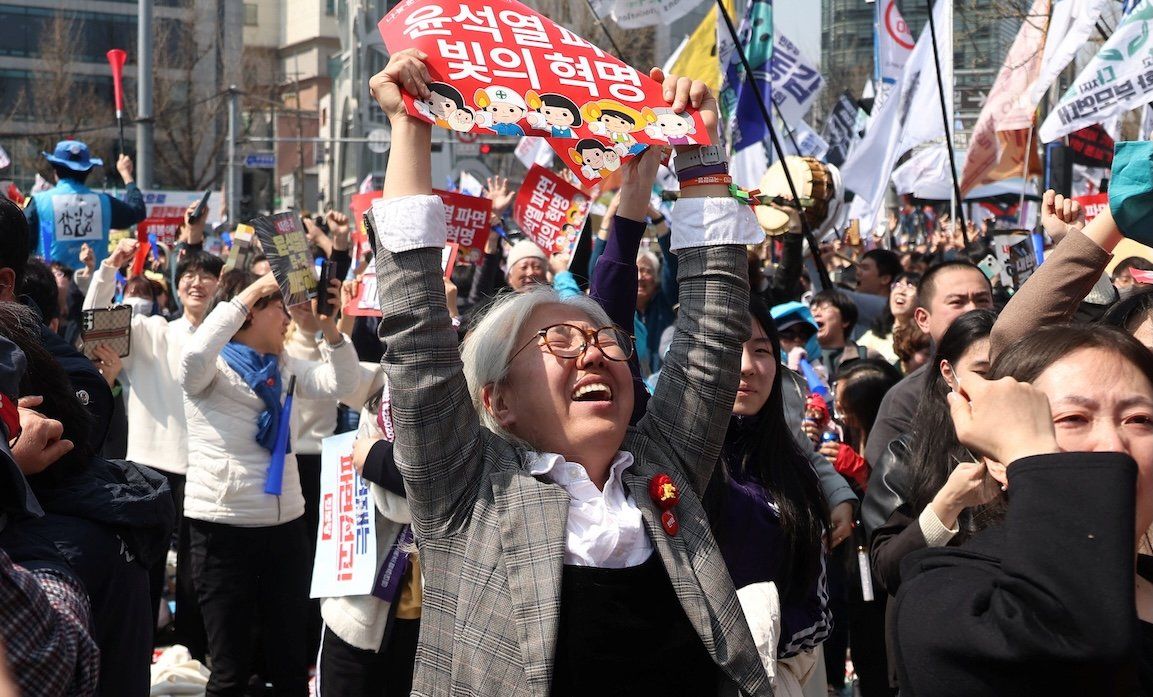
People celebrate after President Yoon Suk-yeol's impeachment was accepted, near the Constitutional Court in Seoul, South Korea, on April 4, 2025.
REUTERS/Kim Hong-ji
South Korea’s Constitutional Court on Friday voted unanimously to oust impeached President Yoon Suk-yeol over his decision to declare martial law in December. Supporters of Yoon who gathered near the presidential residence in Seoul reportedly cried out in disappointment as the court’s 8-0 decision was announced. Others cheered the ruling. The center-right leader is now the second South Korean president to be ousted.
South Korean authorities deployed a whopping 14,000 officers and 210 riot units throughout the capital to deal with expected mass protests and potential violence. Yoon did not attend the reading of the verdict, reportedly due to security concerns, but he accepted the decision. He expressed remorse for the way his time in office ended.
“I deeply regret not being able to live up to your hopes and expectations,” the former prosecutor said in a statement.
Yoon’s ouster caps a tumultuous period for South Korea. His martial law declaration marked the first time since 1980 that a South Korean leader had used such powers, and it triggered dark memories of the country’s military rule. Even though the declaration lasted just six hours, the National Assembly impeached Yoon in a bipartisan vote on the grounds that he violated his constitutional duty.
Friday’s ruling starts the clock for a presidential election within 60 days, during which time Han Duck-soo,prime minister and acting president, will remain at the helm.
Yoon faces more legal woes. The former president now faces criminal charges for alleged treason, marking the latest battle between the judicial branch and a political leader — and echoing similar clashes in Brazil, France, Israel, Romania, and the United States. Even if the Constitutional Court had ruled in Yoon’s favor, he still would have faced these charges, but the decision against him makes the case much more likely to proceed.Algerians are headed to the polls today to elect their next members of parliament. However, hopes for true democracy look more remote than ever.
In addition to the health concerns from the Ebola outbreak, the UN is sounding the alarm on a potential development crisis in Africa sparked by the disease.
The protests in the small Balkan country were touched off by the start of construction on a seaside luxury resort linked to US President Donald Trump’s son-in-law, Jared Kushner.