News
Why Iran’s protests are different this time
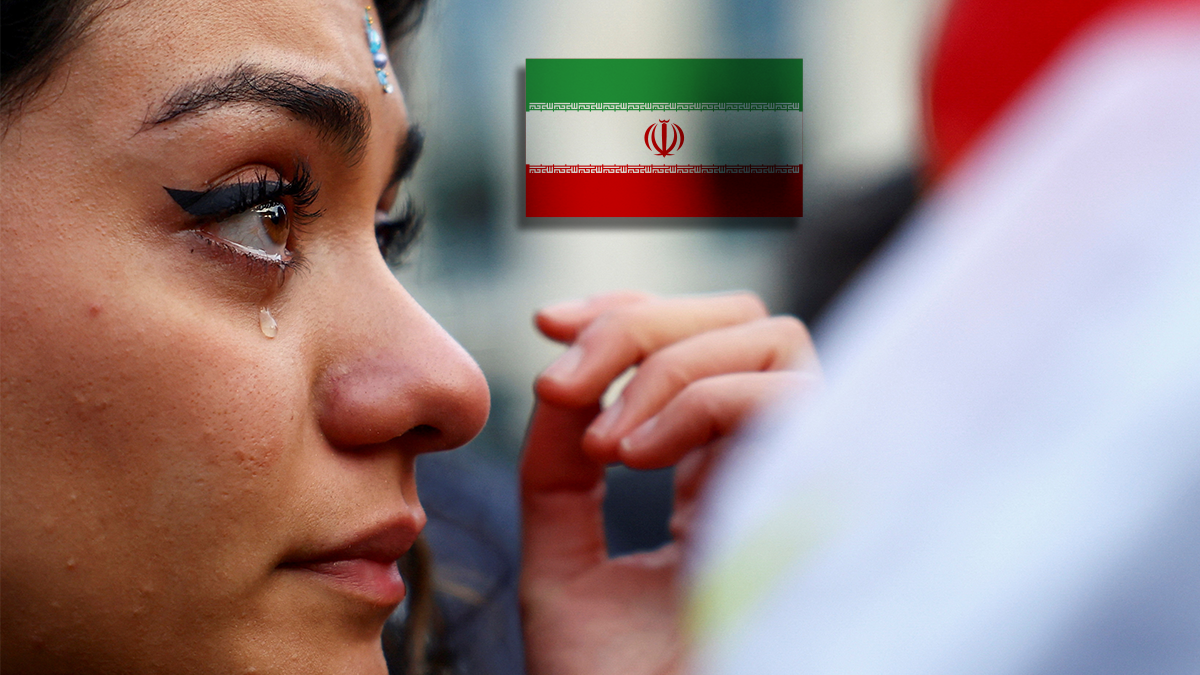
A woman cries in support of Mahsa Amini and Iran's women's movement
Reuters/ GZERO Media
They come from the capital city and from rural townships. Some wear makeup and jeans while others are clad in traditional robes though they leave their silver hair uncovered. They are all Iranian women uniting against the Islamic Republic’s oppressive regime.
Nationwide protests – that have spread to Iran's 31 provinces – broke out on Sept. 17 after Mahsa Amini, 22, a young Iranian woman, was allegedly beaten to death by the regime’s “morality police” for failing to fully cover her hair.
🌖A symbol like the moon🌖. Mahsa, a name of Persian origin that means like the moon, has emerged as a symbol of the ayatollahs’ oppressive system that sometimes sends women to “reeducation centers” for failing to comply with strict modesty requirements – sometimes with deadly consequences.
Iran has a long tradition of mass demonstrations, including those that led to the 1979 revolution and the country’s current system of clerical despotism. However, in recent years many of the country’s mass movements have had their momentum halted by brute government force. Will this time be different?
Not your grandmother’s revolution. There are several indications that this uprising is different from previous ones. Historically in Iran, anti-government movements were galvanized by an overlapping set of economic and political grievances. The 2009 Green Movement, for example, which saw millions of Iranians take to the streets in defiance of the totalitarian government, was moved to action after a rigged presidential election that saw the incumbent Mahmoud Ahmadinejad return to power despite conspicuous electoral irregularities.
Moreover, mass protests in 2019 over the hiking of fuel prices as well as broader economic grievances spread to more than 200 cities before being violently quashed in a crackdown known as “Bloody November.”
This time, however, the primary motivating factor is … sisterhood. Incensed by years of oppression at the hands of Iran’s morality police, Iranian women are leading the call for revolution. In most instances, women spanning the generational divide are risking their lives by tearing off their headscarves – and burning them – in a show of defiance against the gray-bearded ayatollahs who govern their bodies.
To be sure, there is an amalgamation of interests on the ground. Iranian men disillusioned with the dismal state of the economy and lack of political agency have joined protesters in calling for change. From 2012 to 2020, income per head shrunk by 68%, and around 40% of Iranian households now live below the poverty line.
Hamid Dabashi, a professor of Iranian Studies and Comparative Literature at Columbia University, says that while there are indeed economic undertones to these protests – pointing to crippling Western sanctions – “a serious component of the uprisings are middle class women who are highly educated, globally wired” and united by mutual loathing of a system that enforces mandatory veiling. Indeed, the movement is diffuse and leaderless – centered around one key demand: to let women choose.
Conversely, the 2009 Green Movement was led by old school reformist politicians with deep ties to the established regime. Mir Hossein Mousavi, a former prime minister during the Iraq-Iran war who adopted the traditional Islamic color of green for his campaign, co-led the protest movement along with Mehdi Karoubi, a Shia cleric, after the two ran in the 2009 presidential race. They were both placed in 2011 under house arrest – where they’ve remained for over a decade – for their roles in the Green Movement after emerging as key protest leaders jostling for power within a system they were deeply entrenched in.
But Dabashi says that being leaderless is not necessarily a bad thing. “We have had too many leaders,” in the past, he says, adding “that revolutions used to be on the level of epics that required a hero,” which could be distracting.
Still, the current dynamic of the movement means that the situation is much more fluid. “We don’t know what’s going to happen on the next page because there's a democratic distribution of characters,” Dabashi explains. As a result, “there’s no clear agenda, political program … or identifiable objective that in a week they can point to and say this is what the uprising achieved.”
Looking ahead. Iran’s security forces, including the notoriously brutal Basij paramilitary that’s part of the Islamic Revolutionary Guards Corps, are known for using coercive means to quash dissent. Already in recent weeks, there have been reports of at least 75 deaths.
But it’s one thing to crack down on a group of poor Iranians protesting high fuel prices. It is quite another to arrest or shoot women who are demanding change from across the generational spectrum. The regime can’t shoot millions of women who refuse to put their hijabs back on.
What happens next is anyone’s guess, but Dabashi says that things aren’t going backwards. “An epistemic shift has happened in terms of the partition of the relationship between the nation and the state,” he says, adding that “the ruling regime has now painted itself into a corner that if mandatory veiling disappears so will the Islamic Republic itself.”
The supreme leader and his regime has a time-tested approach for quashing dissent. Still, each confrontation with the Iranian people leaves the regime a little more bruised and battered.
Can Washington turn military pressure into a diplomatic strategy? Brett McGurk joins Ian Bremmer on the GZERO World podcast to discuss the Iran war, Houthi attacks, and how elections in Israel and the US could reshape the region.
Think you know what's going on around the world? Here's your chance to prove it.
Canadian Prime Minister Mark Carney is in Turkey on Thursday for talks with President Recep Tayyip Erdogan - the visit is the first by a Canadian prime minister.