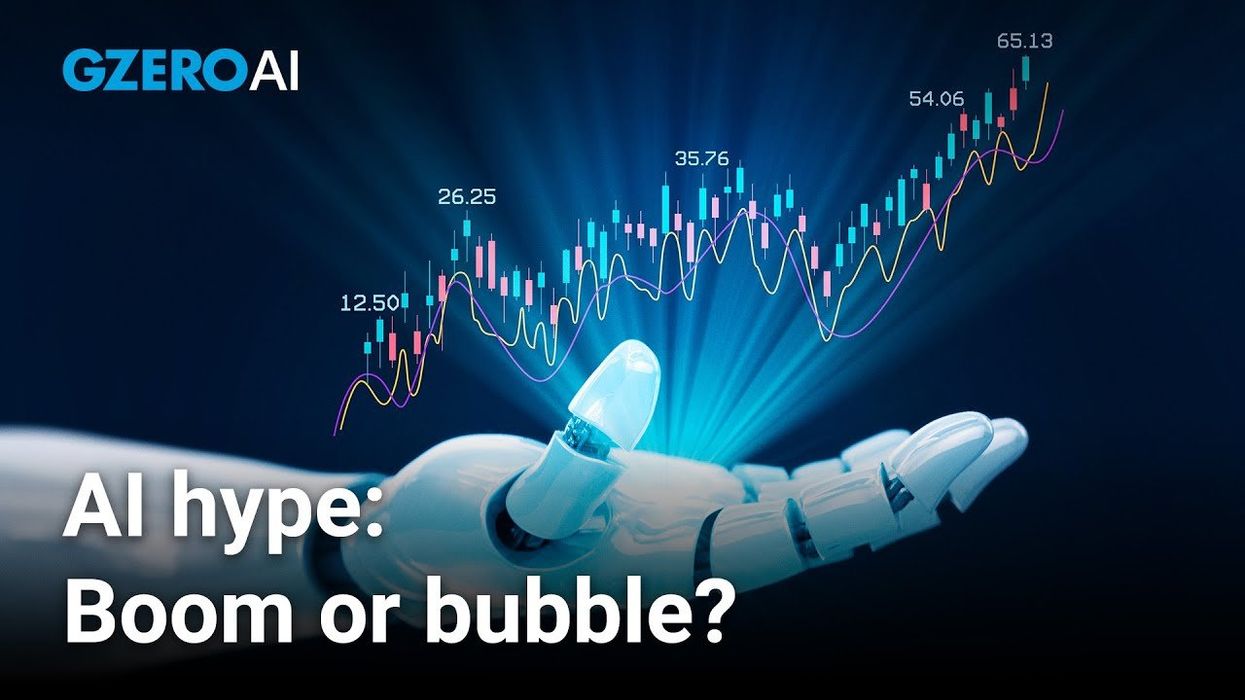
AI is turbocharging the stock market, but is it all hype?
July 16, 2024
Global Stage LIVE from United Nations WATCH REPLAY
GZERO AI is our weekly video series intended to help you keep up and make sense of the latest news on the AI revolution.
Presented by
In this episode of GZERO AI, Taylor Owen, host of the Machines Like Us podcast, explores how artificial intelligence is turbocharging the stock market and transforming our economy. With AI driving the S&P 500 to new heights and drastically boosting NVIDIA's stock, researchers predict a future where we could be 1,000 times wealthier. However, Owen raises critical questions about whether this rapid growth is sustainable or simply a bubble ready to burst.
So whatever your lingering skepticism of this current moment of AI hype might be, one thing is undeniable: AI is turbocharging the stock market and the economy more broadly.
The S&P 500 hit an all-time high this year, largely driven by AI. NVIDIA's stock jumped 700% since the launch of ChatGPT, at one point becoming the most valuable company in the world. And some researchers think this is going to get even crazier. They argue that we could see 30% per capita economic growth by 2100 because of AI. What this means is that in 25 years of 30% per capita growth, we would be 1,000 times richer than we are now.
But what are these wild predictions based on? Really comes down till human labor being replaced by AI. These economists argue that AI could replace humans and that machines could do all sorts of things that humans can't or things that we can already do much better. Perhaps more importantly though, humans aren't constrained by the number of humans we have in the workforce. We can scale labor in a way unconstrained by human capacity. This fundamentally changes, they argue, the core dynamics of the economy.
But these are still predictions, and they're wild speculations, and they're often being promoted by the very same people who will benefit the most from the hype around AI. There's just no good evidence at this point that these things are necessarily going to come to fruition. And even if this wealth is generated, this 1,000 times richer than we are now wealth, there's no guarantee how it's going to be distributed, who will get it, who will benefit and who won't. It's pretty clear that wealth is likely to trickle up to those that own and control these technologies, as they have in the past. It's also clear that those that are most precarious in the workforce will be the most vulnerable and likely the most harmed. This is almost certainly, if we're talking about machines replacing humans, going to be women and minorities who are overrepresented in the service workforce.
Some argue that UBI could be a solution to this, that we should simply take this excess wealth and distribute it to all of us so that we don't have to work. But there's a real problem here. People find meaning in their work. I recently spoke to Rana Foroohar, a global economic reporter for the Financial Times, and she made this case really powerfully to me that we derive meaning from work, and if you take that away, there are going to be serious political repercussions. We've already started to see these. Because of all of this, Rana thinks we're in a bubble. She thinks the economy simply can't run this hot for this long. It would be historically unprecedented, she argues, for this to go on for very much longer. But also the narratives she argues about why this economic growth is going to happen simply are too tenuous to support the economic growth that's being built on it. And this for her is a clear sign that we're in a bubble. When you have a single narrative that doesn't allow for any contradictions, this clear narrative of a certainty of a path that is supporting a huge amount of economic activity, that is the sign of a bubble.
Finally, she argues that economic growth is simply too concentrated. Too few people are seeing the benefits of this at the moment. These are the six or seven tech companies who are responsible for the bulk of the value being generated around AI. This concentration is not broadly good for society. If a tech bubble collapses though, we are all on the hook for it. Like any bubble, we as a society, our pension funds, our investments, our retirements, the rest of the economy are being floated by this bubble, so we need to think really carefully about how and when this deflates.












Keep up with what’s going on around the world - and why it matters.