Skip to content
Search

Latest Stories

News

Read the latest news from GZERO with insights on global events.

Presented by

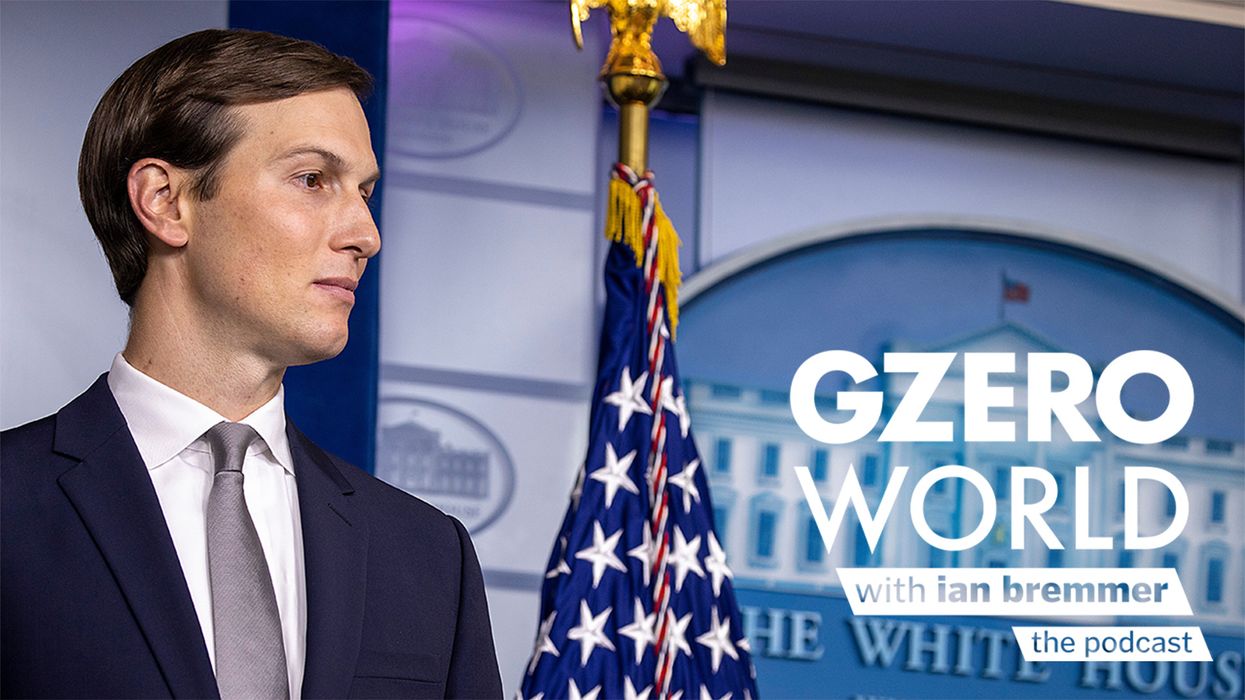
Jared Kushner in the White House - GZERO World with Ian Bremmer Podcast

Podcast: Jared Kushner on Middle East peace & pandemic in the US

Listen: President Trump's top advisor—and son-in-law—Jared Kushner joins Ian Bremmer on GZERO World.

Transcript

Listen: President Trump's top advisor—and son-in-law—Jared Kushner joins the GZERO World Podcast for an in-depth conversation with Ian Bremmer.

On the heels of a historic deal normalizing relations between Israel and the United Arab Emirates, Kushner discusses the latest development in a key mission of his tenure in the White House—moving closer to an elusive Middle East peace deal. Kushner also addresses the Trump administration's much criticized response to the COVID-19 pandemic and controversies surrounding President Trump's attack on voting by mail. He also previews future Iran and China policies should President Trump win a second term.

Subscribe to the GZERO World Podcast on Apple Podcasts, Spotify, Stitcher, or your preferred podcast platform to receive new episodes as soon as they're published.
Next Page

listen on:

More from GZERO World Podcast

What America got right–and wrong–in the post-9/11 era

The terror attacks of September 11, 2001 radically altered the course of American history. They reshaped our politics and sense of security, sending the country on a completely different arc—from wars in Afghanistan and Iraq to the sweeping expansion of the national security apparatus. 25 years after that fateful day, has America learned the right lessons or do we risk repeating the mistakes of the post-9/11 era? Former Defense Secretary Mark Esper joins Ian Bremmer on GZERO World to reflect on how 9/11 changed America and the biggest lessons from the last 25 years of US foreign policy.
Keep reading... Show less

9/11 was a dividing line in American history. Former Defense Secretary Mark Esper weighs in on what the country learned (or failed to learn) from the post-9/11 era.... More >

The lasting impact of 9/11 on US leadership

In this ‘ask ian,’ Ian Bremmer reflects on the 25th anniversary of 9/11, examining the long-term consequences of America's response to the attacks.

Keep reading... Show less

In this ‘ask ian,’ Ian Bremmer reflects on the 25th anniversary of 9/11, examining the long-term consequences of America's response to the attacks.... More >

Spain says Morocco knew about crossing into Ceuta, Trump makes promises to voters if GOP wins midterms, Zelensky looks to Canada to fill funding gap

Sánchez releases classified documents on Ceuta crisis

Spanish Prime Minister Pedro Sánchez’s government on Wednesday declassified documents showing that Morocco had knowledge of plans for a mass migrant crossing into the Spanish exclave of Ceuta days before it occurred. The disclosure may be an attempt to deflect some of the backlash Sánchez has faced over the surge of 70,000 people into the tiny North African territory, including mass protests, calls for his resignation, and criticism that his pro-immigration policies left Spain unprepared – all especially perpetuated by the far-right, anti-immigration party Vox that has been rising in the polls ahead of the 2027 election. But the release hasn’t taken the pressure off: critics of Sánchez are saying that the documents also show that some in Spanish intelligence also knew about the plans to cross the border. Both countries have blamed human traffickers and misinformation spread on social media for helping fuel the surge.

Keep reading... Show less

Spanish Prime Minister Pedro Sánchez’s government on Wednesday declassified documents showing that Morocco had knowledge of plans for a mass migrant crossing into the Spanish exclave of Ceuta days... More >

Terrorism fades as Americans’ top concern

The month after 9/11, terrorism was the most significant concern for Americans. In polling conducted by Gallup the following month – and just days after the invasion of Afghanistan –46% of Americans said terrorism was their top concern. At the same time, trust in government hit a three-decade high in 2001, buoyed by President George W. Bush’s decisive response to the attacks. When the US invaded Afghanistan in October of that year, 92% of Americans supported the decision.

Fast forward 25 years, the top problems have shifted away from terrorism – less than 1% of respondents ranked it their top problem in August 2026. Instead, the economy is increasingly on voters' minds as fuel and living costs skyrocket, driven by another US president embarking on a far less popular war in the Middle East.

Keep reading... Show less

Fast forward 25 years from 9/11, and the top problems have shifted away from terrorism – less than 1% of respondents ranked it their top problem in August 2026.... More >

GZERO Podcasts

The race to the Moon is back – but reaching it is only the beginning. Astronaut Chris Hadfield joins Ian Bremmer to explore how cheaper technology, private industry, and growing US-China competition... More >

Listen: What does global energy transition look like in a time of major geopolitical change, including rebalancing of trade? In this special episode of "Energized: The Future of Energy,” host JJ... More >

Creating artificial human retinas in zero gravity. Mining rare minerals on the moon. There seems to be no limit to what could be possible if we continue to take our more important industries to... More >

9/11 was a dividing line in American history. Former Defense Secretary Mark Esper weighs in on what the country learned (or failed to learn) from the post-9/11 era.... More >

In this episode of The Ripple Effect: Investing in Life Sciences, host Dan Riskin speaks with Patrick Horber, President of Novartis International, and David Gluckman, Vice Chairman of Investment... More >