
Podcast: Why Putin will fail: former Finnish PM Alexander Stubb
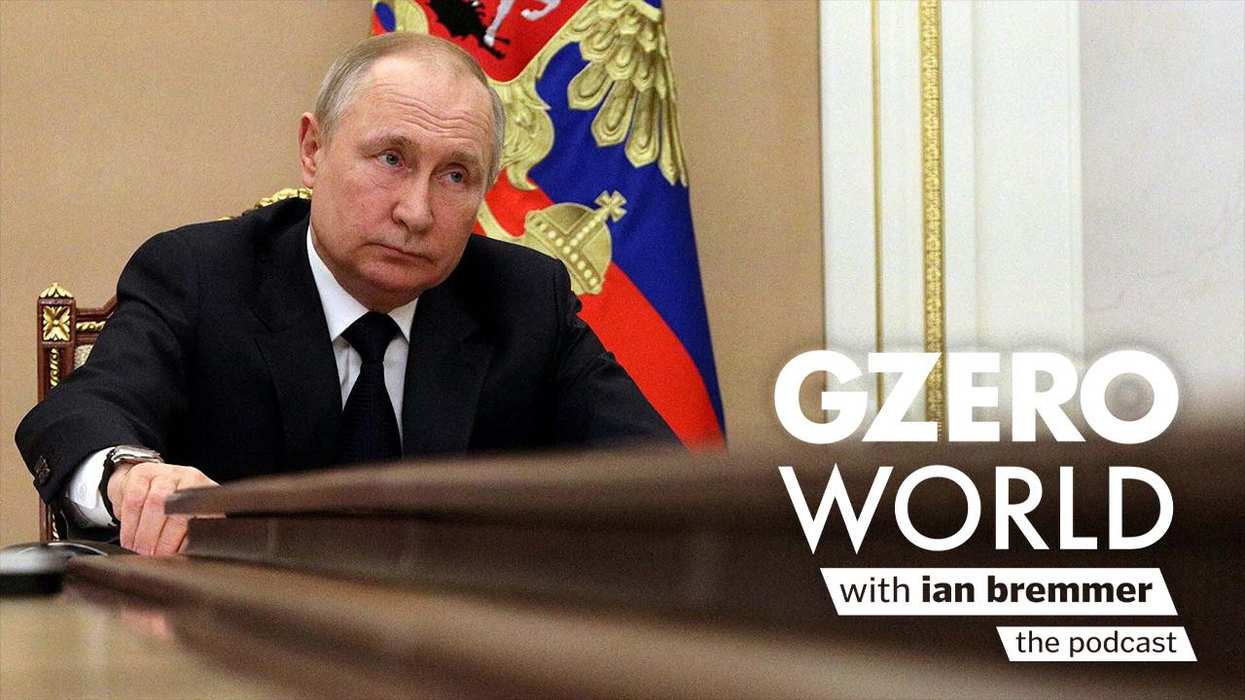
Listen: The ripple effects of Russia’s war with Ukraine are spreading well beyond Ukraine's borders. And one country watching very closely is Finland. On the GZERO World podcast, Ian Bremmer talks to former Finnish PM Alexander Stubb, who explains why his country has moved from neutrality to an open embrace of NATO. He believes Putin will ultimately fail at the three things he's trying to accomplish: annex Ukraine; push back NATO's borders to where they were during the Cold War; and prevent Finland and Sweden from joining the alliance.
TRANSCRIPT: Why Putin will fail: former Finnish PM Alexander Stubb
Alexander Stubb:
You have to remember that Putin has three aims at the moment. Number one, invade and annex Ukraine. Number two, push back the frontiers of NATO. And then number three, prevent Finland and Sweden from joining NATO. I'm afraid he's going to fail in all three.
Ian Bremmer:
Hello and welcome to the GZERO World Podcast. This is where you'll find extended versions of my interviews on public television.
I'm Ian Bremmer, and today, why Russia's invasion of Ukraine is about much more than just Ukraine. 13 other nations share a border with Russia, it's big, and Finland's is over 800 miles. Residents of that Northern European nation have no illusions that Putin will stop if he manages to take over Ukraine. And my guest today, former Finnish Prime Minister, Alexander Stubb, weighs in on the West's response to Russia so far, as well as Finland's unique role in the region and how likely his country is to join NATO. Let's get to it.
Announcer:
The GZERO World Podcast is brought to you by our founding sponsor, First Republic. First Republic, a private bank and wealth management company, understands the value of service, safety and stability in today's uncertain world. Visit firstrepublic.com to learn more.
This GZERO World Podcast is also brought to you by Visa. At Visa, we are committed to creating opportunities for small business owners. That's why we've created the Visa Economic Empowerment Institute, a digital platform dedicated to sharing research and fostering the open exchange of policy ideas designed to empower citizens, small businesses, and economies alike. Visit visaeconomicempowermentinstitute.org to learn more.
Ian Bremmer:
Alexander Stubb, Mr. Prime Minister, very good to see you. Thanks for joining.
Alexander Stubb:
Thank you. My pleasure.
Ian Bremmer:
I want to start just with whether you think the West, broadly, Europe, the United States, NATO, everyone, is doing as much as they should be doing right now to respond to the Russian invasion of Ukraine?
Alexander Stubb:
Well, I definitely think they're doing more than I ever expected us to do. I've never seen an onslaught of sanctions at the magnitude that we're seeing at the moment. Four waves of sanctions coming from the European Union, add to that sanctions from the United States. You look at the turnaround of German foreign security and defense policy, you look at 500 million euros' worth of armaments being sent by the European Union. So I never thought I'd see this day, but remember, crisis drive us forward.
Ian Bremmer:
When you look at what that all means for the future of Europe, how has Europe changed? And are any of these changes permanent in your view?
Alexander Stubb:
I think every change that happens in the European Union is permanent. You know how things go, integration in one area leads to pressure to integrate another one. So if we take the last three crisis which has driven change, one was the financial and Euro crisis, took four years to set up the European stability mechanism, banking union and so on.
Then we had COVID, took four months to set up the biggest rescue package in European history. And now we're seeing the realization of a European foreign security and defense policy, a thing that people just used to talk about now happening because of the Russian aggression in Ukraine.
Ian Bremmer:
Does that also include countries like Finland and Sweden? I mean, it's been quite startling to me to see the percentages of popular support for NATO that we've never seen in history from your country and from Sweden. Is that an inevitability at this point now?
Alexander Stubb:
Yeah, definitely. I guess two answers on that. The first one is that I think there seems to be some misunderstandings, especially about the Finnish position post Cold War. I mean, we were neutral during the Cold War, but it wasn't ideological neutrality, it was neutrality because of necessity.
Ian Bremmer:
No, it was imposed. It was imposed.
Alexander Stubb:
Exactly.
Ian Bremmer:
Yeah.
Alexander Stubb:
We had to. We had to. But when we had the chance to then join the European institutions where we really belonged like the European Union, we immediately did it and we forged a very close relationship with NATO.
Now, the second answer is I think the opinion polls in Finland on NATO, and people have to understand, they've reversed. They used to be 50% against, 20 in favor. Now they're 50 in favor, 20 against. And they're driven basically by what I call rational fear.
So there's this fear, what is Russia going to do next? And the rationality behind is, "Okay, we don't want to be alone anymore. We need to go into NATO." So I fully understand the reaction of the Finnish public and also of course the Swedish public.
Ian Bremmer:
I noticed also the reaction of the Russian government, the Foreign Ministry spokesperson saying that there would be both diplomatic and military responses, consequences from Russia if the Finns and the Swedes were to decide to take that step. How do you read that?
Alexander Stubb:
Well, we Finns are pretty calm, cool and collected, and our reaction is to say that, "Well, there's nothing new in that. We've heard it from Putin before. We've heard it from Sergey Lavrov before. Now we heard it from the spokeswoman of the Russian Foreign Ministry." And our answer is, "Well, I mean, we fully understand your take, but the truth is that we are a sovereign independent nation state and take our own security political decisions."
You have to remember that Putin has three aims at the moment. Number one, invade and annex Ukraine. Number two, push back the frontiers of NATO to where they were around the Cold War, so get Central and Eastern Europe out of NATO. And then number three, prevent Finland and Sweden from joining NATO. I'm afraid he's going to fail in all three.
Ian Bremmer:
Yeah, I was just about to say, as you're going through those, none of those, not only does it look like they're not going to happen, but indeed, Putin's position on all three arguably are likely to be materially worse because of this invasion. Do you agree with that?
Alexander Stubb:
Yeah, definitely. I mean, a lot of people talk about the rationality or irrationality of Putin. From his perspective, he's behaving very rationally, but the outcome is the exact opposite what he was trying to achieve.
So his vision is of a single historic Russia, bring in Belarus, Ukraine, perhaps a little bit beyond, be the great leader with a legacy of Ivan the Terrible, Peter the Great or Stalin. And in one week, in seven days, he basically achieved all the opposite.
Number one, he wanted the Russification of Ukraine. Well, it's about as Europeanized at the moment, and they ain't going back. Number two, he wanted an ununited European Union, never seen it more united. He wanted to destroy the Transatlantic Partnership. Well, it's Transatlantic 2.0, and then some. Then he wanted to destroy NATO. Well, NATO now has a purpose again.
And on top of that, he wanted to see Finland and Sweden out of NATO, and with his actions, he's probably caused a permanent change in public opinion, and I think the train has left the station, Finland is moving toward full NATO membership. It's not going to happen today, it's not going to happen next week, but it will eventually happen.
Ian Bremmer:
And on top of all of that, his economy's falling apart too. So I mean, given all of that, do you think it is incumbent on the West or smart for the West to try to find some kind of avenue for climbdown for Putin?
Alexander Stubb:
Well, I had the opportunity to mediate peace in Georgia in 2008. I was Finnish Foreign Minister at the time and Chairman of the OSCE. So Bernard Kouchner, the Foreign Minister of France, and I went into Belize and then later to Moscow to broker a five piece or five point ceasefire agreement. That was easy to do. We did it, well, easy and easy, but we did it in five days.
In this particular case, we are beyond the point of no return. Will there be an escape route for Putin? I would argue no. I mean, it's impossible. The only thing that he understands is power and force, I'm afraid. He's not going to back down.
So what we need to see eventually, I hope, is regime change happening from the inside. The problem of course there is that historically when there's regime change in Russia, you get the hardliners in first. That's what happened in 1991. So we don't want that. It's after all a country that does have nuclear weapons.
So to try to get some kind of a pathway out for Putin, he can't lose face in front of his own. So therefore, it's going to be very difficult to find a solution on that.
Ian Bremmer:
Now, a lot of people say that he can't lose face, but at the same time of course, Putin completely controls the narrative domestically, much more so than any American or European president. He's gotten rid of all the Western media. He's gotten rid of all the local Russian independent media. Can't he sell whatever story he wants to sell? I mean, there are a lot of Russians right now that believe that Ukraine engaged in acts of genocide against Russians in the Donbas, something that is obviously ridiculously untrue.
Alexander Stubb:
Yeah, I mean, I guess the starting point here is to understand that Russia has always, ever since the Romanovs came in, the Tsar family, after an era of unrest and unpeace, if you will, they've been led by a strong leader. And the system is very hierarchical. You have the leader and then after that you have sort of a pyramid of his or her princes. They sort of make sure and back up that the leader can do whatever he wants to.
So the narrative in Russian history has always been that, "The rest of the world is out to get us," so that the Russia, the biggest country in the world geographically is somehow surrounded by enemies. And throughout history, the enemies have varied from the Mongols to the Japanese to the Europeans to the Americans and right now to NATO.
So yeah, I'm sure he can push that narrative, but at the same time, we do live in a connected world, and at the end of the day, Russians will get the information in. Right now they don't have it. The narrative is crude.
Final point on that, remember that for Russia, there are three words for truth, and one of them is tactical truth, "pravda." And that basically means that you can give not only a white lie, but a blatant lie as long as it's tactically useful for the good of the whole, in other words, Russia. That's why the Russians are now believing in the propaganda that they hear.
Ian Bremmer:
When you think about where the world is going to be in the next 10 years, compared to the last 30, how dramatically different does it look for the average European?
Alexander Stubb:
Remember, Finns are not overdramatic. And quite often I say that we human beings have a tendance to do three things. One, we over-rationalize the past. Two, we overdramatize the present. And three, we underestimate the future.
So when you ask me to look into the future in a non-dramatic fashion for the next 10 years, my answer is that this is the 1914, 1939, 1989 moment of our generation. And by that I mean to say that it is the end of the Cold War, but what we don't know, is this a step back into a world that used to exist during the Cold War or are we able to detach ourselves from escalation from military conflict and move on?
What I'm sure about in the next 10 years is that if Putin is there, Russia will be utterly, completely and fully isolated. The sanctions are there in the economic field, in finance, in energy, in transport, in sport, in culture, in anything that you can imagine. So we're basically getting this enormous North Korea or Iran, or South Africa when they had sanctions on. That is the future that I predict for the next 10 years from a Western perspective.
Ian Bremmer:
Now, I'm glad you said from a Western perspective, because of course, if we look at the next 10 years, the largest economy in the world is likely to be China. And China's view on Russia is not at all to isolate them, but rather to do more business, rather for them to be more dependent economically, technologically, certainly in terms of energy sale.
I mean, how much do these old analogies even remotely apply when the largest economy in the world and a lot of other developing countries, the Indians, I mean, the Gulf States through not taking Biden's call but talking to Putin in the last week. I mean, this is not a world where the Americans and Europeans are calling the shots in the way that it was in those previous sort of tipping point geopolitical moments that you mentioned.
Alexander Stubb:
Yeah, sure. Perhaps two observations. One, a global one, and then second one in China. The global one is that we in the West, whatever that means, let's include, say, Japan and Australia, New Zealand, South Korea, South Africa in that, we in the West have to understand that this is not about West versus Russia, right? It is more about the global institutional order, the liberal order.
What is the resilience of the international institutions that were created in the post World War II era? Whether they came through Bretton Woods in the form of the IMF or the World Bank, whether it's the UN, NATO, the EU, the WTO, you name it. What do we do with those institutions? How do we pivot them to represent what the world is today? Why do we have a security council in which Russia is still a member? Okay, they have nuclear weapons, I understand, but why don't we have other countries there?
The second point is to say on China. Listen, China's probably right now thinking two things, "One, we wanted to focus on internal affairs. We wanted to focus on our party conference in October, November, the continuation of Xi Jinping, dealing with COVID, perhaps turning economically a little bit inward, et cetera, et cetera."
Then at the same time, the sort of slightly cheeky side is saying, "Well, this sort of instability in Europe is not necessarily a bad thing, because right now the focus is not so much on the tension between the US and China, it's more on the tension between Russia and the US."
Then my final point on this is to say, do not overestimate the appetite for China to deal with Russia. They might want to use Russia as a little sort of card in a game, in the sense that the Russian economy is, it's now about 2, 2.5% of the world economy, so we're talking Netherland, Spain type of size. In the future, it's going to be smaller. The only thing that it has is natural resources, it's got geographic size, and then it's got military power.
So the natural business partner, China, is not Russia. And on top of that, with value change, with the Belt and Road Initiative, it's a hell of a lot more dependent, China is, on Europe and the United States than it is on Russia.
Of course, if you look at it from pure sort of Mearsheimerian power politics, you can say that, "Yes, China can now play the game." And I'm sure they will, but don't think for one minute that the big partnership in the future is going to be China and Russia.
Ian Bremmer:
Alexander Stubb, I really appreciate your willingness to under-dramatize the future of this conflict for everyone out there. It's a great service, and I want to thank you for joining us today.
Alexander Stubb:
My pleasure. Thanks a lot. Thanks for having me.
Ian Bremmer:
That's it for today's edition of the GZERO World Podcast. Like what you've heard, come check us out at gzeromedia.com and sign up for our newsletter, Signal.
Announcer:
The GZERO World Podcast is brought to you by our founding sponsor, First Republic. First Republic, a private bank and wealth management company, understands the value of service, safety and stability in today's uncertain world. Visit firstrepublic.com to learn more.
This GZERO World Podcast is also brought to you by Visa. At Visa, we are committed to creating opportunities for small business owners. That's why we've created the Visa Economic Empowerment Institute, a digital platform dedicated to sharing research and fostering the open exchange of policy ideas designed to empower citizens, small businesses, and economies alike. Visit visaeconomicempowermentinstitute.org to learn more.
Subscribe to the GZERO World Podcast on Apple Podcasts, Spotify, Stitcher, or your preferred podcast platform, to receive new episodes as soon as they're published.