Trending Now
We have updated our Privacy Policy and Terms of Use for Eurasia Group and its affiliates, including GZERO Media, to clarify the types of data we collect, how we collect it, how we use data and with whom we share data. By using our website you consent to our Terms and Conditions and Privacy Policy, including the transfer of your personal data to the United States from your country of residence, and our use of cookies described in our Cookie Policy.
{{ subpage.title }}
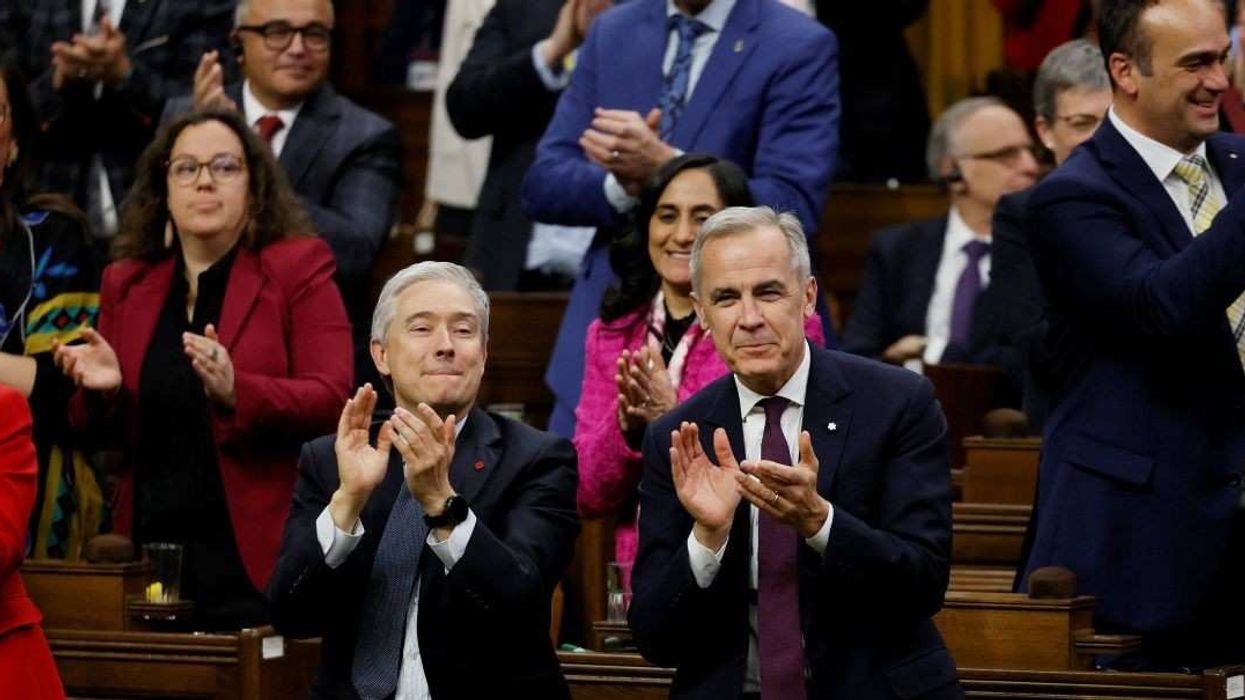
Canada's Prime Minister Mark Carney and Minister of Finance Francois-Philippe Champagne applaud after a confidence vote on the federal budget passes in the House of Commons on Parliament Hill in Ottawa, Ontario, Canada November 17, 2025.
Canada’s government survives budget vote
Canada’s six-month old minority government survived a de facto confidence vote on its first budget yesterday, avoiding the possibility of a Christmas election. Carney now has a mandate to run the second-highest deficit in Canadian history, at CA$78.3 billion, in order to implement wide-ranging industrial policy that includes infrastructure, resource development, and defense. It’s a blow for the opposition parties, most notably the Conservatives, whose leader Pierre Poilievre is facing a leadership review vote by his party at its annual convention in January.
What will the budget mean for Canada? Over the next five years, the government will invest CA$115 billion in infrastructure spending, including electricity-grid upgrades and high-speed rail, as well as in major projects, including port infrastructure, LNG plants, and to support critical minerals development projects that could challenge China’s dominance in the sector. It will spend CA$25 billion on housing, a major election issue, as well as an extra CA$81.8 billion on defense. A “Buy Canadian” procurement regime will steer federal contracts toward domestic suppliers for all these engagements.
But the plan comes with an average CA$64.3 billion annual deficit for the next four years, double what had been projected by the previous government. According to the Fitch ratings agency, Canada’s general government-debt-to-GDP ratio will rise to 91.8% in 2026 and 98.5% in 2027, compared with 88.6% in 2024 and nearly double its AA rating median of 49.6%. To counter the fiscal pressure, the budget promises to cut 10% of public service jobs to balance the government’s operating expenditures, but capital spending will still have Ottawa in the red.
Those factors made the budget unpalatable to both the right-wing Conservatives and the left-wing New Democrats while two other smaller parties, the Bloc Quebecois and the Greens, refused to support it due to its failure to increase Old Age security payments and its removal of the federal emissions cap on Canada’s oil and gas industry.
So then how did the budget pass? Carney’s government was three seats shy of a majority when the bill was introduced on Nov. 4. That same day, however, a Conservative MP, Chris d’Entremont, crossed the floor to the Liberals, and a day later, another Conservative, Matt Jeneroux, announced he would resign his seat in the spring, ostensibly for family reasons, amid rumours that he was also considering joining the government.
That left Carney still in need of two crucial votes, or a combination of votes and abstentions. He got the support of Elisabeth May, leader of the Green Party, in exchange for a promise to meet Canada’s climate targets in the Paris Agreement to reduce greenhouse gas emissions by 40-45% below 2005 levels by 2030, though it is not clear how that will be achieved with the new energy investments in the budget. Four opposition MPs then abstained, two each from the Conservatives (Jeneroux, and another with serious health issues) and the New Democrats (one whose local mayors and Indigenous leaders did not want an election, and another who saw benefits in the budget for her riding). This allowed the budget to pass by a vote of 170 to 168.
Where does this leave the opposition? The drama has weakened Conservative leader Poilievre. Many MPs were already unhappy with the party’s election defeat in April, blaming Poilievre for failing to pivot to the issue of opposing US President Donald Trump. The Conservative leader also lost his own seat and had to win a seat in a by-election in order to return to Parliament in September.
But the biggest problem in the Conservative Party is governance. In the wake of the budget floor crossing, Poilievre and his advisors reportedly threatened MPs to prevent further defections, leading one to liken their style to that of “the Sopranos”. This could spell trouble for Poilievre at an upcoming Conservative leadership review in January, required when the party loses an election: a score under 80% could severely undermine his ability to remain leader.
At the other end of the political spectrum, the NDP are fighting for relevance after the 2025 election reduced them to seven seats and saw their leader resign. The party is voting to choose a new leader in March 2026, making the prospect of an election now without a permanent leader an unappealing prospect. However, the decision by two members to abstain revives bitter memories of the party’s deal to prop up the previous Liberal government, which angered many members and became a factor in the New Democrats’ defeat.
How stable is the government?
With the budget passed, the Liberals don’t need to worry about another confidence vote until the fall of 2026. But nothing prevents the government from going to the polls at any time, if it thinks it could be to its advantage. The longest a government can stay in power in Canada is five years, but the average lifespan of a government without a locked-in majority of Parliament is about two years. The timing of the next election could hinge on many factors, including striking a trade deal with Trump, the state of the Canadian economy, and the strength – or weakness - of opposition leaders.
Joe Biden starts to campaign on AI
On May 8, Joe Biden spoke at Gateway Technical College in Racine, Wisconsin. The president was bragging.
Six years after his predecessor, Donald Trump, visited the same city to boast of Taiwanese tech company Foxconn’s $10 billion plan to bring a LCD manufacturing plant to Racine — that never materialized — Biden chose the same site for a new high-tech manufacturing project of his own. Microsoft will invest $3.3 billion to build a new data center to support artificial intelligence, a project that the company says will bring 2,000 permanent jobs and 2,300 union construction jobs to Wisconsin.
It’s good business, and better politics. Wisconsin is an important swing state for Biden in his forthcoming election against Trump. This latest announcement seemed to mark a moment where Biden accepted that AI is going to be an important part of his presidential legacy — and that it’s a record he should run on.
Right place, right time
OpenAI ushered in the generative AI revolution with ChatGPT midway through Biden’s first term. Silicon Valley rushed to develop it, Wall Street rushed to fund it, and governments around the world rushed to regulate it. Biden was in just the right position to reap the political rewards.
The US hasn’t passed comprehensive regulation to rein in AI, lagging behind its European counterparts in that regard, because it would require Congressional action. Instead, Biden secured voluntary commitments from the top AI companies to reduce the risks of their technology and issued a sweeping executive order dictating that every federal agency and department needs to assess and mitigate the risks AI poses, and how they can safely use it.
Beyond that, AI has become a focus of Biden’s industrial policy and export control measures, both of which have major implications for foreign policy and national security. Microsoft's investment also comes mere weeks after the Biden administration helped orchestrate the PC giant’s $1.5 billion investment in the Emirati tech giant G42, which pledged to restrict ties with China in favor of working with US tech firms.
Federal dollars pour into AI
The Microsoft data center was one in a series of chest-pounding announcements from the Biden administration, which has used funds from the CHIPS and Science Act to incentivize tech infrastructure firms to build in the United States. Taiwan Semiconductor Manufacturing Company will get $6.6 billion to invest a total of $65 billion to expand its chip fabrication complex in Phoenix, Arizona. Samsung will get $6.4 billion to pour $45 billion into its Texas facilities, and Intel will be granted $8.5 billion to construct and expand facilities in Arizona, Ohio, New Mexico, and Oregon.
AI wasn’t necessarily top of mind when the CHIPS Act passed in 2022, said Scott Bade, a senior analyst in Eurasia Group’s geo-technology practice, but it’s become the focus of the government’s efforts to nationalize chips and data centers.
“If you look at the political motivations for the Chips Act, a big part of that was the auto industry not having access to chips during the pandemic,” Bade said. Most of those were so-called legacy chips, not the high-powered graphics processors needed for AI, but the investments and legislation was already in place by the time AI became the hot topic in consumer and military tech.
The US has an advantage over rival China when it comes to artificial intelligence technology, but also the chips and chip-making facilities necessary to train and run powerful AI applications. Not only are many of the most important AI chipmakers — such as Nvidia, AMD, and Intel — American firms, but important non-US infrastructure firms are subject to US export controls because they rely on small parts made in America. The Biden administration has ramped up export controls to give the US an economic and technological advantage over China. And don’t forget the military side — global powers are looking to AI to super-charge their weaponry.
The election looms
AI lets Biden make some important claims in his rematch against Trump, including:
- American companies are leading the world on AI
- Multinational firms are investing in US facilities
- They’re bringing high-tech manufacturing jobs to the US
- And the US is keeping China at bay in the AI space
Not all of those arguments will resonate in retail politics, but Arizona and Wisconsin, where new facilities are popping up, are key swing states looking for good union jobs. In Wisconsin especially, Biden will make the case that he’s delivering what Trump couldn’t.
“The fact that you have a fab in a major swing state that helped him win last time and also has an important Senate race — that's not a coincidence,” Bade noted.
Speaking in Wisconsin, Biden barely mentioned technology, let alone artificial intelligence. Instead, he focused on delivering where Trump could not.
“During the previous administration, my predecessor made promises, which he broke more than kept, left a lot of people behind in communities like Racine,” Biden said.
Artificial intelligence might not be the snazziest talking point for retail politics, but it’s bound to be a major undercurrent — even when it’s not mentioned explicitly.