News
A dangerous game for “Putin’s Chef”
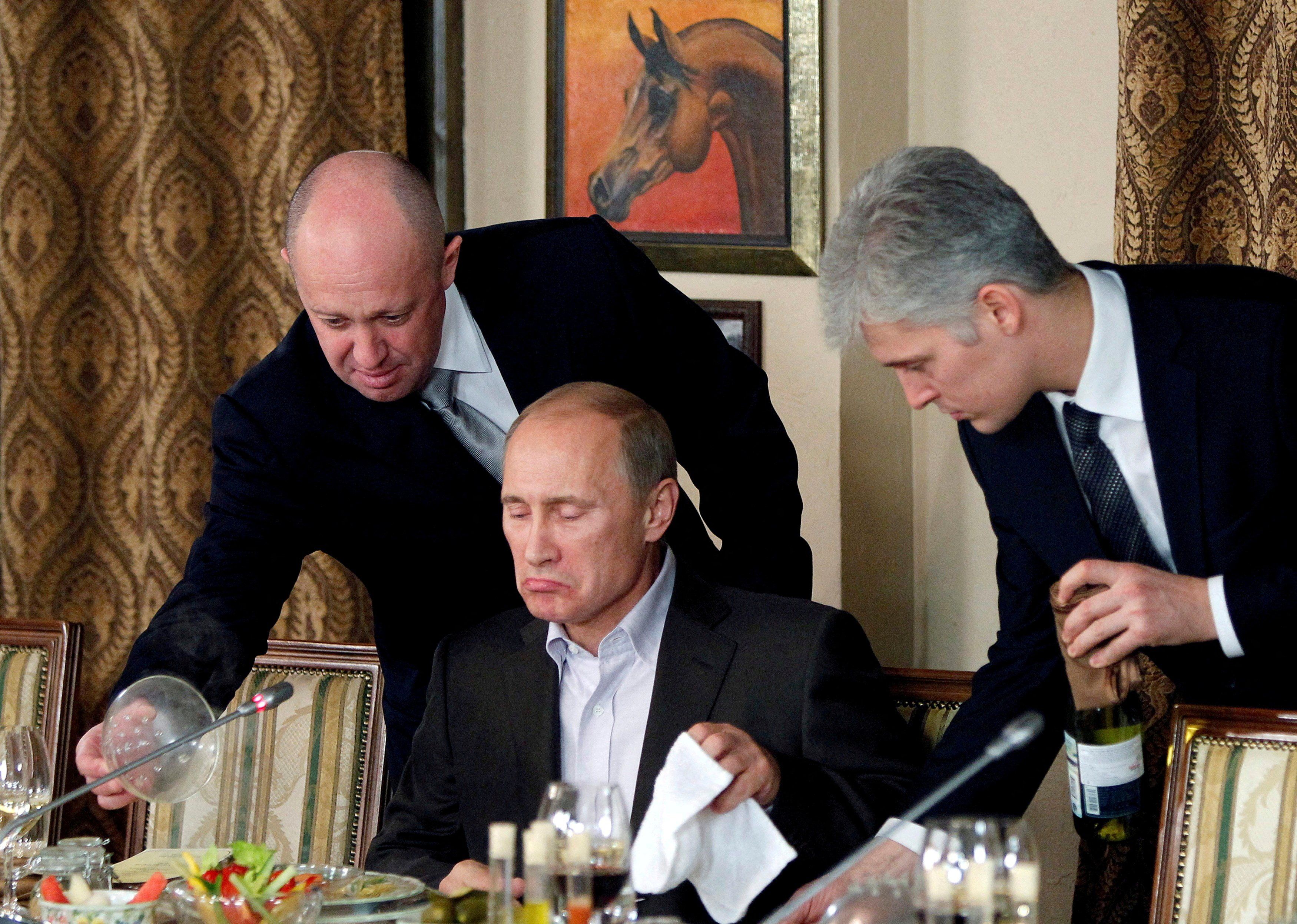
Yevgeny Prigozhin, left, serves Vladimir Putin dinner at a Moscow restaurant in 2011.
Reuters
In November, we profiled the uber-controversial Russian mercenary chieftain, Yevgeny Prigozhin, a man once determined to remain in the shadows who, since Russia invaded Ukraine, seems eager to become the war’s most famous man.
Who is this guy? In the Soviet Union’s dying days, Prigozhin spent nine years in prison on robbery and fraud charges, and after his release, he opened a profitable hot dog stand in St. Petersburg. His business then expanded into catering, which allowed Prigozhin to meet wealthy and well-connected people for whom he could do (possibly criminal and highly dangerous) favors. He was eventually introduced to Vladimir Putin – earning the nickname “Putin’s chef” – who rewarded Prigozhin’s loyalty with Kremlin catering contracts.
In 2014, the enterprising Prigozhin spotted an opportunity to move full-time into the business of violence by forming the Wagner Group, a private militia named after Hitler’s favorite composer. In 2016, profits from Wagner and other projects helped him form a troll farm to try to manipulate US public opinion via cyberspace ahead of US elections, bringing him a higher level of scrutiny from US law enforcement.
But it’s the Wagner Group’s role in Ukraine that has brought him to a new level of prominence – and now leaves him in a potentially precarious position with the Kremlin. Prigozhin has repeatedly claimed that Wagner, which he owns, is responsible for important battlefield advances while the Russian Defense Ministry remains embarrassingly and dangerously incompetent.
That he feels free to make these comments and hasn’t yet been punished by the Kremlin suggests Prigozhin has some degree of protection from Putin or someone close to him. But how long is his leash? Tatiana Stanovaya, writing for the Carnegie Endowment for International Peace, warns that “Prigozhin is still only acting as a private individual. His relationship with the state is informal, and therefore fragile, and could end without warning.”
The Institute for the Study of War, a Washington-based military think tank, has reported that Prigozhin appears to have overplayed his hand in recent weeks. The Kremlin, according to ISW, is “continuing to dim Prigozhin’s star by depriving him of the right to recruit in prisons and by targeting his influence in the information space.” It also reports that a Wagner-affiliated blogger has “obtained a document that outlines rules for covering the war in Ukraine with explicit requirements to refrain from mentioning Wagner and Prigozhin in the media.”
Prigozhin has used friends in Russian media to push back against speculation he’s on the outs with Putin, but he appears to be playing an increasingly dangerous game.
Can Washington turn military pressure into a diplomatic strategy? Brett McGurk joins Ian Bremmer on the GZERO World podcast to discuss the Iran war, Houthi attacks, and how elections in Israel and the US could reshape the region.
Think you know what's going on around the world? Here's your chance to prove it.
Canadian Prime Minister Mark Carney is in Turkey on Thursday for talks with President Recep Tayyip Erdogan - the visit is the first by a Canadian prime minister.