Skip to content
Search

Latest Stories

Hard Numbers

Hard Numbers: Zelensky wants longer security guarantee, Foreign stocks outperform Wall Street, Israel recognizes Somaliland, Nepal scraps waste scheme, Bukele ready for another decade

​Ukrainian President Volodymyr Zelenskiy listens to US President Donald Trump at the Mar-a-Lago club, in Palm Beach, Florida, USA, on December 28, 2025.

Ukrainian President Volodymyr Zelenskiy listens to US President Donald Trump, after Trump said that Russian President Vladimir Putin expressed willingness to help Ukraine "succeed," during a press conference at the Mar-a-Lago club, in Palm Beach, Florida, USA, on December 28, 2025.

REUTERS/Jonathan Ernst
Make us preferred on Google

50: Ukrainian President Volodoymyr Zelensky said he wants a 50-year security guarantee from the United States, far longer than the 15-year guarantee that US President Donald Trump reportedly offered. A peace agreement still looks unlikely, for now. What’s more, Russia accused Ukraine of attempting a drone strike on one of President Vladimir Putin’s residences, which Kyiv denied.


29%: Despite the occasional stumbles, US financial markets have long been the envy of the world. Not so in 2025: an index of non-US stocks grew 29%, roughly 12 points higher than the S&P 500. It’s the biggest gap since 2009. Breakthroughs in AI in China, combined with concerns over the Trump administration’s tariff policies, helped drive the divergence.

1: Israel became the first country to recognize Somaliland, an autonomous region of Somalia that broke away from the East African country 30 years ago. The move comes after Israel reportedly contacted Somaliland in March as a potential destination for Palestinians uprooted by the Gaza war. Somaliland’s position is also strategic for Israel: it sits across from Yemen on the Gulf of Aden, and could be a useful staging ground for possible operations against the rival Iran-backed Houthis. For an explainer on Somaliland, watch this video.

10: El Salvador’s President Nayib Bukele says he’s open to staying in his role for another ten years. Bukele, who has already gotten the country’s top court to strike down term limits, is immensely popular – both at home and elsewhere in Latin America – for his ferocious crackdown on gang violence and crime. But activists and critics warn he is undermining democratic institutions and violating human rights.

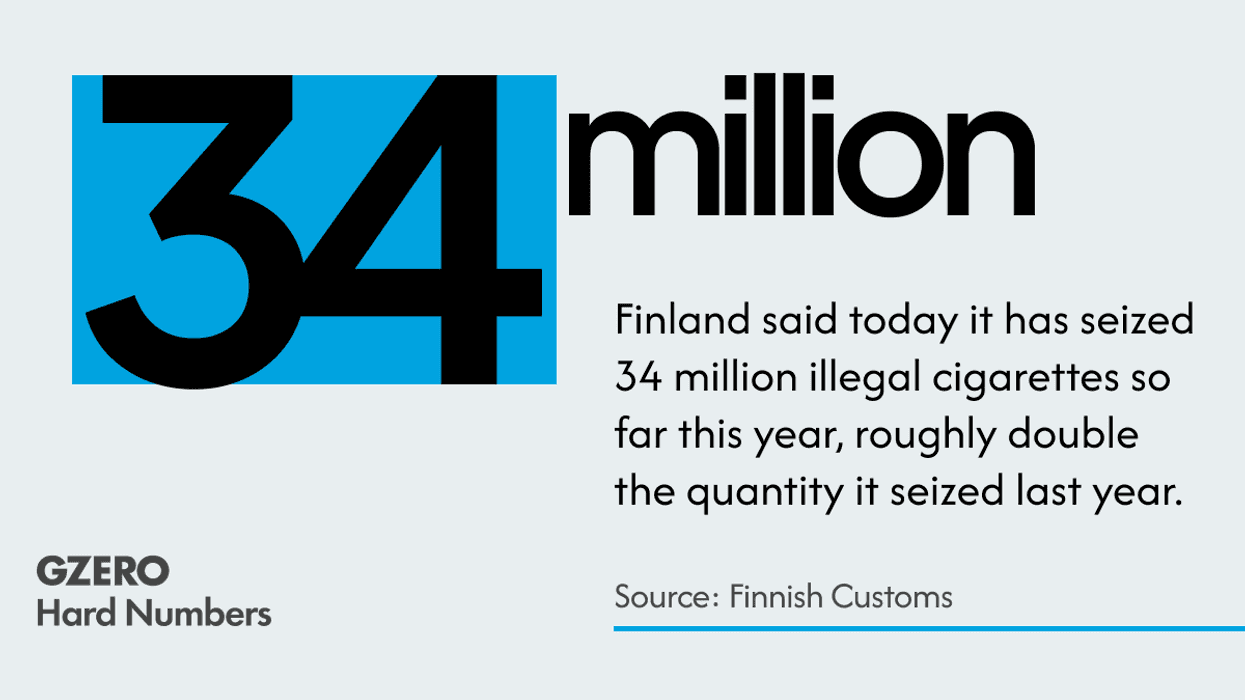
$4,000: In a bid to cut down on the estimated 50 tons of garbage on Mount Everest, Nepalese authorities introduced a scheme in 2014 requiring climbers to pay a $4,000 deposit, refundable only if they brought at least 8 kg (18 lbs) of rubbish down with them. However, the authorities are now scrapping the scheme after it failed to show any results. What a waste of time…


More For You

Ebola’s economic side effects
Natalie Johnson
In addition to the health concerns from the Ebola outbreak, the UN is sounding the alarm on a potential development crisis in Africa sparked by the disease. The intergovernmental body warns that it could cost billions of dollars of the continent’s GDP, and that roughly 328,000 jobs stand to be lost if the disease spreads to countries like Rwanda [...]
The EU steels itself for tariffs
Farida Dowidar
The trade bloc is also reducing its quota of tariff-free steel imports, as trade tensions mount with Beijing. The EU’s goal is to reduce its near-$400 billion annual trade deficit with China. However, the move could hurt other steel exporters with whom the EU has solid relations, including the UK, Ukraine, and Japan. Brussels isn’t the first to [...]
Sri Lanka launches drones against… mosquitoes
Farida Dowidar
Sri Lanka is facing one of the worst outbreaks of the mosquito-borne dengue virus in years. Amid energy shortages sparked by the war in Iran, dengue cases are straining hospital resources. In a bid to eliminate mosquito breeding grounds, the Sri Lanka Air Force has launched drones to detect sites where the insects breed across the country’s [...]
Mass layoffs inbound at Volkswagen
This is not Fahrvergnügen. The company is set to axe one-sixth of its work force. The move reflects the tough fortunes of Germany‘s auto sector, which is under pressure from the flood of lower-cost Chinese car exports, as well as the effects of the Iran war and US tariffs. [...]