January 22, 2026
As artificial intelligence reshapes the global economy, Africa’s AI future is becoming a test case for whether ambition will be matched by investment, or filled by default.
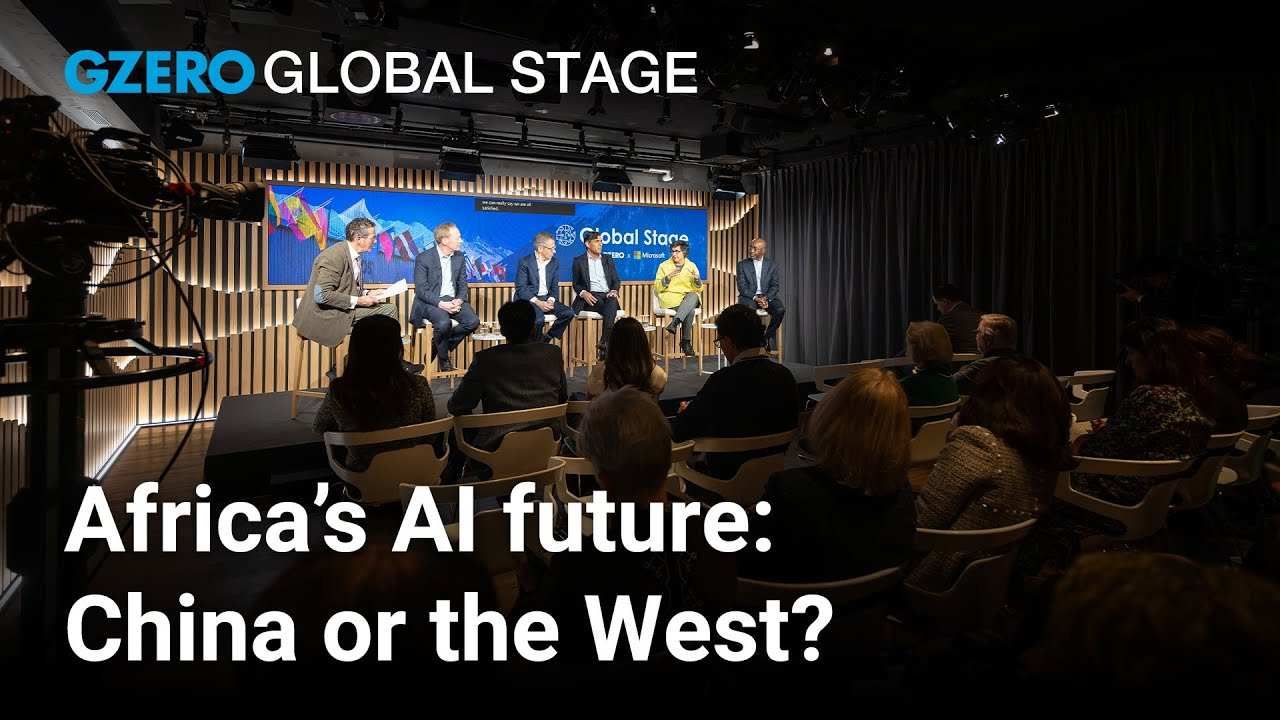
In a GZERO Media Global Stage livestream from the 2026 World Economic Forum in Davos, an all-star panel delivered a blunt warning: without serious capital, the next phase of AI infrastructure in Africa will follow the same path as past telecommunications booms, led by China.
“Let’s not treat AI as the magic bullet for everything,” said Strive Masiyiwa, Founder and Executive Chairman of Cassava Technologies. The real challenge, he argued, isn’t technology; it’s investment. And if Western governments and institutions hesitate, they shouldn’t be surprised by the outcome. “People shouldn’t complain when China does the investment,” Masiyiwa said. “If you don’t invest, Africa will turn to where it can get that investment.”
Brad Smith, Vice Chair and President of Microsoft, agreed, and laid out what could change the equation. African governments, he said, can help catalyze private capital by creating demand themselves. “The more the public sector moves to the cloud and uses AI, they create the demand that will energize more free market investment,” Smith explained.
Scale is key. Rather than fragmented national efforts, Smith argued that aggregating demand across regions, for example, building a data center in Kenya that serves multiple East African countries, could unlock the capital and energy needed to power AI at scale. Without that coordination, he warned, market failures will decide the outcome. “At the end of the day, the capital therefore, will flow from China,” Smith said, describing a Belt and Road–style expansion into AI infrastructure, chips, and data.
The panel widened the lens further. Ian Bremmer, President and Founder of Eurasia Group and GZERO Media, noted that China is already investing across the full ecosystem, including in universities, energy, and infrastructure, positioning itself for long-term advantage. Former UK Prime Minister Rishi Sunak added that AI diffusion is already happening through cheap, open-source models, raising urgent questions about what alternatives the West can offer countries that cannot afford proprietary systems.
And the consequences of inaction extend well beyond AI. Arancha González Laya, Dean at the Paris School of International Affairs, pointed to electricity access as a foundational example. European governments, development banks, foundations, and the private sector are already mobilizing to bring power to hundreds of millions of people in Sub-Saharan Africa. “Where is the US in all of this?” she asked. “Nature has a horror of the void. If they leave the space empty, someone will fill it.”
The message from Davos: Africa’s AI future is not predetermined by technology, but by who shows up, who invests, and who builds the infrastructure first.
This clip is drawn from a GZERO Media Global Stage panel discussion recorded at the 2026 World Economic Forum. To watch the full conversation, visit gzeromedia.com/globalstage.
The Global Stage series, presented by GZERO Media in partnership with Microsoft, convenes leaders from government, business, and civil society at major international forums to examine the critical issues at the intersection of technology, politics, and society, and to explore how global cooperation can deliver solutions in an era of accelerating change.
More For You
Could Chinese AI give Europe an edge? | The Debrief with Heather West
Could China give Europe a shortcut in the AI race?
Europe has struggled to build models that compete with American and Chinese rivals. But Chinese models that companies can download, customize, and run themselves could offer another way forward—with more control over data and security.
Most Popular
- YouTube
With the midterms just weeks away, Democrats are hoping for a blue wave, while Republicans are fighting to hold onto Congress. Amy Walter and Liam Donovan join Ian Bremmer to break down the races, the issues driving voters, and what the results could mean for Trump's presidency.
With the midterms just weeks away, Democrats are eyeing control of Congress as Republicans struggle with the political fallout from the Iran war, rising prices, and Trump's unpopularity. Amy Walter and Liam Donovan join Ian Bremmer to break down what could happen in November and what it means for the future of both parties.
Since returning to power in 2025, the Trump administration has drastically changed the answer to this question, pursuing an ‘America First’ philosophy that is dramatically more transactional: the US will give you money, but you must give the US something valuable in return.
© 2025 GZERO Media. All Rights Reserved | A Eurasia Group media company.