Twenty years ago, far-right parties won less than 7% of the vote across Europe. Today? Close to a quarter.
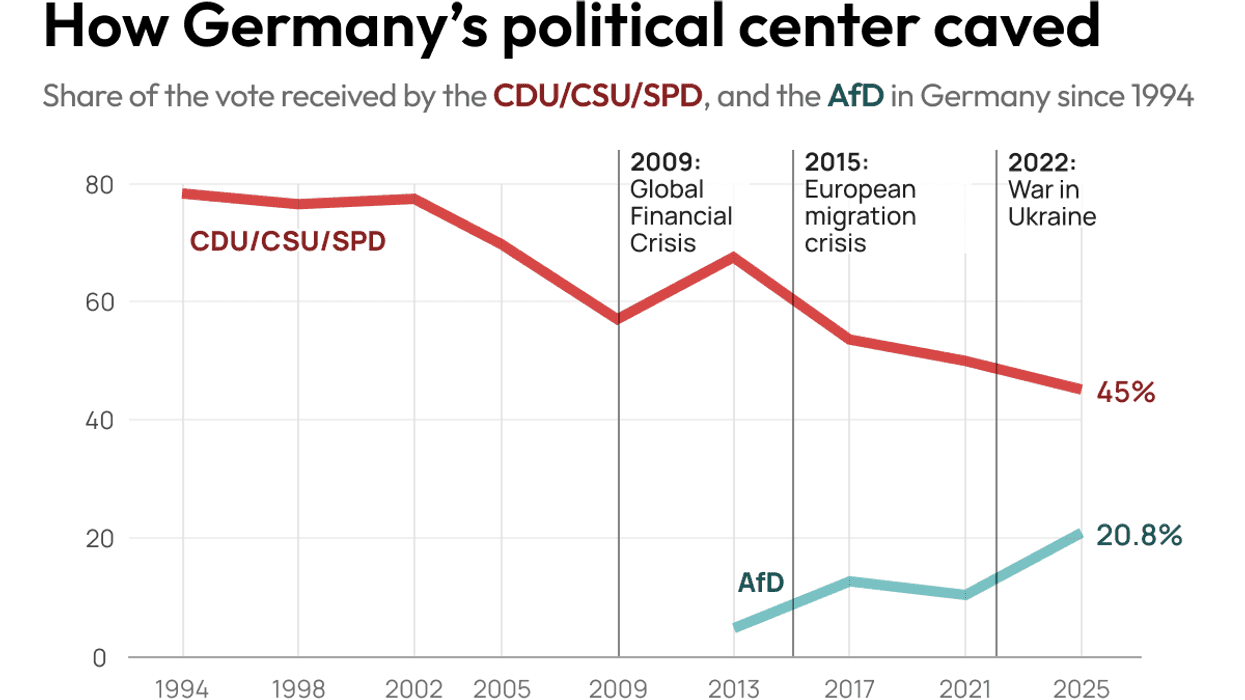
That’s according to data from the PopuList, a project involving more than 100 political scientists that tracks election results in Europe since 1993. The parties once on the political fringes look increasingly mainstream. In France, the National Rally gained ground in Sunday’s Senate election and is the frontrunner in next year’s presidential election. In Germany, the far-right Alternative for Germany (AfD) is close to governing a German state after strong performances this month and now is the most popular party nationwide. Far-right parties are also part of governing coalitions in Croatia, Czechia, Italy, and Finland, while leading polls in Austria, Belgium, and the UK.
What do we mean by the “far-right”? The PopuList defines “far-right” as parties that hold beliefs that are nativist – that outsiders, including migrants, threaten the country – and authoritarian beliefs, which favor a strictly ordered society and severe punishment for challenges to authority.
Populist parties are those that divide society into two opposing camps: ordinary people versus the corrupt elite, and argue that politics should express the will of the people. The project differentiates between far-right and far-right populist parties. For our analysis, we combined them into a single far-right category because parties classified solely as “far right” consistently accounted for only a small share of the vote.
Far-left and far-left populists, by contrast, reject the basic socioeconomic structures of contemporary capitalism and advocate alternative systems of economic and political power. Parties like these haven’t seen the same surge as the far-right. But as centrist parties in places like France lose steam, far-left parties like France Unbowed, led by Jean-Luc Mélenchon, could garner enough support to face off against National Rally’s Marine Le Pen in the second round of the French presidential election next spring.
How did we get here? The PopuList’s data shows a sharp rise in support beginning in 2015 – the same year as Europe’s migration crisis.
Large numbers of migrants and refugees arrived from the Middle East and North Africa amid wars and political instability. Germany, for example, took in over 1 million refugees from Syria, Iraq, Afghanistan, and elsewhere in 2015. At the same time, economic frustration lingered in Europe after the Global Financial Crisis of 2008 and the continent’s larger industrial decline.
Far-right populist parties proved masterful at capitalizing on that anxiety – blaming migrants for fueling a sense of insecurity. Between 2013 and 2016, far-right populist parties nearly doubled their vote share from around 7% to 12%. Their support has largely continued to climb since, with historic gains in elections in Austria, France, and the UK between 2024 and 2025. (Reform UK rejects the “far-right” label.)
The appeal goes beyond immigration and the economy. Parties like the AfD also see a perceived threat to largely white and Christian national and European culture, and skepticism of institutions like the European Union, which some see as weakening national identity.
Whether the far-right can build on these gains will face a major test in 2027, when France, Italy, Poland, and Spain are all due to hold elections – each with a far-right party seeking more influence.