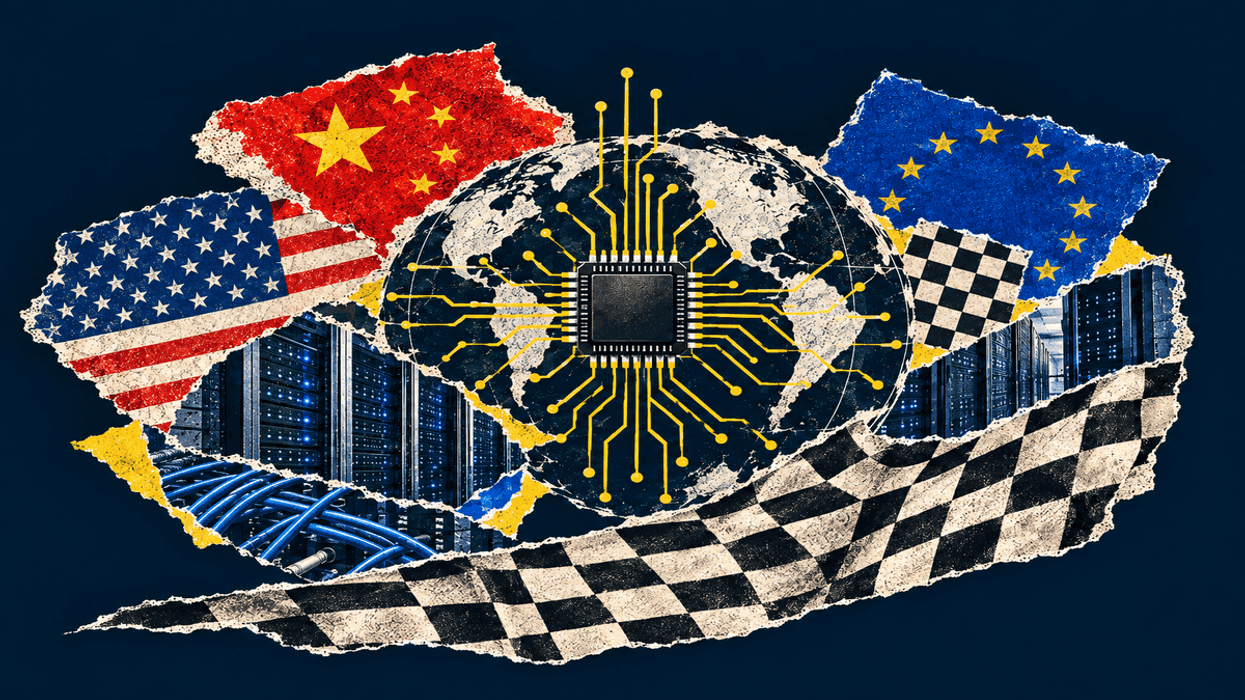
Artificial Intelligence is undoubtedly the most transformative and disruptive technology of our era. But although people in nearly 150 countries use it, the infrastructure that makes it possible is largely controlled by just two: the US and China, with European companies trailing in a distant third place. That includes physical data centers, storage software, specialized chips, and networking hardware.
Currently, nine companies control about 70% of the market for AI computing hubs, according to a recent report by Oxford University. Eighty-seven of those hubs are run by American companies, around two-thirds of the global total. Companies based in China operate 39, while European companies have just six.
Countries without substantial domestic AI infrastructure largely face a choice between US and Chinese technology, which, together, control 90% of global computing power. That concentration of control over AI infrastructure is on the agenda for talks about AI governance this week at the United Nations.
One emerging trend is the push among countries for “AI sovereignty” – the ability for countries outside China and the US to house and control critical parts of the tech infrastructure themselves.
The Center for New American Security (CNAS), a Washington-based think tank, estimated that the number of state-backed AI projects outside of the US and China grew fivefold between 2024 and 2025. For example, India, Japan, and Singapore are backing domestic AI infrastructure and models, and Canada recently launched plans to reduce its reliance on American tech providers.
The EU also recently unveiled a technology-sovereignty package designed to boost the union’s own production of advanced semiconductors, AI models, and cloud computing. The push comes with a hefty price tag: the Center for European Policy Analysis estimates that achieving sovereignty in cloud computing and AI could cost Europe close to $600 billion over the next decade. Roughly speaking, that would amount to about 30% of the EU’s total annual budget over that period, an enormous strategic commitment.
On Tuesday, French President Emmanuel Macron called for a “third way” forward – inviting countries like India, Brazil, Canada, and Gulf states to pool their computing power and investment resources to reduce the world’s dependency on the US and China. Countries face a tradeoff: spend enormous amounts of money to build new versions of technology already developed overseas or remain largely dependent on two AI superpowers. Which will they choose?