
Skip to content
Search

Latest Stories

The United States will no longer play global policeman, and no one else wants the job. This is not a G-7 or a G-20 world. Welcome to the GZERO, a world made volatile by an intensifying international battle for power and influence. Every week on this podcast, Ian Bremmer will interview the world leaders and the thought leaders shaping our GZERO World.

Presented by

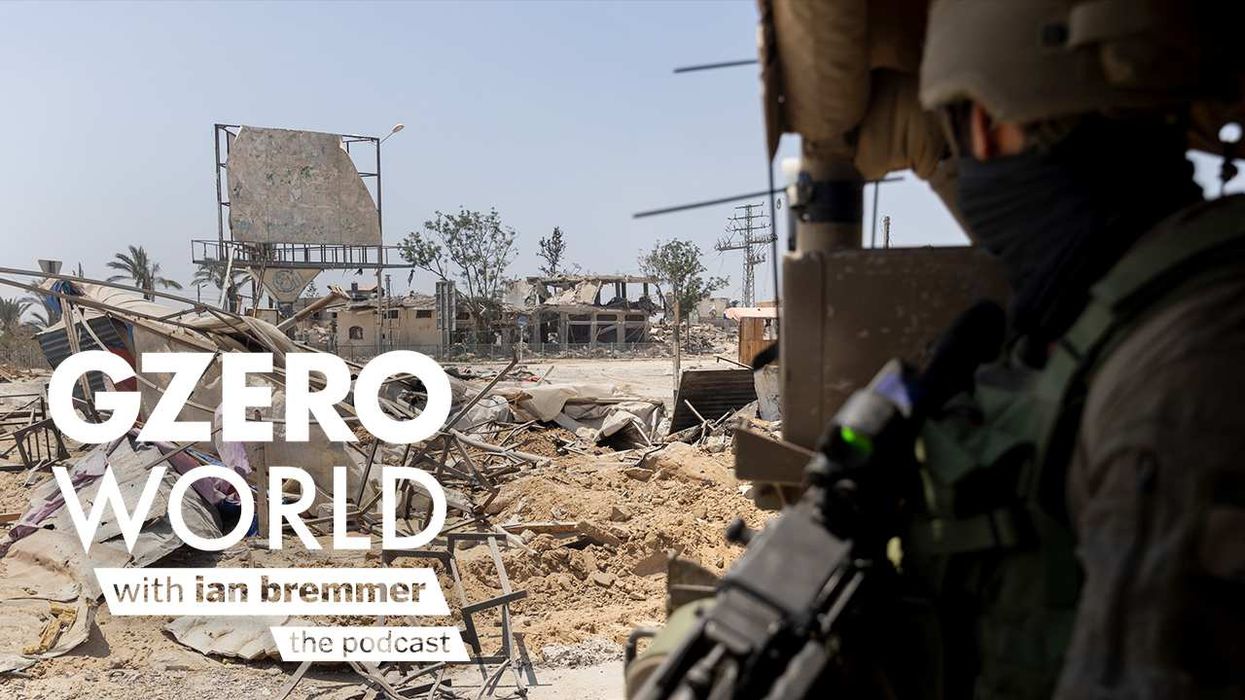
An image of an Israeli soldier with the GZERO World Podcast logo superimposed

Could Israel's Gaza gamble be paying off?

As Netanyahu returned to the White House to unveil a new peace proposal alongside Trump, Israel faces a paradox: military dominance abroad, growing isolation everywhere else.

Transcript

On the latest episode of the GZERO World podcast, the paradox at the heart of Israeli foreign policy today. Militarily, Israel is dominant. Diplomatically, it’s more isolated than ever.


This week, Israeli Prime Minister Benjamin Netanyahu made his fourth trip to the White House since President Trump returned to office, standing beside him to unveil what Trump called a “landmark” Gaza peace proposal. But behind the bold language is a growing distance between Israel and the world. Gaza has been devastated, Hamas is on its heels, and yet, the cost to Israel’s global standing continues to rise.

Former US diplomat and Middle East peace negotiator Aaron David Miller joins Ian to unpack the uncomfortable truth: Israel may be winning on the battlefield, but it’s losing support in global capitals, and possibly at home.

“Not a single cost or consequence has been imposed by any Arab state on Israel,” Miller says. “They’ve done nothing. The Arab states are running scared of Trump. They’re either afraid of him or they want something from him.”

From European governments pulling investments and recognizing Palestinian statehood, to rising grassroots pushback across American campuses, Israel’s brand is eroding—even as Netanyahu locks arms more tightly with Trump.

Subscribe to the GZERO World Podcast on Apple Podcasts, Spotify, Stitcher, or your preferred podcast platform, to receive new episodes as soon as they're published
Next Page

listen on:

More from GZERO World Podcast

The global aid crisis, with David Miliband

What happens when the world’s safety net disappears? For decades, international aid has helped fight poverty, stop disease outbreaks, and keep fragile societies from falling over the edge. But after the shutdown of USAID last year, the relief system is in danger of collapsing entirely. International Rescue Committee President & CEO David Miliband joins Ian Bremmer on the GZERO World Podcast to talk about the long shadow cast by America’s retreat from global aid and what comes next.

Keep reading...Show less

Humanitarian aid isn’t just charity—it’s the world’s safety net against disease, conflict, and instability. David Miliband joins Ian Bremmer to unpack what America’s retreat from global aid means for... More >

The UK a decade after Brexit, with Rory Stewart

Ten years ago, Britain voted to leave the European Union in one of the most consequential political decisions of the 21st century. Supporters promised greater sovereignty, stronger economic growth, and a more independent future. Instead, Brexit ushered in a decade of political upheaval, economic uncertainty, and a fundamental rethinking of Britain's role in the world.

Keep reading...Show less

Ten years after Brexit, former UK cabinet minister Rory Stewart joins Ian Bremmer to examine the referendum's lasting impact on Britain's economy, politics, and place in the world—and why the UK is... More >

Lebanon's best chance for peace, with Kim Ghattas


While the world’s attention has focused on the Strait of Hormuz and the escalating conflict between the United States and Iran, another potentially transformative front has opened in Lebanon. Israeli attacks against the Iranian-backed group Hezbollah have left more than 4,000 people dead and displaced over a million. Now, a fragile ceasefire has raised a question diplomats have struggled with for decades: Can Hezbollah actually be disarmed?

Keep reading...Show less

As Hezbollah’s power weakens and Israel occupies parts of southern Lebanon, could the country finally reclaim its sovereignty? Or is it headed toward another war? Journalist Kim Ghattas joins Ian... More >

Inside Ukraine's strategy to pressure Putin, with Dmytro Kuleba

For more than four years, Russia has wagered that it can outlast Ukraine. The Kremlin has more troops, more resources, and a greater tolerance for casualties, betting that Kyiv — and its Western allies — will eventually lose the will to keep fighting.

But that assumption is being tested. Ukraine is carrying out increasingly sophisticated strikes deep inside Russian territory, forcing Moscow to defend military bases, energy infrastructure, and even symbolic strongholds like Crimea. At the same time, NATO support has strengthened, Europe is expanding its defense cooperation with Kyiv, and President Donald Trump has struck a noticeably warmer tone toward Ukraine than he did just months ago.

Keep reading...Show less

Ukraine is bringing the war to Russia, challenging one of the conflict's biggest assumptions: that time is on Vladimir Putin's side. Former Ukrainian Foreign Minister Dmytro Kuleba joins Ian Bremmer... More >

GZERO Podcasts

Humanitarian aid isn’t just charity—it’s the world’s safety net against disease, conflict, and instability. David Miliband joins Ian Bremmer to unpack what America’s retreat from global aid means for... More >

Listen: What does global energy transition look like in a time of major geopolitical change, including rebalancing of trade? In this special episode of "Energized: The Future of Energy,” host JJ... More >

Creating artificial human retinas in zero gravity. Mining rare minerals on the moon. There seems to be no limit to what could be possible if we continue to take our more important industries to... More >

In his latest Quick Take, Ian Bremmer examines the collapse of US-Canada trade talks and what it reveals about President Trump’s growing political vulnerability.... More >

In this episode of The Ripple Effect: Investing in Life Sciences, host Dan Riskin speaks with Patrick Horber, President of Novartis International, and David Gluckman, Vice Chairman of Investment... More >