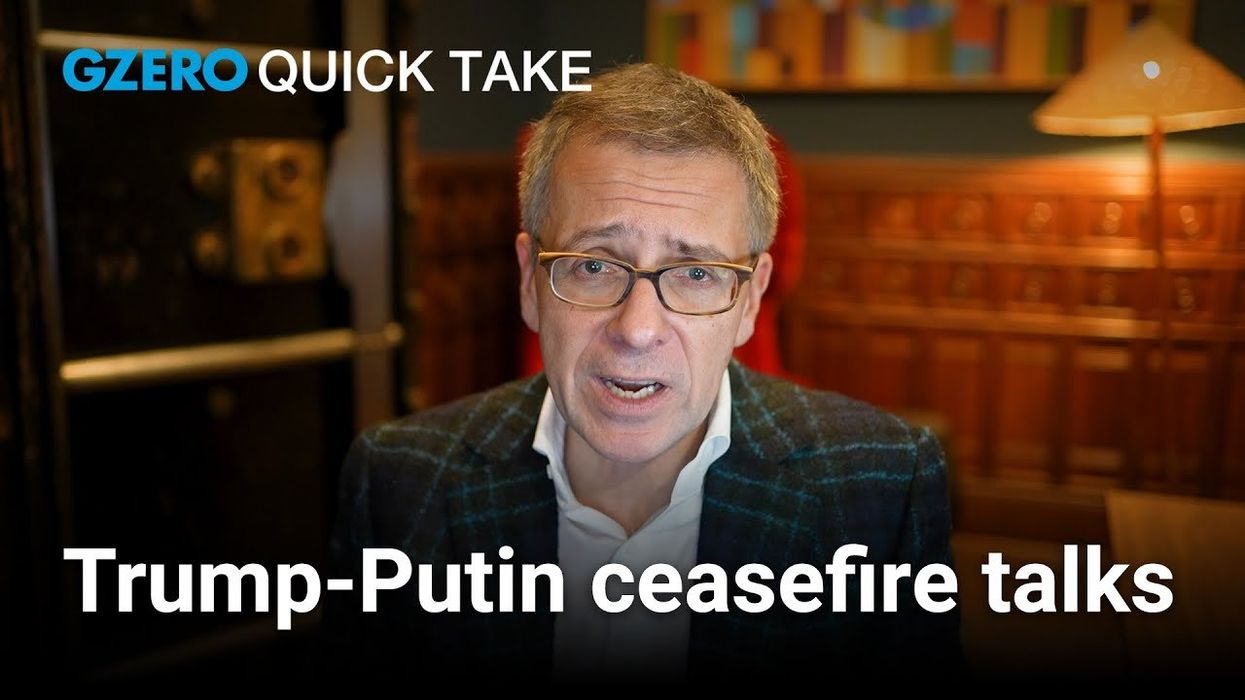
What will Trump offer Putin in Ukraine ceasefire talks?
March 17, 2025
Ian Bremmer, political scientist and president of Eurasia Group and GZERO Media, shares insights on global political events.
Presented by

Ian Bremmer's Quick Take: A Quick Take to kick off your week. Tomorrow is the call between President Trump and President Putin. The most important geopolitical discussion I would argue that we have seen so far of the Trump administration. Look, what we've had so far has been a move towards a ceasefire. Trump beating up on the Ukrainians, on President Zelensky in particular, which is comparatively easy to do. They are in a much weaker position. That's particularly easy to do if you don't feel like you need to be in lockstep with NATO allies, with the Europeans, with the Canadians. And as a consequence, Trump, off-again and now on-again relationship with the Ukrainian president, has now gotten Ukraine to agree to a one-month ceasefire with no preconditions. And that's definitely progress. And the Europeans are all on board and supportive of that.
That is closer to a ceasefire than Biden certainly ever got the Ukrainians. And though I would argue, it has certainly caused a lot of concern among US allies of whether or not the Americans can be counted on long-term. In the near term, it makes it easier and more likely to get to an end of the war than we were a month ago. And frankly, I think we would've been better off if Biden had been more willing to push Zelensky and push the European allies, and show that American power recognized that Ukraine was weakening in their position, vis-a-vis Russia and that the war was only leading to more expense and more lives being lost on both sides. And so, pushing for a shorter-term ceasefire was an important thing to do.
They weren't willing to expend much political capital. They certainly weren't willing to upset people, and as a consequence, we didn't get there. That's the good news is that we now have Zelensky in a position with everybody on board on the Western side, that a ceasefire should be agreed to, and nothing else needs to be discussed. That, of course, is not the Putin position. And now a much harder point, a much more challenging point, and open to question, is to what degree is Trump when push comes to shove, prepared to hurt Putin. Because of the earlier call that the two men had, 90 minutes long, and then the follow-up conversation in Riyadh between the cabinet members of both countries, that was easy.
That was, "Hey, Biden wouldn't talk to you. I'm willing to talk to you. Let's talk broadly about things we might be able to do together. We can talk about investment. We can talk about strategy. We can talk about the Arctic. We can talk about arms control. And yes, we can talk about Ukraine." And nothing was being forced for the Russians to agree with. This was all upside, especially because it was just a bilateral conversation. The Ukrainians weren't involved. The Europeans were involved. It's exactly the format that Putin wants to support. But now we have the Ukrainians saying they'll support a one-month ceasefire with no preconditions. What about Russia?
Because if Russia comes out of this phone call with Trump and says, "That's it, there's no pathway. I refuse to accept what you're putting forward." Well, then either Trump looks really weak for having gotten the Ukrainians to the table but not the Russians' table, isn't prepared to do anything about it. Or he has to actually follow through with some level of strikes, sanctions, economic strikes against Putin and further support to Ukraine, which is not, of course, at all where Trump wants to be. That will escalate the fighting. It won't lead the fighting to an end. So, what really matters here is how much is Trump prepared to offer to Putin when he drives a harder bargain than Zelensky was driving. And how much is Trump prepared to give away?
And I mean, from Putin's perspective, he wants to test that proposition. Ideally, for Putin, Putin gets enough that Trump says yes, and that Ukraine says no and ruins the conversation, and Ukraine is blamed for not wanting peace. And then the Americans and the Russians can go forth and build their own broader engagement, bilaterally over the heads of the Europeans, and the Ukrainians are the problem and the Europeans are stuffed. That is Putin's ideal outcome, but it's not clear he can get to that ideal outcome. Because if he pushes Trump too hard and it blows up, then suddenly he's angry, he's embarrassed. And he's also much more powerful than the Russians, and he's willing to talk to the Europeans in that environment. It's exactly what the Russians don't want.
If you're Putin, you push, but you also don't want this conversation to blow up. So, you want to see how much you get for Trump, but you also want to get to yes. And so, really, the question is not how much Putin ends up giving up. It's really about whether or not Trump makes it easy on Putin. And there are lots of reasons to believe that he will. So far, he has been willing proactively to say that Ukraine should never join NATO. Well, that wasn't a part of the one-month ceasefire that the Ukrainians agreed to, but it might be a requirement for Putin. Trump throws that out. Does that then blow up the Ukrainian conversation?
Trump has also said that Ukraine's not going to get all of their land, but he hasn't made that a condition of the one-month ceasefire. Does Putin require that? Does Trump say yes? It's a fairly easy give for Trump, except it's not been coordinated with the Ukrainians. Are the Ukrainians prepared to accept that? By the way, that would be the minimum table stakes that I think Putin would demand since Trump has effectively already given them away. Now, he could go much harder than that. He's also talked about wanting formal recognition over some of the territories that Russia presently occupies.
Might the United States directly be willing to recognize that territory? Ukraine wouldn't have to, but the United States would. I think that's a bad idea in a first-phase agreement, where the Russians can come right back and start fighting at the end of 30 days. But it's possible that Trump would be willing to give it away. Putin has said that he refuses to allow a 30-day ceasefire to be an opportunity for the Ukrainians to reconsolidate their military, which is facing pretty much a lot of hardship right now. They don't have as much artillery, they don't have as much ammunition, and they've also been bleeding recruits.
Is Trump willing to say, "Okay, for 30 days, I'm going to re-suspend aid to the Ukrainians?" I could see him doing that. But I can't see Trump saying that the Europeans are going to re-suspend aid to Ukraine over those 30 days. And certainly, I don't see the Europeans agreeing to that by themselves. And well, would Russia agree to a deal that doesn't have the Europeans in that environment? Might the Americans re-suspend intelligence aid to Ukraine over those 30 days? In principle, maybe you don't need that. If there's no fighting going on, maybe the intelligence isn't such a problem. So, that could be an easier give for Trump to offer that Zelensky wouldn't have a problem with.
And then there are broader issues of, for example, the Americans withdrawing forward troop deployments that are presently rotating in the Baltic states. For example, something that would make it feel that the United States is no longer as much of a threat with NATO to Russia, a give to the Russians. Finally, you could imagine the United States being willing to take some sanctions off. This is undermining the common position with the Europeans but is less of a direct problem for Zelensky than saying you don't get NATO or saying that you're not going to get to keep your land as a codified piece of a deal with the Russians.
My view is that the 30-day period, Trump should maintain a fairly hard line because he's maintained a hard line with the Ukrainians and it's been effective. And the US is ultimately in a stronger position than the Russians are. But Trump has also made it clear that he really, really, really wants to get to yes, and that a lot of these things don't matter very much for him. So, he's essentially put Putin in a stronger position than he really is. And this is why it's so interesting that Trump always likes to use these analogies with the cards. He said, "The Ukrainians don't have the cards, and the Russians don't really have the cards." And yet, as someone who plays poker, we all know that frequently people that don't have cards win.
And the reason they win is because they play better than you do. And so, what we're going to see tomorrow is the degree to which Putin, who doesn't have the cards that Trump has, is nonetheless a more effective poker player. And I am concerned, at least somewhat concerned, that Putin's poker skills are actually better, more effective than Trump's are. Even though if both sides were to actually have to show their cards right now, we'd see that the Americans would win quite easily. And the Americans with the Europeans would win overwhelmingly, and yet that's not the way these hands are being played right now.
So, anyway, we'll see where it goes tomorrow. I'm sure I'll give you a quick response after we get that news. But that's where I think we are. I suspect Putin's going to come out of this happier than he should have any right to be and that the Americans will give away more than they should. But hopefully, not by a dramatic margin and that that will make it more likely that we still get to this one-month ceasefire. But we'll see tomorrow, and I'll talk about it then. Be good.

Keep up with what’s going on around the world - and why it matters.