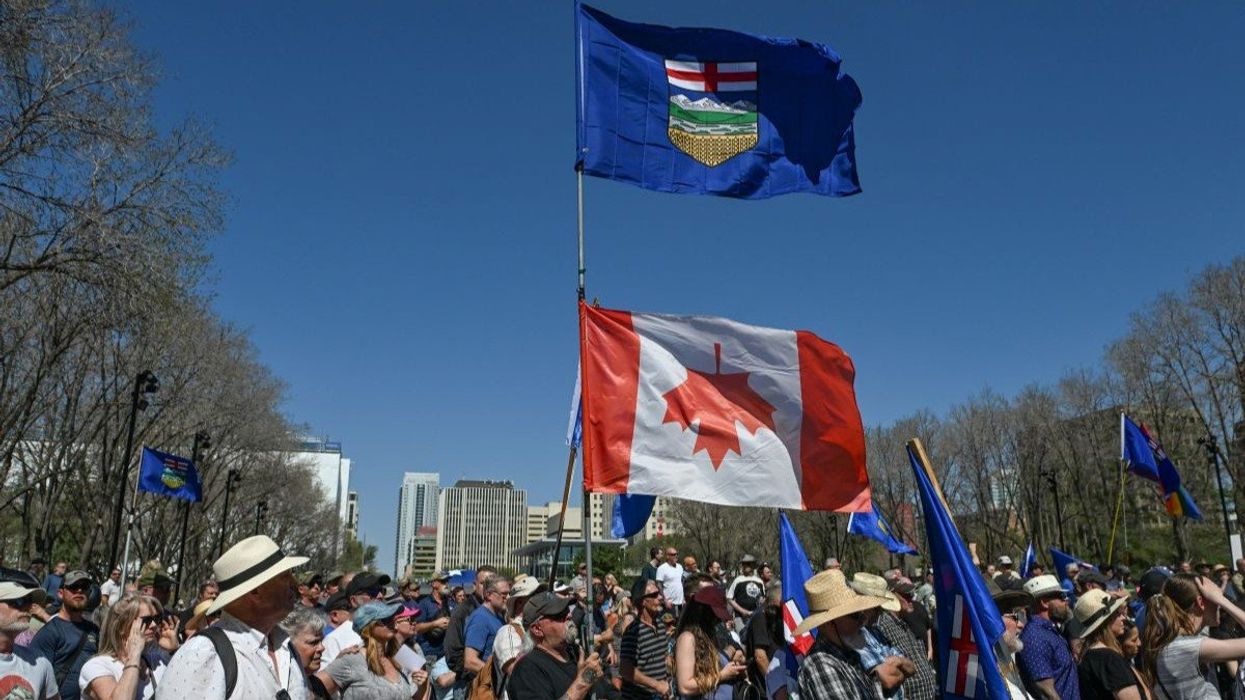
Pierre Poilievre, leader of Canada’s Conservative Party, is having a pretty good summer. He’s holding well-attended “Axe the tax” rallies across the country, promising to get rid of Prime Minister Justin Trudeau and his unpopular carbon tax, which is hitting drivers at the pumps.
This week, though, Poilievre had to postpone rallies in British Columbia and the Yukon because of wildfires that have forced tens of thousands to flee their homes and burned 15 million hectares of bush, leaving an area the size of Illinois in ashes. Since the carbon tax was designed to reduce the emissions that contributed to these catastrophic fires, it was bitterly ironic that Poilievre’s campaign against the tax was interrupted by the fires, but he is not changing course.
In both Canada and the United States, this has been a hellish summer, with so much climate-related extreme weather that it is hard to keep track. The summer started with wildfires and floods in typically temperate Nova Scotia. Heat records have fallen in Arizona. Ocean water the temperature of a hot tub has killed coral in the turquoise waters of the Florida Keys. A deadly fire laid waste to tropical Maui. A hurricane hit L.A.
Have voters been listening?
For decades, climate scientists have been warning these disasters would come if we don’t reduce the emissions that are warming the planet. Now that the disasters have started, will people recognize the urgency of the problem?
“That is the multi-trillion dollar question,” says Shari Friedman, Eurasia Group’s managing director for climate and sustainability, who has been working on climate since the 1990s.
“When I started on climate change, the assumption was that people weren't believing this, but that when people saw the effects, they would start to see it .. Now, I think the question is a little bit different because we're seeing the effects – it's pretty clear. And the question now is, what is going to change these trajectories?”
Climate scientists have done heroic work on a massive scale to understand and describe the processes that are causing extreme weather. But this has failed to convince voters to do what is necessary to bring down the emissions that are causing ecosystems to dissipate heat in ways that threaten human existence.
People are not wising up. The Pew Research Center, which tracks attitudes toward climate around the world, has observed a decline in the number of Americans who consider it a major threat, from 59% in 2018 to 54% in 2022.
The role of disinformation
Canadian pollster Frank Graves, of EKOS Research Associates, observed the same decline in Canada over the last three years, which he attributes to online disinformation. To many people, he says, climate change “is fake news. This is made up. This is a plot by the woke left to collect their useless carbon tax.”
In his most recent poll of Canadians, this month, while wildfires were top of mind, Graves observed that a growing number of people — mostly conservatives — blame arson, not extreme weather, for the blazes. (This is a pattern of misinformation found wherever there are wildfires.) Voters who believe fires are caused by arson, not a warming globe, will not support policies to reduce emissions.
“The patterns of who gets this disinformation are very, very similar in Canada and the United States,” Graves says, “because they are emanating from the same sources. And those sources are now telling people climate change is a hoax, and these forest fires are either just bad luck or, more pointedly, they are being produced by arsonists, saboteurs, activists.”
The issue, in both countries, is divided along partisan lines, with conservatives less willing than liberals to accept the views of climate scientists.
Riley Dunlap, emeritus professor at Oklahoma State University, has been studying American attitudes about environmentalism since the first Earth Day in 1970. He watched as the issue, which used to be of concern across partisan lines, became polarized in the 2000s. Now, he notes, opposing climate policy is an identity issue for Republicans – it’s up there with “God, guns, gays, and abortion.”
He has watched with dismay as opinions got harder, with Trump followers going against anything liberals support. Some 40% of Americans do not believe humans are causing climate change.
Researchers at American universities have found that attitudes about personal experiences of extreme events appear “socially constructed and interpreted through ideological lenses, rather than driven by individuals’ objective experiences of changes in weather and climate.”
Researchers found that hot, dry days — as opposed to sudden, extreme weather events — seem to convince some people that climate change is real.
“So far, actual experience doesn't seem to have had a significant effect,” Dunlap said. “But I'm open to the possibility that personal experiences and media coverage could be really shaking people up.”
If you thought this summer was bad …
Gerald Butts, vice chairman of Eurasia Group, who helped Trudeau implement Canada’s carbon tax, points out that researchers will have more opportunities to carefully study the effect of extreme weather on public opinion.
“This is the hottest summer of your life, but it's going to be one of the coolest of the rest of your life. Sure it's weird that the remnants of a hurricane are flooding the California desert while the northern part of the continent is burning. But we're going to see versions of that in every northern hemisphere summer for the rest of our lives.
“I think the deeper question is — because human beings are nothing if not adaptable — and part of that adaptation mechanism is, how do we tune out the things we don't want to see or hear? I mean, as these things get weirder and weirder, what is the new normal for what people can absorb, or will absorb, and react to?”