Skip to content
Search

Latest Stories

Podcasts

Listen to GZERO's podcasts about global politics, including the GZERO World with Ian Bremmer Podcast.

Presented by

Podcast: Worried Sick

Podcast: Worried Sick

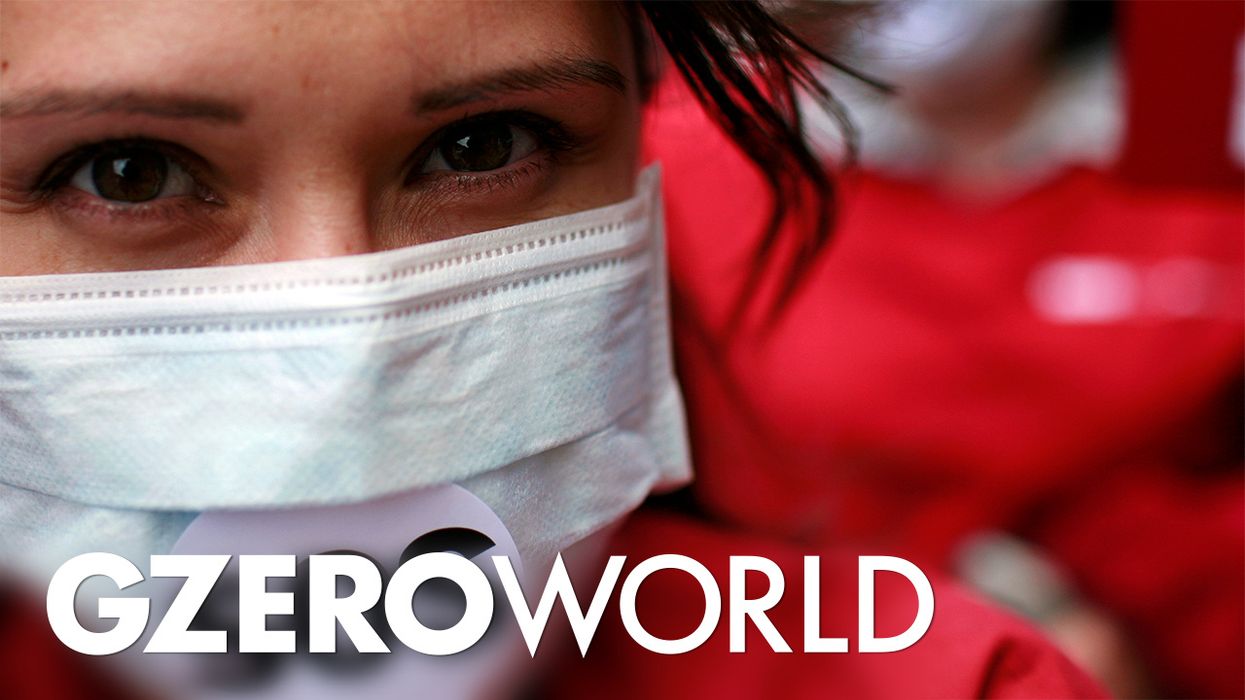
Listen: The "Spanish flu" virus of 1918 killed an estimated 50 million people, more than all the deaths in World War I combined. While global public health efforts have greatly improved mortality rates in more modern outbreaks, experts say the next pandemic is a matter of "when," not "if." In this episode, Ian Bremmer takes a look how diseases spread and become global. His guest, Dr. Anthony Fauci, is a leading epidemiologist and director of the National Institute of Allergy and Infectious Diseases at the NIH.

Transcript

Listen: The "Spanish flu" virus of 1918 killed an estimated 50 million people, more than all the deaths in World War I combined. While global public health efforts have greatly improved mortality rates in more modern outbreaks, experts say the next pandemic is a matter of "when," not "if." In this episode, Ian Bremmer takes a look how diseases spread and become global. His guest, Dr. Anthony Fauci, is a leading epidemiologist and director of the National Institute of Allergy and Infectious Diseases at the NIH.


Dr. Fauci breaks down some of the biggest health threats facing the world today: HIV/AIDS, Ebola, malaria, tuberculosis, influenza, and the recent rise in cases of measles brought on by the misguided anti-vaccine movement.

Also on the show: Five years after his Ebola diagnosis made international news, NYC's Dr. Craig Spencer tells GZERO Media what he learned from the experience and what his life is like today.
Subscribe to the GZERO World Podcast on Apple Podcasts, Spotify, Stitcher, or your preferred podcast platform, to receive new episodes as soon as they're published.

Next Page

More from GZERO World Podcast

The biggest geopolitical risks of 2026 revealed

Listen: With the global order under increasing strain, 2026 is shaping up to be a tipping point for geopolitics. From political upheaval in the United States to widening conflicts abroad, the risks facing governments, markets, and societies are converging faster—and more forcefully—than at any time in recent memory.

To break it all down, journalist Julia Chatterley moderated a wide-ranging conversation with Ian Bremmer, president of Eurasia Group and GZERO Media, and a panel of Eurasia Group experts, to examine the findings of their newly-released Top Risks of 2026 report.

Keep reading... Show less

Listen: With the global order under increasing strain, 2026 is shaping up to be a tipping point for geopolitics. From political upheaval in the [...]

More >

War and Peace in 2025, with Clarissa Ward and Comfort Ero

This week, instead of zooming in on a single conflict, the GZERO World Podcast looks back on 2025 and takes stock of a world increasingly defined by conflict. Ian Bremmer sits down with CNN Chief International Correspondent Clarissa Ward and Comfort Ero, President and CEO of the International Crisis Group to look at some of the biggest crises of 2025–-both the headline making wars and the ones the world overlooked.

Keep reading... Show less

This week, instead of zooming in on a single conflict, the GZERO World Podcast looks back on 2025 and takes stock of a world increasingly defined by [...]

More >

Why we still trust Wikipedia, with cofounder Jimmy Wales

At a moment when Americans can’t agree on much of anything, one unlikely institution still commands broad trust: Wikipedia. On the GZERO World podcast, Ian Bremmer sits down with Wikipedia cofounder Jimmy Wales to ask why the crowdsourced encyclopedia remains one of the most visited and relied-upon sites in the world, even as trust in media, government, and tech companies continues to collapse.

Keep reading... Show less

At a moment when Americans can’t agree on much of anything, one unlikely institution still commands broad trust: Wikipedia. On the GZERO World [...]

More >

The human cost of AI, with Geoffrey Hinton


Computer scientist and Nobel laureate Geoffrey Hinton joins Ian Bremmer on the GZERO World podcast to talk about artificial intelligence, the technology transforming our society faster than anything humans have ever built. The question is: how fast is too fast? Hinton is known as the “Godfather of AI.” He helped build the neural networks that made today’s generative AI tools possible and that work earned him the 2024 Nobel Prize in physics. But recently, he’s turned from a tech evangelist to a whistleblower, warning that the technology he helped create will displace millions of jobs and eventually destroy humanity itself.

Keep reading... Show less

Computer scientist and Nobel laureate Geoffrey Hinton joins Ian Bremmer on the GZERO World podcast to talk about artificial intelligence, the [...]

More >

GZERO Podcasts

Listen: With the global order under increasing strain, 2026 is shaping up to be a tipping point for geopolitics. From political upheaval in the [...]

More >

Listen: What does global energy transition look like in a time of major geopolitical change, including rebalancing of trade? In this special episode [...]

More >

Listen: Creating artificial human retinas in zero gravity. Mining rare minerals on the moon. There seems to be no limit to what could be possible if [...]

More >

Think you know what's going on around the world? Here's your chance to prove it. [...]

More >

Transcript Listen: “The equivalent of what we spent in World War II was spent in the course of a year and a half to support the US economy, and that [...]

More >

Listen: Investing in health and science research isn’t just about curing diseases. It has huge impacts across society, from creating jobs to driving [...]

More >

Listen: As populations grow and communities evolve, transportation authorities and urban infrastructure are seeking ways to modernize.In this episode [...]

More >