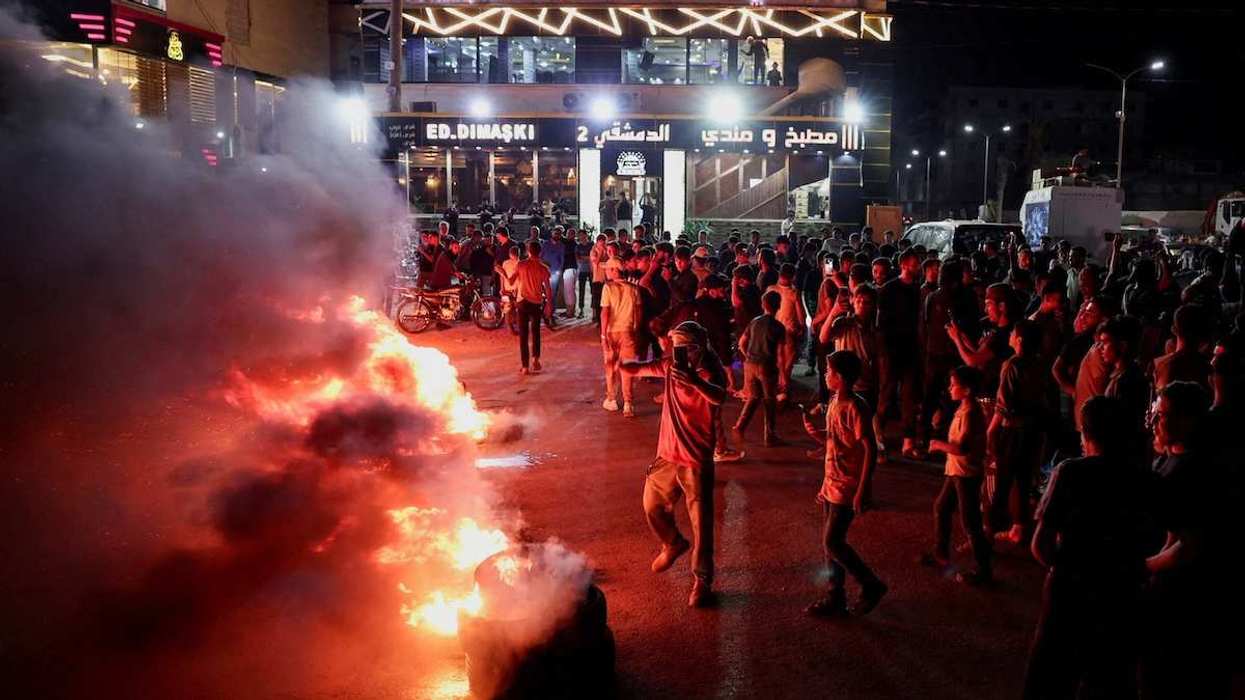
Thursday marked the deadliest day for US troops in Afghanistan in a decade. Twin explosions were reported outside Kabul's airport, killing dozens of people, including at least 90 Afghans and 13 US service members — the first US military deaths in the country since February 2020. Details are still coming to light, but harrowing images have been circulating online, showing pools of blood on the outskirts of the airport and desperate Afghans scurrying to get medical care.
Who's responsible? The explosions, which included at least one suicide bombing, were not carried out by the Taliban, who took control of the country two weeks ago and are closely coordinating with the US military to wrap up the evacuation effort so they can get back to the business of governing by fear. Rather, the blasts were the work of ISIS-K (K stands for Khorasan, a region that includes northeastern Iran, southern Turkmenistan and northern Afghanistan), an offshoot of the broader Islamic State movement that expanded to Central Asia in 2015.
Although ISIS-K and the Taliban are both hardline Sunni Islamist groups (Sunnis often unite against common Shia foes) they are sworn enemies: the former includes a ragtag group of fighters including some Taliban defectors, and is thought to be even more draconian than the Taliban, rejecting all political proposals and believing only in the extreme enforcement of sharia law. While ISIS-K wants to form a caliphate, it has never captured swathes of land in Afghanistan, so it has sought to project strength by waging terror on the Afghan people (it was responsible for a particularly gruesome attack in May on an all-girls school in Kabul).
What does this mean for the withdrawal? Well, it's certainly not good. Already in the lead-up to the attack, foreign governments began suspending evacuation flights, some indefinitely. Germany and France, for instance, announced that they were wrapping up their rescue missions for good.
For the US, meanwhile, which is responsible for security at the interior of Kabul's airport, Thursday's attacks significantly obscured the withdrawal mission, which President Biden still says should be completed by August 31 and won't leave any US nationals behind who want to leave. But as the security situation deteriorates at the airport, and in Kabul more broadly, it's becoming less likely that the US will be able to airlift around 1,500 US nationals who remain in Afghanistan by next Tuesday, or the hundreds of thousands of Afghans who helped the US mission over the past two decades. And there's no indication that the US will extend its mission beyond that date. One former official told the Washington Post that "while it is likely to be denied publicly, the terrorist attack is also likely to mark the de facto end of the formal US-led noncombatant evacuation operation."
How might the US respond? Given that the whole point of the hasty withdrawal from Afghanistan was for Biden to honor his campaign pledge of ending "forever wars," it has seemed extremely unlikely that the US would take any actions that further entrench its troops in Afghanistan or jeopardize the evacuation effort — until now.
A deadly attack on US troops is not something that the Biden administration can let slide. If — as US intelligence warns — more attacks are imminent, Biden might be forced to hit terrorist targets in Afghanistan, precisely the sort of military escalation that he has desperately tried to avoid.
What does this mean for the Taliban? While the Taliban are surely not mourning the loss of American or Afghan lives, they are likely furious that ISIS-K is undermining their authority just days into the group's new gig. ISIS-K boasts just 1,500-2,200 fighters, not enough to pose a serious threat to the Taliban's rule, but this week's events show that it could certainly be a massive thorn in the Taliban's side as they try to get to the business of actually governing. Indeed, this could also have the effect of further radicalizing the Taliban as they try to contain their dogged rivals and prevent defections.
It also massively complicates already-precarious US-Taliban relations. The Pentagon is intent on getting to the bottom of how ISIS fighters managed to get through checkpoints controlled by the Taliban, who man the airport's exterior. "We share a common purpose," a Pentagon spokesperson said after the attacks Thursday, warning that cooperation with the Taliban would last so long as they continue to share a core mutual interest: getting the US out of Afghanistan.