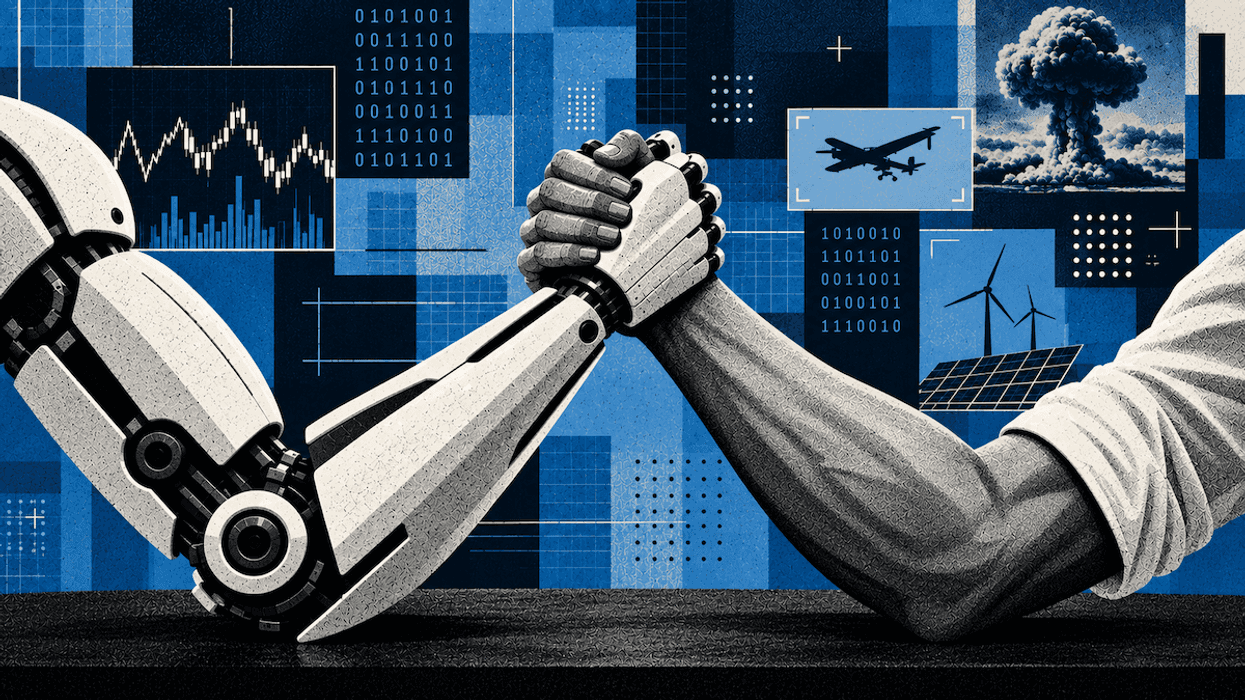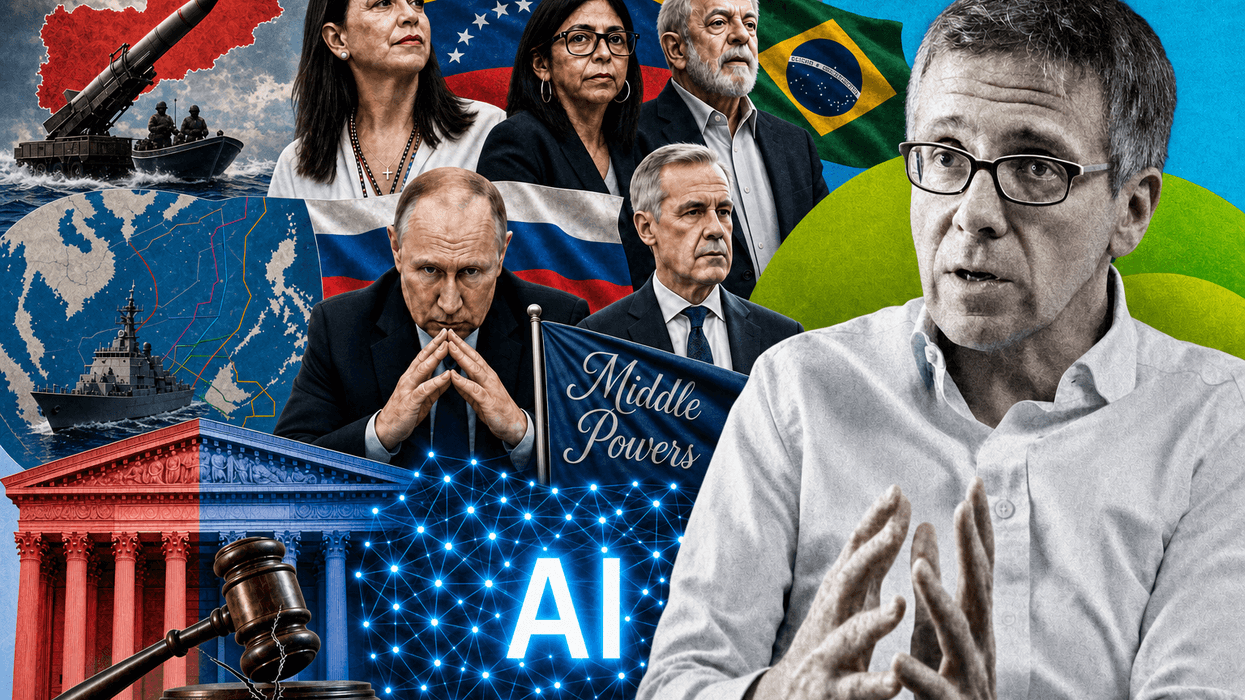
Last week, I explained what happens when the world’s most powerful geopolitical actors abdicate their leadership responsibilities. America’s war with itself continues to escalate with few guardrails. The conflicts in Ukraine and the Middle East show no signs of sustainable resolution. The nuclear threat level is rising for the first time in decades. In short, the world is growing more dangerous.
But that’s only half the story. Today, I want to focus on why I remain hopeful about humanity’s future, even as our G-Zero vacuum of global leadership keeps getting worse.
Cold War 2.0? Not so fast
Let’s start with what’s perhaps the best news for global security and prosperity: Despite heightened tensions and gloomy headlines, fears of a new cold war between the United States and China are overblown.
Yes, the US and China remain powerful rivals with very different political and economic systems, and their governments increasingly deal with each other in zero-sum terms. Chinese leaders view the US strategy toward China as containment, while the bipartisan consensus in Washington is that Beijing’s goal is to supplant the US as the preeminent global power.
But here’s the reality: It’s hard to fight a cold war when nobody else wants to take sides. Every major country in the world sees the need to maintain good relations with both China and America. Try telling Japan or Europe to choose between its security relationship with Washington and its commercial ties to Beijing. Even India’s Narendra Modi won’t boost relations with the US at the expense of his largest trade partner.
More importantly, both superpowers are far too preoccupied with their own internal problems to sustain the kind of long-term confrontation a cold war requires. The United States remains consumed by its domestic political dysfunction, which will only intensify after next week’s election, regardless of who wins. Washington cannot afford to start a new war when it’s already managing two abroad and fighting another at home. For its part, China is grappling with its worst economy in decades. Xi Jinping knows that he needs relations with the US to be stable while the economy regains its footing. Chinese leaders have quietly pushed back their timeline for surpassing US GDP by five years. They’re even softening their stance on Taiwan, with 2027 no longer viewed internally as a hard deadline to “resolve” the island’s situation.
The most geopolitically important relationship in the world is fundamentally adversarial and devoid of trust. Its long-term trajectory remains negative, with no prospect of substantial improvement. But the two countries aren’t yet ready for a decades-long fight – they are trying to get their own houses in order first. At least in the near term, we should expect both sides to maintain their rhetoric while carefully avoiding conflict.
Globalization isn’t over
In more good news, rumors of globalization’s death are greatly exaggerated.
A visitor from another planet would be awed by the remarkable speed and scale of human progress in recent decades. Today, more than half of the world’s population belongs to the global middle class, and over 100 million people continue to be lifted from poverty every year. Two-thirds of humanity can now go online, up from just 16% 20 years ago. International air travel keeps getting cheaper, allowing more people to work and travel in more places. And global trade continues to grow despite facing all sorts of backlash.
This progress will continue because both developed and developing countries depend on it for the economic growth their citizens expect and demand – and the political stability that comes with it. Yes, national security-related sectors are becoming increasingly fragmented and polarized. But rather than spell the end of globalization, this fragmentation is setting the stage for a new form of globalization.
Take cutting-edge technologies, where US-China competition is fiercest and ever more zero-sum. The United States leads the commanding heights of artificial intelligence thanks to its unique ecosystem of venture capital, entrepreneurship, advanced semiconductor access, and world-class research universities. China, meanwhile, dominates the post-carbon energy transition through unmatched state investment in nuclear, wind, solar, electric vehicles, batteries, critical minerals, and related supply chains.
Neither side is happy about the other’s dominance, but globalization is stabilized by an effective balance of power between them. As with the security and commercial balance that most major countries seek between the two great powers, American leadership in AI and Chinese leadership in energy tech creates a natural buffer against global decoupling because other countries don’t want to choose sides.
If Washington decides to ban Chinese EVs and solar panels, Americans will be forced to pay more for their energy transition. Luckily, they are wealthy enough to make that choice. But the rest of the world won’t follow suit – they simply can’t afford not to buy the best-in-class green tech just because it’s made in China. Similarly, if Beijing bans the most powerful AI innovations coming out of America because it can’t control the flow of information and data – China’s leaders want ChatCCP, not ChatGPT – Chinese citizens will miss out on what I believe will be the best tools to unlock their potential and build their human capital. But the rest of the world will want access to the best AI they can find.
The result? A bilateral geopolitical structure that could fatally compromise globalization has become nearly impossible. Even if some in Washington and Beijing may want to do away with global interdependence, most of the rest of the world demands it. And it’s not possible in 2025 for whoever becomes the next American president to blow that up.
The headlines might scream “decoupling,” but globalization will continue – and these new technologies themselves will create unprecedented opportunities to connect the world in ways we can’t even begin to imagine.
AI will drive new opportunities for humanity
Which brings us to AI, a technology that offers us the best chance humanity has ever had to grow, teach, learn, heal, imagine, create, and build a more prosperous and equitable world – all on an unprecedented scale.
Large language models are fundamentally reshaping how we create, interpret, and access information, while large quantitative models are transforming how we manage our physical world. They will find the needles in every haystack and help bring dreams to life. We’re already seeing the AI revolution unfold: Machine learning algorithms are driving health care breakthroughs with new drug discoveries, early disease detection, and personalized treatments. They’re providing students with individualized instruction and feedback. They’re helping farmers sustainably manage crops, industrial organizations optimize operations, and vehicles avoid accidents. These are just a fraction of the thousands of AI use cases already being deployed globally, and they are growing exponentially.
The current (and the next) wave of technological change will drive a new globalization – one that moves beyond simply lifting billions out of poverty (though that will continue, too). The globalization of the past 50 years created a global middle class and radically enriched a small group of wealthy global elites, but it left many people behind. Now, thanks to AI and related technologies, those previously left behind can also expect access to better education, health care, and unprecedented opportunities for professional and personal growth.
Take India: Of its 1.5 billion people, roughly 50 million live like Europeans, 400 million like Indonesians, and a billion like sub-Saharan Africans. AI may or may not squeeze that top 50 million, but it’ll give the bottom billion a chance to join the rest. And this pattern will repeat worldwide. This isn’t just incremental progress – it’s a revolution that extends the promise of global development from national statistics into the lives of all individual human beings everywhere.
Mind the gap
Yes, we remain at serious risk of failing to realize these gains because we still lack global leadership. What should worry us most isn’t muscular confrontation between the United States and China – it’s their mutual abdication of responsibility. It’s Americans still fighting Americans. It’s Washington using none of its influence to end the war in the Middle East. It’s Chinese inaction on Russia and North Korea despite their leverage.
These challenges are profound. But the opportunities to build a better world are also greater than ever before. Globalization not only persists but is potentially becoming more inclusive as transformative technologies like AI offer the potential to extend prosperity to billions more people. Humanity’s capacity for progress and innovation thrives even in this G-Zero world order.
The question isn’t whether we have the means to create a more prosperous, equitable, and peaceful world – we do. The question is whether we can maintain enough stability in our leaderless world to realize that potential.
Get it right and we make it as humanity. Get it wrong … and we might not be here for much longer.