
Skip to content
Search

Latest Stories

The United States will no longer play global policeman, and no one else wants the job. This is not a G-7 or a G-20 world. Welcome to the GZERO, a world made volatile by an intensifying international battle for power and influence. Every week on this podcast, Ian Bremmer will interview the world leaders and the thought leaders shaping our GZERO World.

Presented by

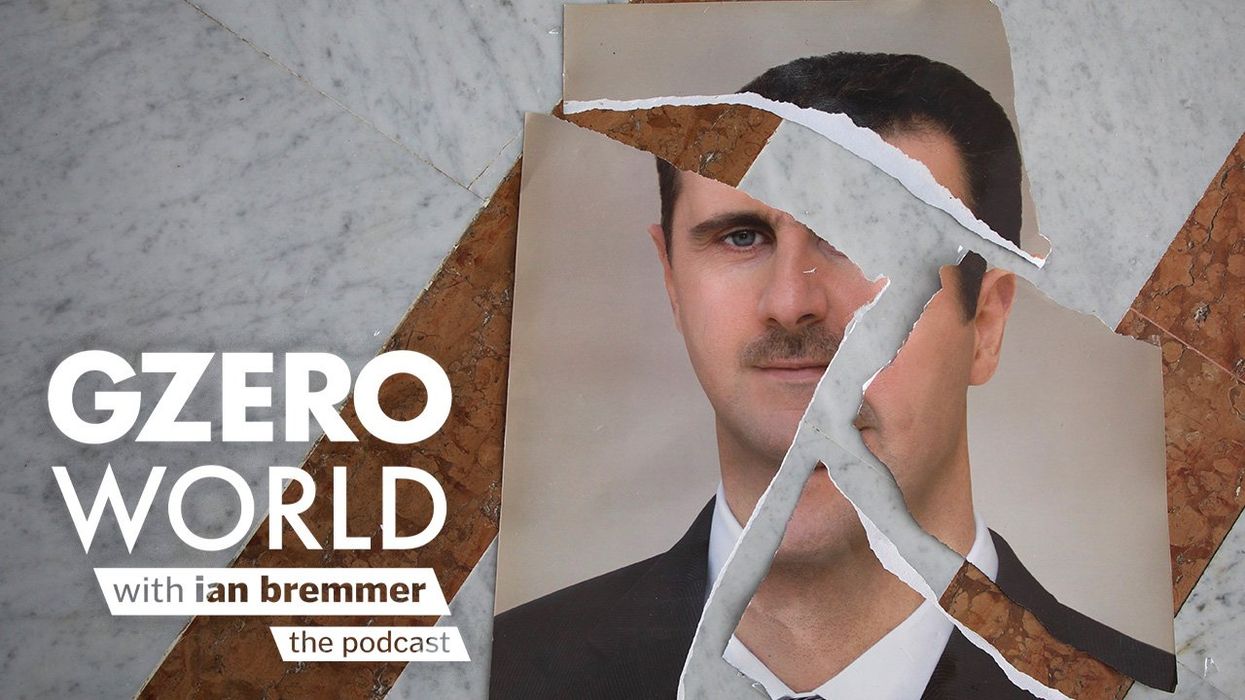
Photo illustration of Bashar al-Assad’s torn portrait, symbolizing the fractured state of Syria and the collapse of his regime and GZERO World with ian bremmer - the podcast

What's next for Syria after Assad, with Beirut-based journalist and author Kim Ghattas

Listen: After 14 years of brutal civil war and, recently, a largely frozen conflict, Syria's regime fell this week like a house of cards. So what comes next? Middle East expert and Beirut-based journalist Kim Ghattas joins Ian Bremmer on the GZERO World Podcast to help make sense of these shocking past few weeks and the potential power vacuum to come.

Transcript

Listen: How did Syria’s government rule with an iron fist for five decades, only to collapse in two weeks? And after 14 years of bloody civil war, why was now the moment that a frozen war exploded into the global spotlight? The cost Syrians have already paid is greater than any nation could reasonably be expected to bear. Since 2011, more than 500,000 Syrians have died, including 200,000 civilians, and nearly six million refugees flooded neighboring Arab States and some European nations, most notably Germany.

But what comes next? Nature abhors a vacuum, and so does geopolitics. Iran, Russia, Israel, the Gulf states, and the United States all have vested interests in Syria's future, a country that this week's GZERO World with Ian Bremmer Podcast guest calls "the crown jewel" of proxy influence in the Middle East. Here to help make sense of these shocking past few weeks and the potential power vacuum to come is Kim Ghattas, a contributing editor at the Financial Times and author of Black Wave.

Subscribe to the GZERO World Podcast on Apple Podcasts, Spotify, Stitcher, or your preferred podcast platform, to receive new episodes as soon as they're published.
Next Page

More from GZERO World Podcast

Winners and losers of the Iran war, with Kori Schake


Operation Epic Fury may be over, but the Iran war is far from resolved. On this week's episode, American Enterprise Institute Kori Schake joins Ian Bremmer to discuss the conflict's global ripple effects.

With the Strait of Hormuz effectively closed to commercial shipping, the US finds itself in what Schake calls a Mexican standoff, unable to force Iran's hand without dramatic escalation, and unwilling to accept the humiliation of ceding control of one of the world's most critical waterways. Meanwhile, Washington's two biggest rivals are gaining ground. Russia is cashing in on higher oil prices at a moment when the Kremlin was under mounting financial pressure over Ukraine.

In Beijing, the Trump-Xi summit took place with the White House in a weakened position. The US needs China's help pressuring Iran, and Xi knows it. As Schake puts it: "It's an important measure of just how much President Trump has lost in starting the war in Iran and pursuing it in the way he has, that he's having to go appeal to China, America's most powerful potential adversary, for assistance in delivering us from a problem of our own creation."

The costs for US allies are adding up too. Partner countries are absorbing economic pain they had no hand in creating, with energy prices squeezing European economies. Schake also raises a harder structural question: with Patriot systems redirected from Europe to the Gulf and munitions stocks stretched thin, the war has laid bare the limits of the American defense industrial base, and what it means for the credibility of US commitments around the world..

Three months into the Iran war, the Strait of Hormuz is in a standoff and the geopolitical fallout is spreading fast. Kori Schake of the American Enterprise Institute breaks down with Ian Bremmer... More >

How AI is transforming warfare and the US military with Katrina Manson


Ian Bremmer sits with Bloomberg defense tech reporter Katrina Manson, who spent years reporting on Project Maven for her new book on the Pentagon's AI push.

The program launched in 2017 with a narrow mandate: use machine learning to process drone footage. It has since expanded into something far more ambitious. Autonomous weapons, drone swarming technology, and AI-assisted targeting are now central to how the Pentagon talks about modern warfare.

The tech rollout is fast, but not reliable. Algorithms fail when the battlefield changes. The targeting process is accelerating to the point where operators are clicking through AI recommendations with little ability to question them. Manson says the military knows about AI's vulnerability "to sycophancy, to escalation, to bias and hallucination," and has not yet found adequate solutions.

Bremmer and Manson also take on the US-China AI race, the IDF's use of AI in Gaza, and what the Anthropic contract dispute reveals about the fault lines between commercial AI ethics and military requirements.


Subscribe to the GZERO World with Ian Bremmer Podcast on Apple Podcasts, Spotify, or your preferred podcast platform, to receive new episodes as soon as they're published.

Bloomberg reporter Katrina Manson joins Ian Bremmer to discuss Project Maven, the program that brought AI to the heart of US warfare, and the risks that come with it.... More >

Cuba's Trump standoff and economic crisis with Michael Bustamante

This week, Ian Bremmer sits down with University of Miami historian and Cuba expert Michael Bustamante to make sense of the US-Cuba standoff.

Keep reading... Show less

Historian Michael Bustamante joins Ian Bremmer to discuss Cuba's economic freefall, Trump's end game, and the hopes of Cuban Americans.... More >

North Korea's nuclear gamble pays off, with the WSJ's Jonathan Cheng

The Kim dynasty has outlasted every threat for 80 years. Wall Street Journal's Jonathan Cheng explains how, and why the Iran war just made Kim Jong Un seem untouchable.

Keep reading... Show less

None... More >

GZERO Podcasts

Three months into the Iran war, the Strait of Hormuz is in a standoff and the geopolitical fallout is spreading fast. Kori Schake of the American Enterprise Institute breaks down with Ian Bremmer... More >

Listen: What does global energy transition look like in a time of major geopolitical change, including rebalancing of trade? In this special episode of "Energized: The Future of Energy,” host JJ... More >

Creating artificial human retinas in zero gravity. Mining rare minerals on the moon. There seems to be no limit to what could be possible if we continue to take our more important industries to... More >

On Sunday, Colombians will have their say on their first left-wing leader, as they head to the polls to vote in the first round of the presidential election.... More >

In this episode of The Ripple Effect: Investing in Life Sciences, host Dan Riskin speaks with Patrick Horber, President of Novartis International, and David Gluckman, Vice Chairman of Investment... More >