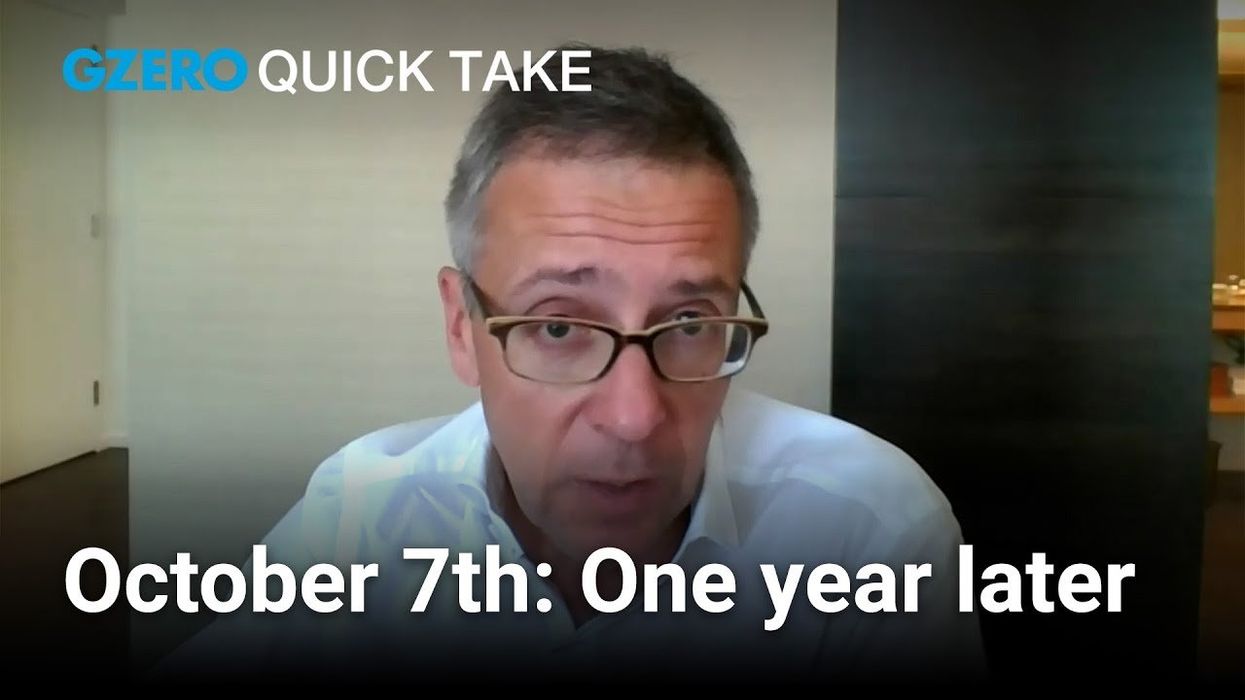
How October 7th changed Israel and the Middle East
October 07, 2024
Global Stage LIVE from United Nations WATCH REPLAY
Ian Bremmer, political scientist and president of Eurasia Group and GZERO Media, shares insights on global political events.
Presented by

Ian Bremmer's Quick Take: A Quick Take to kick off your week. It is October 7th, and that means one year since Hamas perpetrated the worst terrorist attacks since 9/11. Almost 1,200 Israelis dead, mostly civilians, and still a hundred plus held hostage from that day a year ago. Not much progress on that latter front or on a ceasefire. Not much progress in the region since then. What it did do, of course, on October 7th, is it outraged and unified what had been a very divided Israeli population, divided with massive internal demonstrations on domestic political issues. And suddenly the only issue that mattered was responding to, redressing those attacks, whether you're on the left or the right in Israel and being able to defend the Israeli homeland and get the hostages back.
On the former, they've certainly been effective, hitting back as hard as possible. We've seen that Hamas today is a shell of what it was on October 7th a year ago. The leadership mostly dead. The weapons caches mostly destroyed. The tunnels mostly sealed. Hezbollah, the most powerful non-state military actor in the world, has been damaged critically, and they started rocket attacks against Israel a day after the October 7th terrorist attacks. Israel has now opened up a second front, really the primary front now in the war, and after a couple of weeks of that war, Hezbollah's leadership is dead. Their communication capacity was critically destroyed. The war is ongoing but is certainly not going well for Hezbollah. On the one hand, you've seen a major escalation from the rockets and the bombing happening in Gaza to a ground war across the entirety of that territory now to Lebanon and with significant shots fired missiles and the rest military operations with Iran's other proxies, the Houthis and Yemen, Shia militants in Syria and Iraq, and of course involving Iran itself.
On the other hand, the capacity of these proxy organizations to escalate in return is now far, far less capable, far less serious. Hamas cannot threaten Israel the way they could on October 7th. Hezbollah certainly far, far diminished in their ability to escalate even if they want to. Two big questions are remaining. First, Iran. They are a country that still has all sorts of capabilities to escalate if they wish, possibly not effectively against Israel itself, but against the West, against the world. If they wanted to, they could completely disrupt oil tanker traffic through the Strait of Hormuz, and as a consequence, ensure that much of the oil that comes out of the Middle East, not just Iran's one and a half million barrels a day of export but from the Gulf states is stuck in place. And that would mean oil prices towards $150, even in a depressed demand environment as we see now, and a global recession.
So Iran's capacity, if they want to escalate, is far, far greater than that of Hezbollah or Hamas or anyone else in the region. And they have shown themselves to be quite risk-averse in response to Israeli strikes against Iranian leaders across the region, military leaders, and also against Hamas leadership in Tehran. And that was true back in April, and that was true back a week ago. But still, we are awaiting what is almost certainly going to be an Israeli response, a military response, against Iran for the 180 ballistic missiles that they launched against Israel with no fatalities in Israel. One in the West Bank of a Palestinian, but nonetheless, certainly could have caused a lot of people to be killed. And we will see if that the Israeli response leads to further Iranian escalation. I am at this point hopeful, and I would even say optimistic, that it does not, but optimism feels like exactly the wrong word to describe any of this in the region.
Then the second big question remaining is about the devastation on the ground. In Gaza, for the last year, a million and a half Palestinians are now living on the back of humanitarian aid of on average 125-ish trucks coming in a day. That's compared to 800 to 1000 on average before October 7th. As well as all of those tunnels which have now been sealed, they brought a lot of arms and illicit goods in. They also brought things like food, luxury food stuffs, and other things that you could buy on the gray market in Gaza. Those are closed, and there's no Gaza economy. There's no local Gaza agriculture right now. So the 1.5 million Palestinians are living in an absolutely unimaginable condition on single-digit percentage calories, many of them, in terms of consumption from what they would have been living on before October 7th.
Then you have the West Bank, which has been indirectly involved in the fighting. There's been a lot of skirmishing, a lot of shooting, a lot of people getting killed. And then also Israeli settlers and the IDF taking and securing more land from the Palestinians there. Then of course, in Lebanon in the last two weeks, you have over a million Lebanese who have been displaced from that fighting. Far more will be displaced in all likelihood in the coming weeks. All of this from a humanitarian perspective unacceptable by any yardstick. The United States seen by most of the world as complicit in watching it and not providing the either restraint on Israel or the humanitarian support effectively to help ensure that the suffering is reduced. And of course, this is going to cause hatred and radicalization for generations. And antisemitism was already way too high and on an upswing before October 7th, certainly only greater in this environment a year later.
And of course, with all of this, we don't know what's going to happen with upcoming elections. Kamala Harris came out on "60 Minutes" and described the United States as the best friend of the Israeli people around the world, refused to say whether or not the US was an ally of Prime Minister Netanyahu himself. A very strained relationship between the United States and the Israeli Prime Minister today. While former President Trump came out publicly in the last few days and said that the Israeli government, the Israeli military, should actively take out Iran's nuclear capabilities. So frankly, I would say between Harris and Trump, their policies, their orientation specifically on the Middle East and the Israeli wars in Gaza, in Lebanon, and the fighting we're seeing with Iran, probably the biggest difference on foreign policy between those two candidates would be on this issue. And we will find out in a month plus who is going to lead the United States, but utterly critical as we think about the future of this conflict in the region.
So that is where we are a year after the October 7th terrorist attacks, and now very deep in expanding war that is affecting much of the region. And I will continue to talk about it and follow it for you. So I hope everyone's going well, and I'll talk to you all real soon.





Keep up with what’s going on around the world - and why it matters.