Site Navigation
Latest Stories
Sign up for GZERO Daily.
Global Stage LIVE from United Nations WATCH REPLAY
Quick Take
Ian Bremmer, political scientist and president of Eurasia Group and GZERO Media, shares insights on global political events.
Presented by

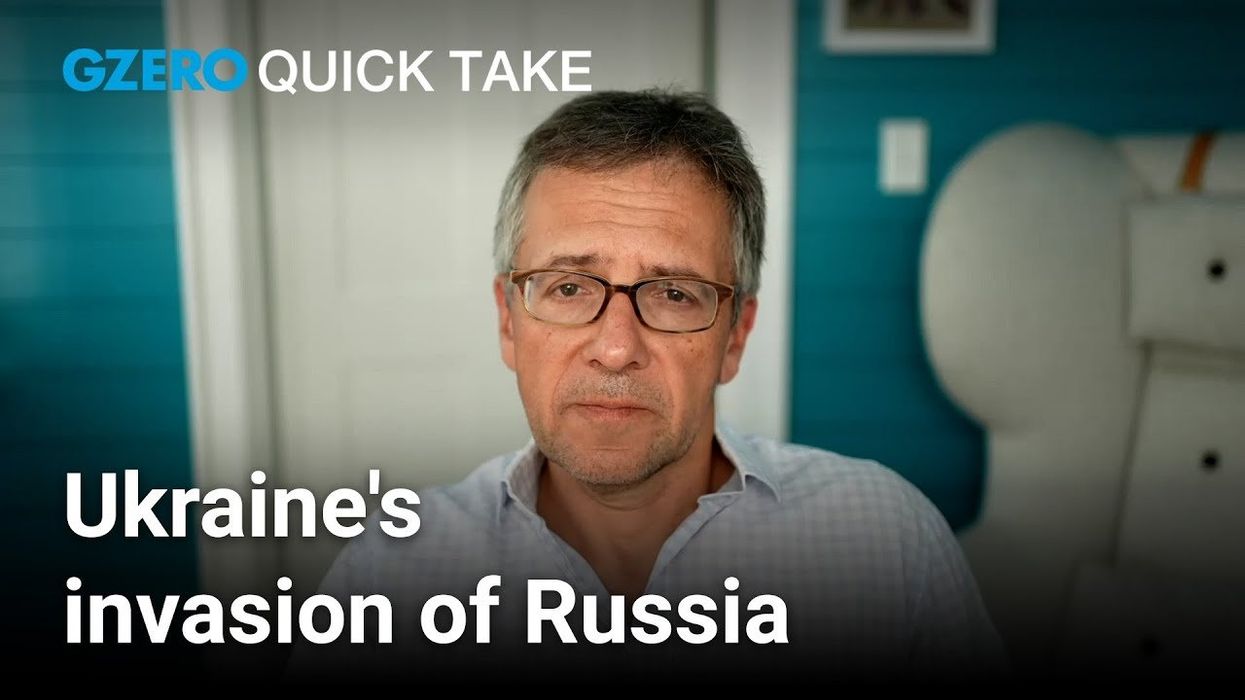
Ian Bremmer's Quick Take: A Quick Take to kick off your week. I wanted to talk a little bit about Russia/Ukraine before news in the United States and the Middle East take it off the headlines again.
The surprise, of course, is that the Ukrainians have invaded Russia. This was a substantial, you'd say more than an incursion, a significant amount of territory presently being held. The Russians have had to, as a consequence, announce a "counter-terrorism operation regime" in Kursk, in Bryansk, and Belgorod, not martial law, but still, that has reduced some of the forces that they can deploy in fighting the front lines in Southeast Ukraine. And it's also certainly embarrassed Putin, embarrassed his senior military leadership. This is supposed to be all about defeating the Ukrainians, and now the Russians have lots of citizens that are facing a war on Russian territory. Now, to be clear, the Ukrainians have no territorial claim on any part of Russia, but there is a feeling of turnabout is fair play.
What's going on here? I think there are a few things. First of all, the fact that the Ukrainians can put the Russians under some pressure domestically in a run-up to what everyone expects will eventually be negotiations helps to improve Ukraine's position. And no matter who you talk to, the Europeans, the Democrats in the US, the Republicans in the US, the feeling increasingly is that it is going to be harder for the Ukrainians to continue to fight and defend their territory the way they have for the last two and a half years. And so that means you need to have negotiations in the coming year. Part of that is because the Ukrainians aren't going to have the troops. Part of it is because it's getting harder to raise the money. And that's not just the United States, though there was a fight about that, and certainly it'll get harder next year, especially if Trump/Vance win, but also if Harris/Walz do, but also the Germans just cut back 50% of their expected support for the Ukrainian military in 2025, because they're under fiscal constraints, this is the largest European economy. So either way, there is a clear understanding from all sides that you want to move towards freezing the conflict at a minimum and negotiations and maybe a ceasefire and a longer-term settlement, more ambitiously. Much better from the Ukrainian perspective to do that if they have leverage over Russia too, and they have shown leverage. They can blow up the Black Sea fleet, which was important to Russia's national security, and they can put some areas of Russia, both in terms of missiles and alts and drones, but also in terms of Ukrainian troops at risk.
Now, can the Ukrainians hold Kursk from the Russians? Hard to imagine that. I expect that within the coming weeks they'll be forced out of that territory by the Russians. But clearly, they had the element of surprise. The Russians weren't ready to immediately defend or immediately counterattack against that incursion. So I suspect this is more about the broader negotiations between Russian Ukraine than the idea that there's going to be a territory swap. I don't think you'll get there. I also think there is a little bit of desperation. If you're the Ukrainians, remember, you're running out of troops. So sending more troops into Kursk makes you more vulnerable and weaker on the home front, especially when it's been harder and harder to mobilize those troops. And there's been political opposition to doing that. And I think that's because the Ukrainians understand that they need to make Russia feel insecure sooner rather than later, because it's going to be hard to keep this fighting up for another one, two years or more, irrespective of how the American election goes, but certainly, if it goes against the Ukrainians, that's going to be a problem for them. So this isn't all about that.
Also, we're learning more about Russian response. Let's keep in mind that we've heard from Russian leaders, including former President Medvedev and occasionally even Putin himself, that nuclear weapons, tactical nuclear weapons are on the table, and don't you dare, sort of, allow the Ukrainians to use weapons that could strike into Russia. Don't you dare hit Crimea. Don't you dare hit Russian territory. And every time those ostensible red lines have been broken, the Russian response has been dramatically more restrained than one might have expected from listening to Putin and the Kremlin at face value. That's useful because they've also said similar things about Ukraine in NATO and the West defending Ukraine. And if you're going to get to a negotiated settlement that is acceptable for the Ukrainians, which means that they're going to lose territory, they will be partitioned. They need to have the ability to defend their territory for the long-term in a credible way. And the best way to ensure that is get them into NATO. The best way to ensure that is to get them troops on the ground in territory that the Russians don't occupy.
Now, you can have an alliance, have security guarantees that don't include the entire territory. Japan, for example, has an alliance with the United States. It doesn't include the Northern territories, contested and presently occupied, some of them by Russia. So there's plenty of precedent here. But the point is that few in NATO believe today that Ukraine in NATO, especially the piece of Ukraine that isn't occupied by Russia in NATO, is an existential risk for World War III the way that many of them would've believed that when Russian retaliation and escalation was less known, was less experienced a year ago, certainly two years ago. So, that's interesting.
Final point I want to raise here is that whether Harris or Trump win the election in November, I think we are moving towards a similar outcome. In other words, both of these leaders would like to see an end to the fighting. Both of them would like to see a ceasefire. Both of them would like to see the west move on because they recognize the reality of the fighting on the ground, and in the case of Trump in particular, because he wants to say, "New wars started under Biden/Harris, I end them." The big difference between the two is that Trump is much more likely to make those decisions unilaterally. In other words, tell the Ukrainians and the Russians, "This is the deal, accept it or else," and not necessarily coordinate with NATO allies in advance. Where a Harris administration would be working closely in multilateral fashion with the Europeans and with the Ukrainians to try to get to a similar outcome. In other words, more risk acceptant towards that outcome on the Trump side, more risk averse and more coordinated with allies, harder to get done in some ways, under a Harris administration, but lower likelihood that it really blows up in your face. So how lucky do you feel is the open question, but not as dramatically different as the media would have led you to expect over the course of the past months talking about a potential Trump administration.
So that's a little bit from me on where we are, a very different position in some ways, in the Russia/Ukraine war today, and maybe even, I don't want to call it optimistic, but maybe seeing more of a pathway towards how this fighting can be frozen, if not ended. That's it for me, and I'll talk to you all real soon.
More from Quick Take
GZERO Series
Puppet Regime
Quick Take
ask ian
Ian Explains
GZERO Reports
GZERO Europe

The Debrief

Global Stage

GZERO Daily: our free newsletter about global politics
Keep up with what’s going on around the world - and why it matters.