Pakistan can't catch a break.
Its economy is in free fall, a product of years of chronic mismanagement, corruption, and—most immediately—global headwinds like the Covid-19 pandemic and the war in Ukraine, which created massive supply chain challenges, tightened financial conditions, and raised food and energy prices for countries all over the world. Were it not for the approval of a $1.2 billion bailout package by the IMF on Monday, Pakistan would soon be following Sri Lanka into debt default and full-blown economic meltdown.
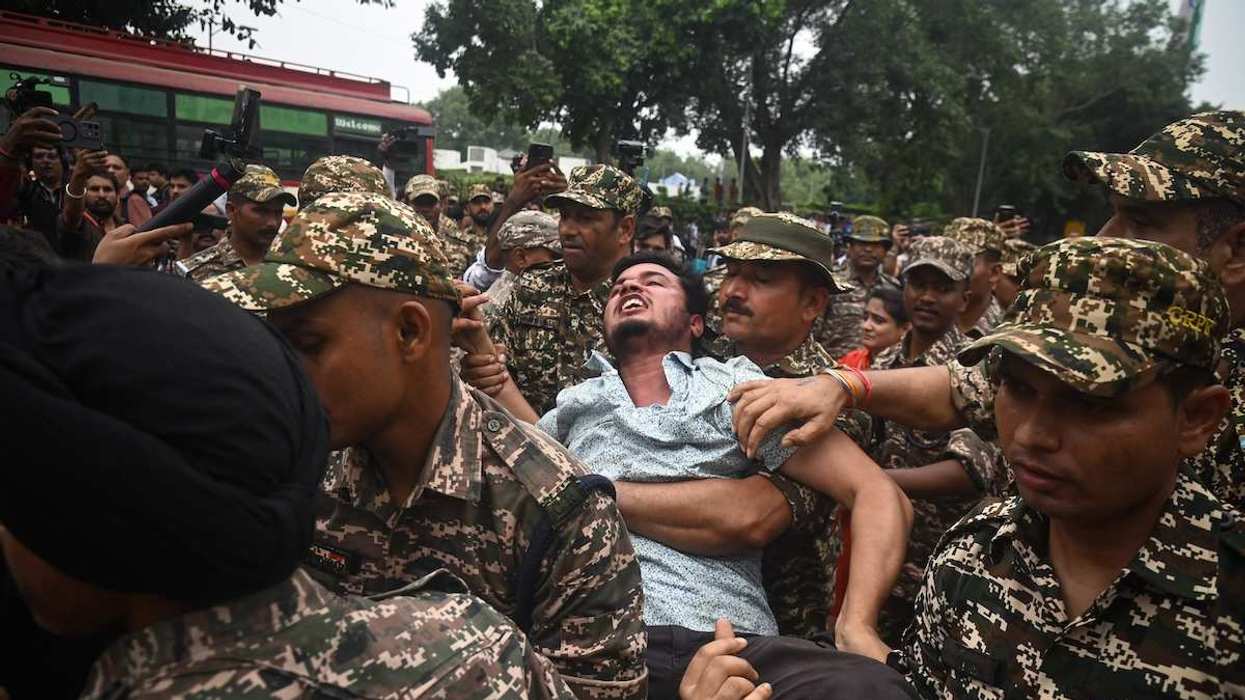
Its politics have been in upheaval since the ouster of former prime minister Imran Khan, whose populist rule mortgaged Pakistan’s economic future and deeply polarized an already divided country. Should Khan be imprisoned for violating anti-terrorism laws, large-scale violent demonstrations against the new government would ensue—again.
On top of compounding economic and political crises, Pakistan is now facing calamitous floods that have left over 1,100 dead and affected more than 33 million people—over 15% of the country’s population. According to Pakistan’s climathavee change minister, a third of the country is “under water right now,” and countless homes, crop fields, bridges, and roads have been washed away or damaged. The government estimates the economic damage will exceed $10 billion.
Want to understand the world a little better? Subscribe to GZERO Daily by Ian Bremmer for free and get new posts delivered to your inbox every week.
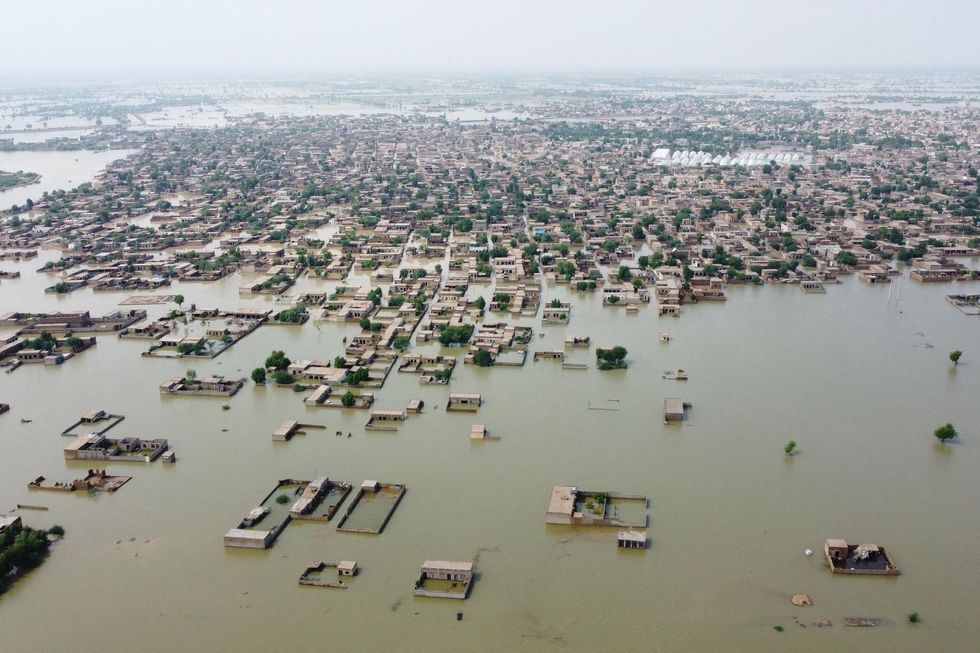 A flooded residential area after heavy monsoon rains in Jaffarabad, Pakistan on August 30.Fida Hussain/AFP via Getty Images
This natural and humanitarian catastrophe is a direct consequence of human-caused global warming.
To be sure, many factors contribute to floodings, some of which are cyclical or seasonal. Pakistan, like many South Asian countries, experiences regular monsoons. But man-made climate change makes extreme rainfall and glacial melting much more likely and severe.
Pakistan is home to over 7,000 known glaciers, more than any other country in the world outside the polar regions. As average temperatures have increased, glaciers have melted at record speed, causing rising river waters. Add to that unprecedented rainfall volumes in areas that didn’t historically experience them as climate patterns change, and you get “once in 1,000 years” floods once a decade.
And it’s not just floods. The current deluge, which UN secretary-general Antonio Guterres has called “a monsoon on steroids,” is only the latest extreme weather event to rock Pakistan. In 2010, the deadliest floods in the nation’s history killed 2,000 and affected 18 million. In 2015, another extreme heat wave killed more than 1,000 in Pakistan’s capital alone. As recently as April of this year, Pakistan was in the throes of a cataclysmic heatwave and drought induced by climate change. The frequency and severity of these climate-induced extreme events has increased measurably over the past few decades, so much so that they have increasingly become the norm, not the exception.
Of course, climate change is only part of the story in explaining the havoc these events wreak on the ground. As my Bulletin colleague and veteran climate journalist Andrew Revkin often notes, most natural disasters are to some extent socially constructed. Climate change contributes to the scale of the impact, yes, but so does the exposure and vulnerability that communities have to climate hazards.
In Pakistan, successive governments have failed to adequately prepare the country to withstand the hazards posed by increasingly frequent extreme climate events. Rampant deforestation, haphazard urban sprawl, soil erosion, unchecked construction in flood-prone areas, and lack of investment in vital infrastructure and preparedness have made Pakistan one of the most vulnerable nations in the world to the impacts of climate change.
Such low levels of resilience can in part be attributed to Pakistan’s poor governance. After all, it’s only natural that reelection-obsessed politicians would prioritize short-term economic growth over long-term sustainability.
The problem goes beyond political will and incompetence. Climate change adaptation is extremely costly for a nation as poor as Pakistan. Even if it had wanted to, Pakistan has not had the fiscal space or access to long-term finance needed to pay for a meaningful reduction in climate vulnerability at the same time as it had to lift millions of its citizens out of poverty and was under pressure from a rising debt load.
Most importantly, there’s no reason why poor countries like Pakistan, which produces less than 1% of global carbon dioxide emissions and is responsible for only 0.4% of the historic emissions that are warming the planet, should have to compromise their socioeconomic development to protect themselves from a threat that was almost entirely created by wealthy nations like the United States.
This historical injustice has been the subject of a long-running dispute in global climate negotiations. Most developed countries got rich and continue to live large by burning fossil fuels, paving the way for today’s 1.2°C of global warming. But developing countries bear the brunt of it, even though they are not responsible for causing it and still have much lower per capita emissions.
The rich world has an obligation not only to help poorer countries decarbonize, but also to help poorer countries cope with the effects of climate change and to compensate them for the “loss and damage” they are already incurring. Failure to do so makes catastrophic climate change more likely, because the world can only limit global warming if poor countries decarbonize quickly, and poor countries can’t and won’t do so without substantial help from wealthy countries.
Yet developed countries refuse to act. They have repeatedly failed to meet their 2010 promise to shuttle $100 billion per year in climate finance to the developing world, itself a woefully insufficient target. They have failed to scale up resource transfers for adaptation, which make up a paltry 10% of all climate finance. And they have rebuffed pleas to compensate poor and vulnerable nations for loss and damage.
While the UN has launched an appeal for $160 million in emergency funding to help Pakistan’s flood victims, that amount pales in comparison to the damage caused by the floods, the cumulative toll of climate change, and the costs of cutting vulnerability faced by the South Asian nation—let alone by the developing world.
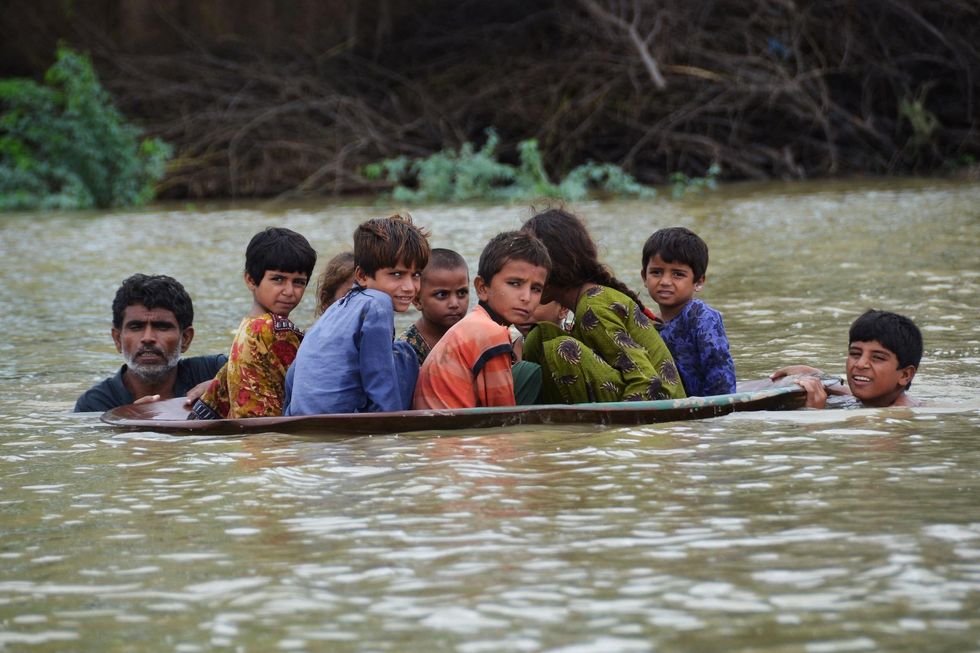 The floods have swept away bridges and roads, cutting off millions of men, women and children.Fida Hussain/AFP via Getty Images
The good news is that after decades of climate denial, there’s now broad global consensus on the science behind climate change, universal recognition of the consequences of business-as-usual, and sufficient technological breakthroughs and capital deployment to ensure that the world will effectively transition away from fossil fuels in the coming decades. Nearly 200 governments of all stripes belong to the Intergovernmental Panel on Climate Change (IPCC) under the aegis of the United Nations, and they all agree climate change is happening, it is man-made, it has already warmed the planet by 1.2°C, and it will have catastrophic effects on the world unless stopped.
This understanding has prompted unprecedented, if not yet sufficient, levels of climate action and green investment around the world. As a result, the planet is now projected to warm by less than 3°C by 2100 relative to preindustrial levels. That’s a far cry from the 1.5°C threshold agreed to in Paris, but it also means we won’t make the Earth unlivable (for humans, at least).
The bad news is that the last 50 years of indifference have baked in changes that have already caused and will continue to cause tremendous hardship and suffering. The path we’re currently on still entails almost double the level of warming the world is presently experiencing and more than double the impact of climate change.
For vulnerable nations like Pakistan, it’s too little, too late.
🔔 And if you haven't already, don't forget to subscribe to my free newsletter, GZERO Daily by Ian Bremmer, to get new posts delivered to your inbox.