Skip to content
Search

Latest Stories

Middle East

GZERO news and analysis about the Middle East

Presented by

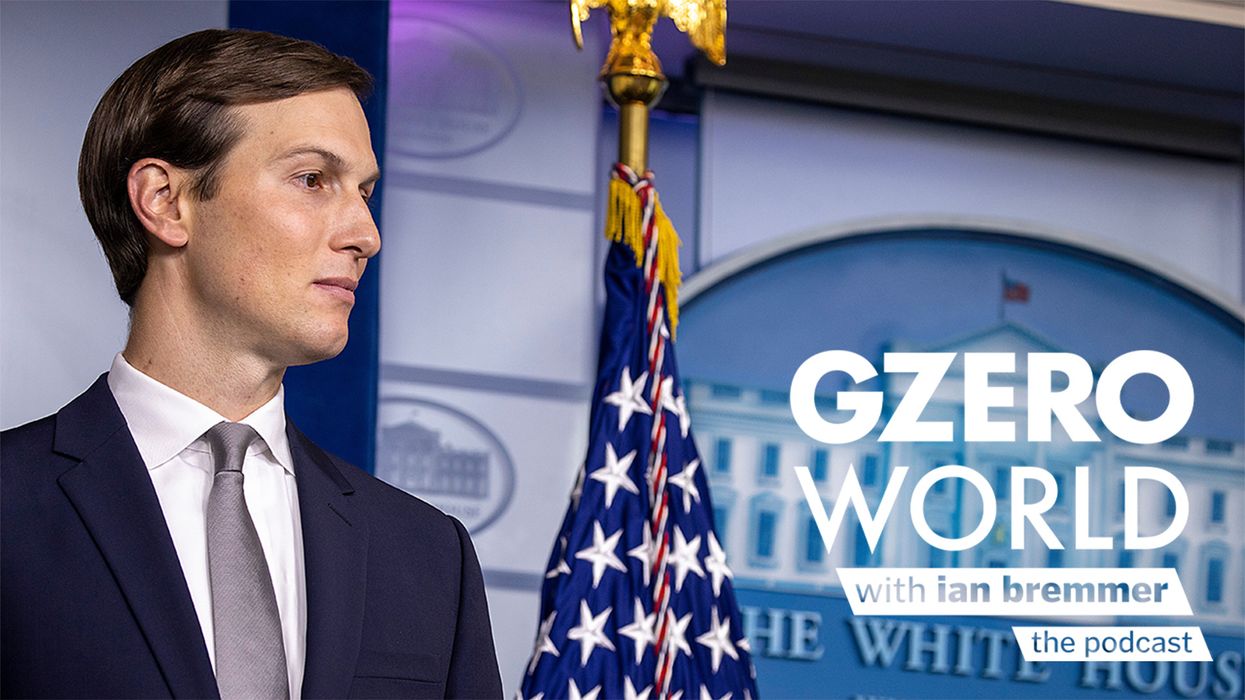
Jared Kushner in the White House - GZERO World with Ian Bremmer Podcast

Podcast: Jared Kushner on Middle East peace & pandemic in the US

Listen: President Trump's top advisor—and son-in-law—Jared Kushner joins Ian Bremmer on GZERO World.

Transcript

Listen: President Trump's top advisor—and son-in-law—Jared Kushner joins the GZERO World Podcast for an in-depth conversation with Ian Bremmer.

On the heels of a historic deal normalizing relations between Israel and the United Arab Emirates, Kushner discusses the latest development in a key mission of his tenure in the White House—moving closer to an elusive Middle East peace deal. Kushner also addresses the Trump administration's much criticized response to the COVID-19 pandemic and controversies surrounding President Trump's attack on voting by mail. He also previews future Iran and China policies should President Trump win a second term.
Subscribe to the GZERO World Podcast on Apple Podcasts, Spotify, Stitcher, or your preferred podcast platform to receive new episodes as soon as they're published.
Next Page

More from GZERO World Podcast

A "Mexican standoff" in Hormuz?

According to American Enterprise Institute's Kori Schake, when the US struck Iran, it was easily foreseeable that Tehran would move against the Strait of Hormuz. Washington failed to predeploy forces to counter that, and now the US is paying for it. The distant blockade prevents Iran from fully profiting from its position, but it doesn't reopen the waterway. Commercial shipping won't run the risk of a potentially mined strait, and the US isn't willing to force the issue.

That leaves two options, neither good, Shake says. Dramatic escalation, after 37 days of intensive military operations failed to produce Iranian capitulation, or accepting that Iran controls one of the world's most critical chokepoints. As she puts it: "We're at a Mexican standoff with the Iranians, which means we're gonna have to negotiate some kind of arrangement that's not just in our interests but also in their interests to get them to release the chokehold on the strait."

The most likely path forward is a drawn-out negotiation, with Washington hoping economic pressure on Tehran outlasts economic pressure on everyone else. But that is a bet, not a strategy, and every week the Strait stays closed, the costs mount for US allies, global markets, and the credibility of American military power.

The US and Iran are deadlocked over the Strait of Hormuz. Kori Schake and Ian Bremmer discuss what went wrong, and what Trump's options are.... More >

The Iran war's global fallout (so far)

The Iran war has had a ripple effect on the global economy and international relations way beyond the Middle East. Kori Schake of the American Enterprise Institute joins Ian Bremmer to discuss how the conflict is redrawing power for the US, Russia, China, and America's allies.

Keep reading... Show less

The Iran war has had a ripple effect on the global economy and international relations way beyond the Middle East. Kori Schake of the American Enterprise Institute joins Ian Bremmer to discuss how... More >

Why Trump can't find the exit ramp in Iran

A ceasefire is holding, barely, but the US blockade of the Strait of Hormuz isn't forcing real concessions from Tehran. Iran is betting Trump has no appetite for renewed war, and they may be right. Gas prices are climbing toward $5 a gallon and a global recession looms.

Meanwhile Russia is cashing in. Higher oil prices are refilling Kremlin coffers just as pressure over Ukraine was mounting. Patriot systems meant for Kyiv are now guarding Gulf infrastructure.

And China is playing it smart. With Trump heading to Beijing needing Xi Jinping's help to stabilize the Strait, Beijing has leverage on trade, minerals, and fentanyl, and it knows it. Ian Bremmer explains why the president who promised quick victories looks increasingly trapped.

The Iran war is entering its third month with no clear exit. What does the standoff mean for the US, Russia, and China? Ian explains.... More >

The Gulf rift gets ugly

For many years, mutual concern about Iran helped to paper over deeper disagreements between Saudi Arabia and the UAE. The two powerful and ambitious Sunni Gulf monarchies have been on opposite sides of the civil wars in both Sudan and Yemen, as well as in fierce competition for regional dominance in AI.

But two months into the so-far unresolved Iran war – which has exposed both countries to retaliatory attacks from Tehran – those differences have become a full scale rupture. The starkest moment of divorce was probably April 28th, when the Emiratis announced that they would be leaving the Saudi-dominated OPEC oil cartel after nearly seven decades.

To better understand the tensions between Abu Dhabi and Riyadh, as well as the fallout of the UAE’s decision to “OPEC-xit,” GZERO spoke to one of the top analysts of the Gulf: Eurasia Group’s very own Firas Maksad. This conversation has been edited for length and clarity.

Keep reading... Show less

To understand the deepening rift between the UAE and Saudi Arabia, following the UAE's exit from OPEC, GZERO spoke with Gulf expert Firas Maksad. He breaks down the tensions between Abu Dhabi and... More >

GZERO Podcasts

Three months into the Iran war, the Strait of Hormuz is in a standoff and the geopolitical fallout is spreading fast. Kori Schake of the American Enterprise Institute breaks down with Ian Bremmer... More >

Listen: What does global energy transition look like in a time of major geopolitical change, including rebalancing of trade? In this special episode of "Energized: The Future of Energy,” host JJ... More >

Creating artificial human retinas in zero gravity. Mining rare minerals on the moon. There seems to be no limit to what could be possible if we continue to take our more important industries to... More >

Chris, an Army veteran, started his Walmart journey over 25 years ago as an hourly associate. Today, he manages a Distribution Center and serves as a mentor, helping others navigate their own paths... More >

In this episode of The Ripple Effect: Investing in Life Sciences, host Dan Riskin speaks with Patrick Horber, President of Novartis International, and David Gluckman, Vice Chairman of Investment... More >