
Podcast: Italy In Europe's spotlight: insights from former PM Enrico Letta
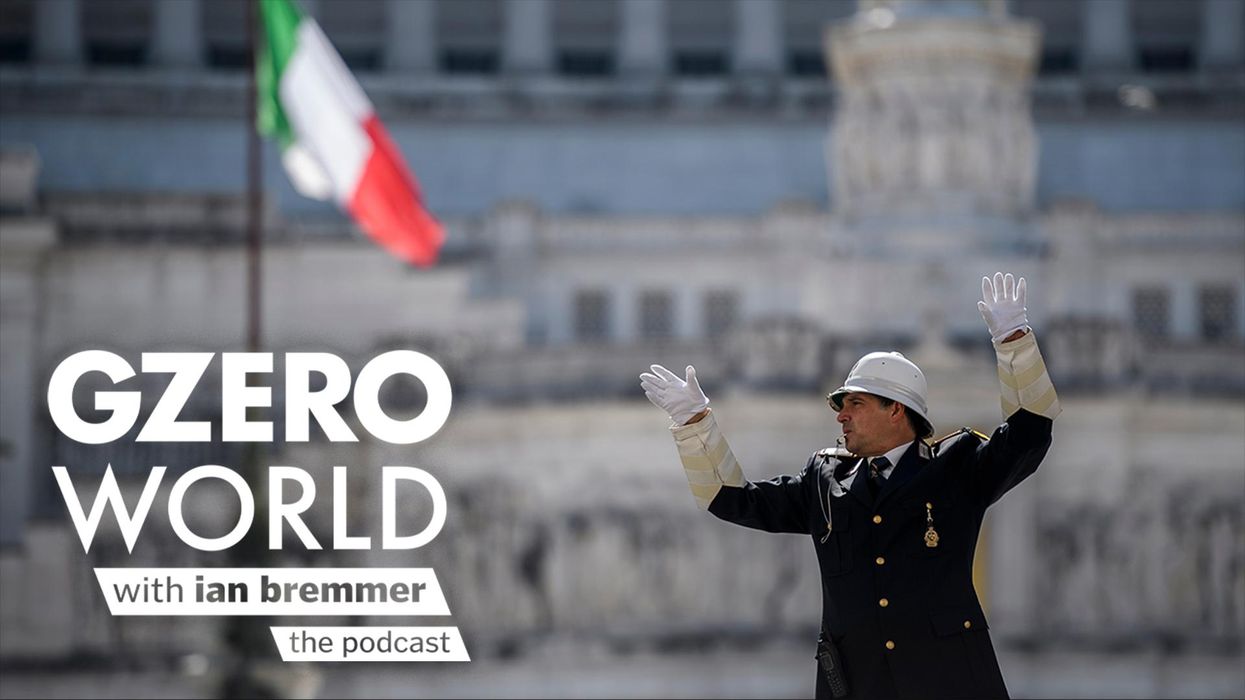
Listen: Italy's new leader, Mario Draghi (nicknamed "Super Mario") looks like he just might break the mold and deliver positive change—and political stability—to Italy. That's according to Enrico Letta, one of Italy's six prime ministers to have resigned in the last ten years. Letta joins Ian Bremmer on this episode of the GZERO World podcast.
TRANSCRIPT: Italy In Europe's spotlight: insights from former PM Enrico Letta
Enrico Letta:
We had in the last 10 years, seven governments, six different prime ministers, and six different majorities. So I think we have a problem.
Ian Bremmer:
Hello and welcome to the GZERO World Podcast. Here you'll find extended versions of the interviews from my show on public television. I'm Ian Bremmer, and today we're taking a look at Italy. It was the first European nation on lockdown last year, and very quickly became the epicenter of the pandemic. The world watched in horror, wondering what exactly was making its way around the globe. Today with more than 100,000 dead, a quivering economy and a brand new prime minister, Mario Draghi, the nation faces unprecedented challenges, but could be poised to come out the other side stronger if the right choices are made. My guest today has been in that hot seat himself. Enrico Letta served as Italy's 55th Prime Minister. He's recently returned to his country as the leader of the center left Democratic Party there. We've got lots to discuss, so let's get right to it.
Announcer 4:
The GZERO World Podcast is brought to you by our founding sponsor, First Republic. First Republic, a private bank and wealth management company, places clients' needs first by providing responsive, relevant, and customized solutions. Visit firstrepublic.com to learn more.
Ian Bremmer:
Prime Minister Enrico Letta. You were prime minister of Italy 2013, 2014. Then you went to teach at Sciences Po in Paris and now you're back to run the Democratic Party of your country.
Enrico Letta:
Maybe I'm a little bit crazy, but politics is a virus. It's a virus where I think there's no vaccine. So I decided to go back and to try to save the party that I founded 14, 15 years ago. There was a crisis, a big crisis, and without a strong Democratic Party at the very center of the system, it could have been a very complicated journey. So I think it is good for Italy. It is good for my party.
Ian Bremmer:
So maybe I'll start with that. How much of this is related to the response to this greatest crisis of our lifetimes, the pandemic? Because your country right now is slipping back into a third lockdown and I mean obviously we in the United States remember back in March the deaths that were coming out, the hospitals that were overwhelmed in North in Italy. How does it feel? How does it look? How are the citizens reacting to this continued, very serious, very urgent challenge of coronavirus right now in your country?
Enrico Letta:
It is not easy. It is very complicated. This fatigue is something that is very wide. I think now we are able to allow economy to work even in a pandemic period, even in a lockdown period. That was not the case one year ago when in three months, March, April, May, everything was stopped. But of course, I think the key problem in terms of sort of collective psychology is the vaccine campaign. Because if we are able to see the possibility to have the end or to have a decrease, and to have some hope, to have the vaccine campaign, showing that it works. So we are in a mixed feeling situation, a sort of turning point. I think April will be a month in which we will understand whether we can decrease definitely in terms of death or in terms of negative figures. In that case, I think this fatigue also will decrease and we can look at the future with more optimism.
Ian Bremmer:
But when it comes to the health response in the pandemic, of course there's been nothing but negative headlines coming out of Europe recently in terms of the slowness of procuring vaccines, of rolling them out, this debacle around the suspension of AstraZeneca. While the United Kingdom, despite having botched Brexit, one of the countries that's rolling out vaccines faster than anywhere else in the world. Talk a little bit about how we should think about those things.
Enrico Letta:
It is exactly the consequence of a lack of Europe of health. You have to know that on social policies and on health policies, Europe was without any common policy for the treaties. In the treaties, you don't have the possibility to have social, common policies on health, common policies. So March '20, when we started facing the pandemic, I think the reaction of the people was a reaction of why don't we have a European response? But European Union was without any competence in that field and even what you mentioned, very correctly, and the fact that the UK is better performance than European Union on vaccines for instance, it is exactly the demonstration of the fact that we don't have at European level, these competencies.
So I attach a great importance, a big importance, what will start in the next months, at European level, we will have for the entire year. From May to May next year, we will have the conference on the future of Europe that will start and will work on new European institutions and Ursula von der Leyen, in her speech, September the 16th on the State of the Union, she launched the idea that this conference has to create Europe of health, giving competences, I think changing treaties on that. It is the only possibility to avoid, to repeat the same mistakes of this Europe.
I think Brexit helped us, I have to say very clearly, because the UK was the country putting vetoes to more integrated European responses and to have them not on board today is allowing us, all of us, to go further and to have more integrated European policies in terms of health. We can build up today, Europe of health. It was impossible years ago because the UK vetoed these kinds of solutions. And it is clear that for citizens today, having Europe of health and having communitarian policies for health is a plus. It is not a minus.
So I think we are entering a period that can be interesting for democratic values. And I have to say also that what happened in the US is pushing in that direction. But I repeat, these mistakes are not there because of Europe, they're there because of the lack of Europe.
Ian Bremmer:
I'll get to the US side in a second, but I want to push you a little bit on this idea that the EU coming together on health is a positive for European integration. So just to be clear, the perception that the EU was dragging its feet, that the regulations were challenging, that they were pushing too hard to get reduced prices as opposed to ... Which they got. I mean, they ended up negotiating better prices for these vaccines, but it was a much longer negotiations process than the Americans, the United Kingdom, who paid a higher price but were three months ahead of the curve. You're saying that this is really because the EU didn't yet have any processes or competencies around this. We shouldn't be blaming von der Leyen for these challenges at this point.
Enrico Letta:
I think she did a very good job last year on the recovery plan because the recovery plan is in the hands of the treaties. They are giving the European Union the competence on these topics. That is not the case on health, on vaccine, on other issues where the European countries decided to have an inter-governmental cooperation on these topics. But maybe it is not enough. So I don't want to say that everything would be perfect in another treaty situation. I would like to say that we have to know that we don't have, at European level, enough competencies on that, and this is a big problem and that is creating part of the issues that you mentioned.
Ian Bremmer:
Now, you had also said before, and it was quite an interesting comment, so I don't want to just leave it there, that you thought that what's happening in the United States right now is also helping the Europeans on the continent to strengthen the EU. What did you mean by that, Enrico?
Enrico Letta:
I think Trump in the four years at the White House was an enormous boost for populism in Europe. It was a boost, Trumpism was a boost because the White House, it is a sort of world megaphone of what you are saying. The world public opinion was following Trump's ideas, Trump's messages because of course president of the US has the possibilities to link what he says with the acts, with the actions. So the advertising, the fact that the visibility of what Trump said in the four years legitimated a lot what European populists did.
And the lack of Trump at the White House today is a big problem for them. I have to say that in the last two months, personally, I didn't know anything about Trump and about what Trump said, did. And in the last four years, every day, morning, afternoon, and evening, there was reporting something about Trump. So the lack of Trump in the landscape is a big problem for populists in Europe, because Trump gave a lot of legitimacy to their disruptions, their behaviors, their languages.
It is not by chance that, for instance, in Italy, the pro-Trump party, so Salvini's party, decided to support, today, Draghi's government with us. And Draghi's government, and Mario Draghi himself is exactly the opposite of Donald Trump. Mario Draghi is the champion of multilateralism. Mario Draghi is the champion of cooperation at the European level. And Trump, in the four years at the White House, was the most relevant enemy of European integration. I don't want to say of Europe. I say of European integration because he said clearly that he was pushing for intergovernmental cooperation, bilateral cooperations.
Ian Bremmer:
And he was a strong supporter, of course, of Brexit. A very visceral and vocal one.
Enrico Letta:
Of course, of course. So I think today we are taking advantage of this new landscape. It is something very positive. We had, last year, an increase in the popularity of the European Union because of the solidarity measures. Now we have not to waste this opportunity in favor of Europe.
Ian Bremmer:
So at least as much of a surprise as you coming back into politics, former prime minister, is also Mario Draghi, known as Super Mario, now running your country's government. For those around the world watching the show who don't necessarily know as much about him, tell us who Mario Draghi is in your view.
Enrico Letta:
Mario Draghi in Italy is considered–and not only in Italy, but in Italy, this perception is higher than worldwide–is the one who saved the euro and saved the country and European integration in the previous crisis. Mario Draghi is the one who said, "Whatever it takes, we will save the euro." And he said this statement July 26th, 2012 in London, when we were at the very heart of the tremendous crisis, previous crisis. And since he said, "whatever it takes", the solution of the crisis started to happen. So Mario Draghi is considered someone who knows where it is possible to find solutions, someone who has credibility worldwide.
I think it is very important, also, the fact that Italy will lead G20 this year. I attach great importance to G20. In my experience, G20 is one of the most interesting news, positive news at world leveling international relations. We didn't succeed in reforming the UN and the G20 is a sort of reform of the UN without reforming the UN. It's a place where you can have the most important countries around the world, around the table, with the possibility to talk. I attended one G20. I can tell you that it is the only place where you can meet all the leaders at world level. You can find a way to find solutions, to share analysis and solutions. So Italy is leading G20 and Mario Draghi, leader of G20, I think, is also a way for Italy to be at the center of the stage.
He has, because of his credibility, a large support in the country and in the parliament. That, for Italy, is something very positive because it allows him to spend time in the domestic problems of Italian politics. When I was prime minister, I was obliged to spend part of my time and try to understand and to find solutions, to find the right compass, to find the right track and so on. For him is the possibility to avoid all this part in terms of domestic issues, domestic political issues. So I think Draghi's credibility and what he did in the past will help him a lot. I think he has the protection of the president of the Republic in Italy and the protection of the public opinion because the public opinion today is supporting him very much so.
Ian Bremmer:
On the global stage, does he get to inherit Angela Merkel's position to a degree? I mean, Italy is not Germany. The economy is smaller. Your governments do not last very long, but Merkel is leaving. And if you consider Emmanuel Macron a very strong figure, but also a polarizing one. I mean Mario Draghi is the figure on the European stage that is, as you say, identified most closely with saving Europe. How significant is that from an EU perspective over this next year or two?
Enrico Letta:
It is clear that at European level he was warmly welcomed. It's the way to reinforce the European Council and the sort of pro-European integration model, because Mario Draghi saving the euro as he did is considered of one of the fathers of the European integration. So I think it was good news for Europe. It was welcomed as a good news for Europe.
You mentioned Angela Merkel, you mentioned Germany. I think we have to follow, very closely, September German elections. Because it is the first time in German history that you have the chancellor not a candidate again. And so it is not clear and not easy to understand what will be the consequence of not having the chancellor in the race. It is not easy to understand who will be the new leader of the country. So it is probable that Germany for some months after September will live in a not easy transition.
I have to say also that in the same period, May next year, France will have presidential elections. It will be a period of instability. So I think for Europe to have Mario Draghi there. I think it is good news in this probable period of instability that German and French elections will bring.
Ian Bremmer:
So finally, if I want to bring stereotypes into this, you think about Italian cars, you say, "Oh, they're always going to be in the shop." You think about Italian governments, they're always falling apart. You've had 68 governments in 75 years. What's the strangeness of governance in Italy?
Enrico Letta:
I think we have a problem. Houston, we have a problem. We had, in the last 10 years, seven governments, six different prime ministers and six different majorities. And I think it's too much. So I think we have a problem. The problem is related also of the instability of political parties and political forces.
This is why when they asked me to come back and when they said, "You are the only one", for me, it was very complicated to say, "Hey guys, I'm very good in Paris..." Because there's something that is today very important. That is the fact that politics is in an evolution. And this evolution, we have to fight. We have to try to renew the way in which political parties are working. We have to apply digital transformations to political parties. We have to make internal democracy evolving. We have to create a new way to have democratic values and to have democracy in our countries. And it is a fantastic challenge for someone like me who loves politics, who taught politics.
And now when they ask me, "Why don't you try to apply what you taught or what you thought?" I have to say, and that for me, the most important push was six years that I spent with young people. I spent six years in Paris with fantastic young people worldwide, people coming from the rest of the world with a lot of Italians studying there. And for me, this generation, the generation in their twenties or thirties, it was a fantastic boost for me to learn something, to be obliged to change. Now I think I'm a different person and this is why I'm a little bit crazy maybe in this journey. But I'm happy because this journey will be very interesting for me and I hope very useful for the country.
Ian Bremmer:
Prime Minister Enrico Letta. He is back whether or not you missed him. Great to see you.
Enrico Letta:
Thank you. See you soon.
That's it. For today's edition of the GZERO World Podcast. Like what you've heard? Come check us out at gzeromedia.com and sign up for our newsletter, Signal.
Announcer:
The GZERO World Podcast is brought to you by our founding sponsor, First Republic. First Republic, a private bank and wealth management company, places clients needs first by providing responsive, relevant, and customized solutions. Visit firstrepublic.com to learn more.
Subscribe to the GZERO World Podcast on Apple Podcasts, Spotify, Stitcher, or your preferred podcast platform to receive new episodes as soon as they're published.