
Skip to content
Search

Latest Stories

The United States will no longer play global policeman, and no one else wants the job. This is not a G-7 or a G-20 world. Welcome to the GZERO, a world made volatile by an intensifying international battle for power and influence. Every week on this podcast, Ian Bremmer will interview the world leaders and the thought leaders shaping our GZERO World.

Presented by

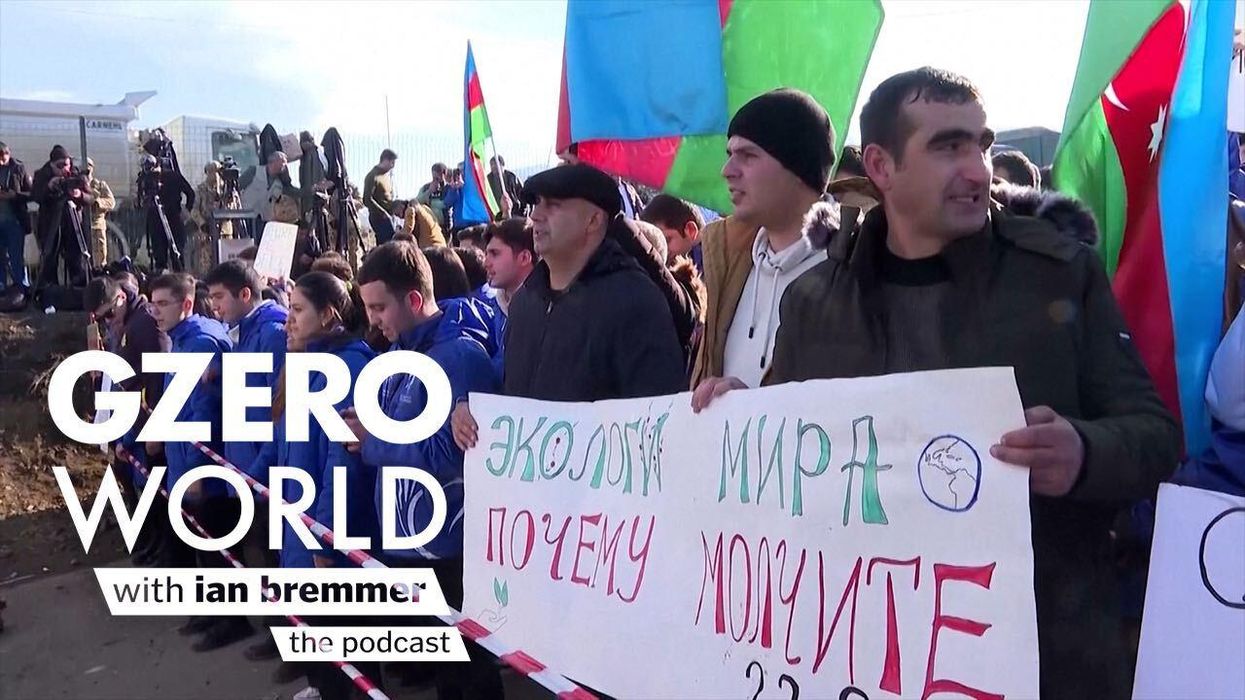
Nagorno-Karabakh protests | GZERO World with Ian Bremmer - the podcast

Special podcast: View from "fully blockaded" Nagorno-Karabakh during Armenia's conflict with Azerbaijan

Listen: The people of the small Armenian enclave known as Nagorno-Karabakh have no way to get out. Recently, the long-simmering conflict in Nagorno-Karabakh has once again heated up with Armenia accusing Azerbaijan of blocking the only road that connects the disputed region with Armenia. The Azeris deny this and blame Russian peacekeepers. There are extremely heated opinions on both sides to this issue. Regardless of where the blame lies, the humanitarian risks to the region are growing. 30,000 kids cannot go to school as roads and gas have been cut off. Food can't be brought in because the airport is closed. In a special edition of the GZERO World podcast, Ian Bremmer speaks to Ruben Vardanyan, who last month became state minister in charge of Nagorno-Karabakh, which the Armenians refer to as Artsakh. Vardanyn discusses the blockade and reality on the ground, his region's hope for democracy, and the history of Artsakh's 30-year struggle to break free of Azerbaijan, whose government does not recognize the territory as independent.

Listen: The people of the small Armenian enclave known as Nagorno-Karabakh have no way to get out. Recently, the long-simmering conflict in Nagorno-Karabakh has once again heated up with Armenia accusing Azerbaijan of blocking the only road that connects the disputed region with Armenia. The Azeris deny this and blame Russian peacekeepers. There are extremely heated opinions on both sides to this issue. Regardless of where the blame lies, the humanitarian risks to the region are growing. 30,000 kids cannot go to school as roads and gas have been cut off.

Food can't be brought in because the airport is closed. In a special edition of the GZERO World podcast, Ian Bremmer speaks to Ruben Vardanyan, who last month became state minister in charge of Nagorno-Karabakh, which the Armenians refer to as Artsakh.


Vardanyn discusses the blockade and reality on the ground, his region's hope for democracy, and the history of Artsakh's 30-year struggle to break free of Azerbaijan, whose government does not recognize the territory as independent. Before the fall of the Soviet Union, people living in the Nagorno-Karabakh Autonomous Oblast voted in a referendum to become free from the Azerbaijan Soviet Republic. Now, Russian peacemaking forces won't commit to staying very long in the region, and the European Union and the US have called for an end to the blockade. How will a resolution be reached, and what impact might this have on the Armenia/Azerbaijan peace agreement?

Subscribe to the GZERO World Podcast on Apple Podcasts, Spotify, Stitcher, or your preferred podcast platform, to receive new episodes as soon as they're published.
More from GZERO World Podcast

Singapore's global moment, with President Tharman Shanmugaratnam

How does a small country like Singapore, strategically positioned between the US and China, navigate a world of growing uncertainty? On the GZERO World Podcast, Ian Bremmer sits down with Singapore’s President Tharman Shanmugaratnam to unpack a global order in flux. For a small country at a global crossroads, managing the current geopolitical moment isn't an abstract concept. It is central to its survival. Despite "radical uncertainty," the city-state has continued to flourish as a global hub for finance, trade, and technology.

Keep reading...Show less

How does a small country like Singapore, strategically positioned between the US and China, navigate a world of growing uncertainty? On the GZERO [...]

More >

Europe's wake-up call, with Alexander Stubb and Kristalina Georgieva

The GZERO World Podcast heads to Davos, Switzerland for the World Economic Forum this week for a look at transatlantic relations and how President Trump’s second term is reshaping the global order. Uncertainty and tensions were high this week as Trump doubled down on his desire to control Greenland—before announcing a deal with NATO over the Danish territory’s future and walking back tariff threats. Ian Bremmer spoke with Finnish President Alexander Stubb on the sidelines of Davos to discuss the future of the transatlantic relationship, Arctic security, the war in Ukraine and why, despite so many geopolitical challenges, Europe is more united than ever.

“Trump has a different type of way of doing foreign policy, and a lot of it is actually quite effective,” Stubb says, “ I feel that the US, Ukraine, and Europe, we're now on the same page.”

Then, Bremmer sits down with Kristalina Georgieva, Managing Director of the International Monetary Fund, for a look at the surprising resilience of the world economy. Georgieva says there are four key reasons why the IMF upgraded its global growth forecast for 2026. They also discuss the importance of independent central banks and Trump’s push for more control over Fed policy.

Subscribe to the GZERO World Podcast on Apple Podcasts, Spotify, Stitcher, or your preferred podcast platform, to receive new episodes as soon as they're published

The GZERO World Podcast heads to Davos, Switzerland for the World Economic Forum this week for a look at transatlantic relations and how President [...]

More >

Trump's second term–one year in, with Stephen Walt


It’s been a year since President Trump returned to office, this time with fewer constraints, a better understanding of how government works, and a much more muscular view of US foreign policy. This week on the GZERO World Podcast, Harvard’s Stephen Walt joins Ian Bremmer to help answer a simple question with complicated answers: what kind of presidency is he building this time around?

Over the past year, we’ve seen a dramatic expansion of presidential power and a rewriting of America's role in the world. There’s been a retreat from multilateral institutions, targeting of long-standing allies, and a view of global politics where great powers dominate, and weaker ones fall in line. It’s a big departure from 80 years of the postwar order America spent building and leading. How much more will change by the time he leaves office?

“A lot of the things that Trump has done are not surprising in terms of where he's trying to take things. People knew he was going to get tough on tariffs. They knew he was going to be harsh on Europe,” Walt says, “I'm surprised not by the direction things have gone, but by the speed and scope by which things have changed.”

Subscribe to the GZERO World Podcast on Apple Podcasts, Spotify, Stitcher, or your preferred podcast platform, to receive new episodes as soon as they're published

It’s been a year since President Trump returned to office, this time with fewer constraints, a better understanding of how government works, and a [...]

More >

Venezuela after Maduro with Sen. Gallego and Frank Fukuyama


The United States has pulled off a stunning operation in Venezuela, capturing longtime strongman Nicolás Maduro and bringing him to New York to face federal charges. For President Trump, it was a dramatic show of force, executed without US casualties and framed as proof that American dominance in the Western Hemisphere is back. But once the dust settles, far bigger questions remain. What happens when a regime falls but the system behind it stays intact, and who takes responsibility for what comes next?

Keep reading...Show less

The United States has pulled off a stunning operation in Venezuela, capturing longtime strongman Nicolás Maduro and bringing him to New York to face [...]

More >

GZERO Podcasts

How does a small country like Singapore, strategically positioned between the US and China, navigate a world of growing uncertainty? On the GZERO [...]

More >

Listen: What does global energy transition look like in a time of major geopolitical change, including rebalancing of trade? In this special episode [...]

More >

Listen: Creating artificial human retinas in zero gravity. Mining rare minerals on the moon. There seems to be no limit to what could be possible if [...]

More >

At the Munich Security Conference, the mood is clear: Europe no longer assumes the United States will lead.Ian Bremmer reports from Munich, where [...]

More >

Transcript Listen: “The equivalent of what we spent in World War II was spent in the course of a year and a half to support the US economy, and that [...]

More >

Listen: Investing in health and science research isn’t just about curing diseases. It has huge impacts across society, from creating jobs to driving [...]

More >

In this episode of Local to global: The power of small business, host JJ Ramberg sits down with Shamina Singh, Founder & President of the Mastercard [...]

More >