Israel strikes: Why Hezbollah remains silent
September 30, 2024
Global Stage LIVE from United Nations WATCH REPLAY
Ian Bremmer, political scientist and president of Eurasia Group and GZERO Media, shares insights on global political events.
Presented by

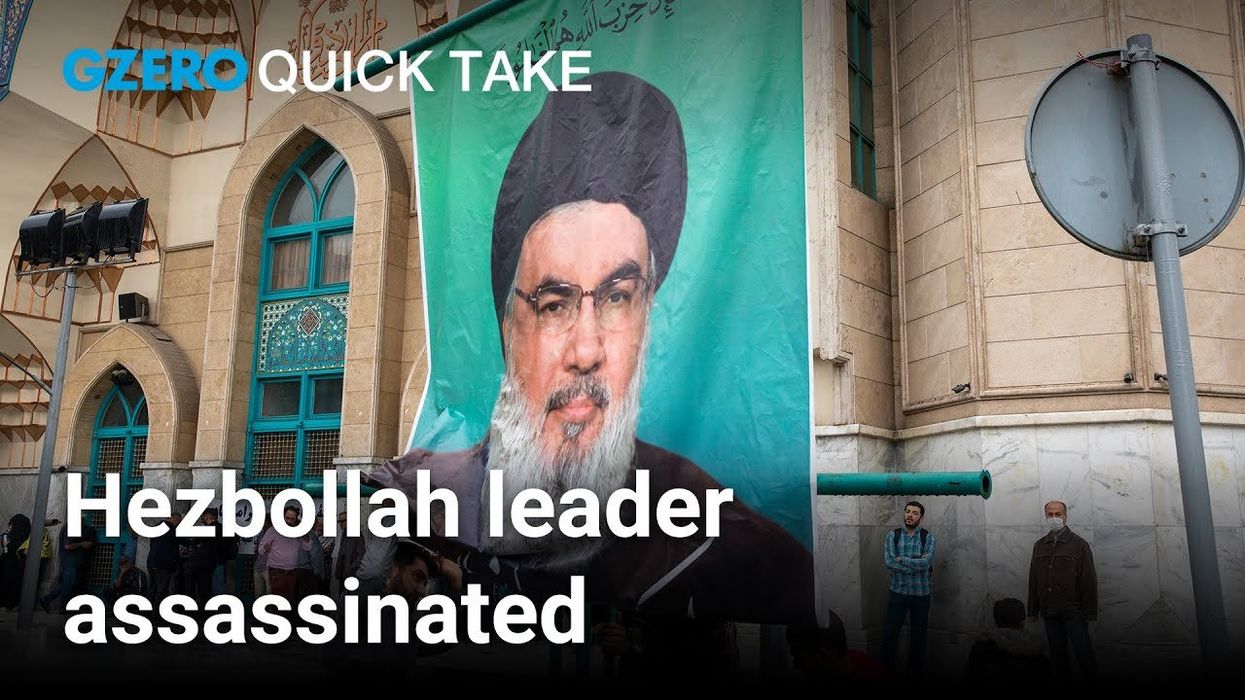
Ian Bremmer's Quick Take: A quick take to kick off your week. We are talking about the Middle East and the significant escalation in Lebanon primarily that has so far culminated with the assassination of Hassan Nasrallah, the leader of Hezbollah, and most of Hezbollah's senior leadership, with virtually no response by Hezbollah against Israel. Lots of things to think about here.
First is the fact that Israel's asymmetric military and intelligence capabilities really matter. For a long time, people have talked about the potential of existential threats against Israel. It certainly does not appear that way today, and in fact, it shows just how asleep at the switch the Israeli defense forces and more important leadership were back on October 7th in terms of border security, in terms of ignoring intelligence, in terms of most of the IDF being redeployed to the West Bank as opposed to Gaza, that allowed Hamas to pull off this spectacular and horrific terrorist attack against the Israeli citizens, killing over 1,000.
In today's environment, the ability of the Israel military to strike their enemies with virtual impunity, and with virtually no capacity for them to strike back effectively against Israel, is what's really dramatic here, and that's led to a few things in the region. First, it's led to the ability of Prime Minister Netanyahu to gain a lot of popularity. He was blamed for the October 7th attacks, for them happening on his watch, for him not being capable of defending Israel back then. Today, it's a very different story. It's being able to destroy Hamas, irrespective of the civilian consequences for the Palestinians there, it's his ability to take on and decapitate Hezbollah and Israel post-October 7th has taken virtually no hits as a consequence. That's led Netanyahu's former adversary, political opponent, Gideon Sa'ar, former Minister of Defense, to join Netanyahu's government, join his cabinet and their New Hope Party.
It means that if there were new elections today, a good chance... There's always a of coalition formation because it's a very fragmented political party system, but much easier to imagine that Israel's Prime Minister would be able to win a new election today, as opposed to the absolute thumping he would've taken over the course of the last year. It's a very different environment, and the fact is that the Israeli population supports these wars, and I say that really across almost the entire political spectrum. They support the war in Gaza, they support the attacks against Hezbollah, they support getting their citizens back into their homes in the north, there's some 60,000 that have been evacuated, and they do not support a two-state solution for the Palestinians, virtually none of them.
That is, of course, very, very different from pretty much everyone else in the world who does support territorial integrity and self-determination for the Palestinians, but they don't have the ability or the willingness to make that happen, and certainly none of Israel's friends are prepared to truly cut off Israel. We've seen the Brits stop with a few of the weapons systems, we've seen some targeted sanctions, tiny, from the Europeans and the Americans against Israel. But the military aid, the weapons sales, the trade, that all continues as it has. And by the way, that's also true in terms of the Abraham Accords, the Gulf states that have been working with the Israelis and others in the Arab world, they're very unhappy about what's happening on the ground in the Middle East, but they're also not prepared to change their relationship with Israel.
So where else does this go? Does this mean all-out war with Hezbollah? I don't think so, and I say I don't think so because I don't think Hezbollah has that capability. They do have men that are far better trained than Hamas; they have about 10 times the numbers of missiles and delivery systems than Hamas ever had, though a lot of them have been destroyed clearly, and certainly their leadership is gone. But even if they were to launch everything they had against Israel, it's hard to see them doing much damage. They could kill some Israelis, no question, but probably not that many, and they certainly couldn't do any real damage to the Israeli defense forces or the Israeli government. Meanwhile, Hezbollah would be utterly destroyed and the Lebanese economy would be in shambles. So it's hard to imagine any Hezbollah leadership, even a more hardline, hard as that is to imagine, leader of Hezbollah than Nasrallah taking those steps against Israel.
That then leads the bigger question, which is, okay, so the Axis of Resistance has been engaging in attacks, Red Sea, we'll see more of that from the Houthis, potshots at Americans, British military in the region, not very effective, some missiles against Israel, not very effective. What about Iran, might the Iranians do anything. Answer here, no. I spent an hour last week with the Iranian Vice President, Javad Zarif, and he made it very clear that his country, his government, is not going to fall into the, as he called it, Israeli trap, that they want nothing more than Iran to engage in what would be ineffective strikes against Israel that would bring the Americans into the war against Iran, that they are not going to take that bait.
And you'll remember, lest you think this is just propaganda, that back in the Trump administration when Qasem Soleimani, the head of the Iranian defense forces, was assassinated, so not so different than Israel taking out Hassan Nasrallah, the Iranian response was virtually nothing. Rhetoric, but no efforts to go after the Americans because they just didn't have the capabilities, and that's what we're seeing with the Iranians vis-a-vis Israel today. Now, the bigger question is whether Bibi Netanyahu, on a roll in the region, decides that he's going to go after Iran directly, and there, I think it's a question of their capabilities. The bunker that Nasrallah was in was comparatively easy to hit when you had intelligence that he was there. Yes, bunker-buster bombs, but limited and available to the Israelis.
The incredibly deep underground nuclear program, for example, at Fordow of Iran, under meters and meters of granite reinforced, the Americans are the only ones with the clear capabilities to destroy that. Israel could clearly set back Iran's program, but those kind of strikes would likely only redouble the efforts of the Iranians to build a full nuclear weapons capability, and a glancing blow by Israel, that would antagonize the United States and others and potentially lead to blow-back that Israel hasn't had to face so far, but might, that they wouldn't like; that's a risk that I think is greater than Israel would want to take, especially for not destroying the Iranian nuclear program, but only a limited amount of damage.
So I think you'd still see espionage, you'll still see sabotage, you'll still see willingness for the Israelis to go after members of the IRGC that they find in Syria, Iraq, other places, absolutely. But direct strikes on Iran, specifically the nuclear program, which is the target that the Israelis are most interested in, that seems like a bigger stretch to me. Not impossible, more likely today than it was a week ago, but still, I think that the escalation that we have been seeing in the war in the Middle East may be close to having played itself out now, simply because Israeli military capabilities are so much greater than that of their adversaries, and their ability to now focus on defense and security makes it more challenging for them to do anything, their enemies to do anything against them.
So anyway, that's where we are right now. I hope everyone's doing well, and I'll talk to you all real soon.









Keep up with what’s going on around the world - and why it matters.