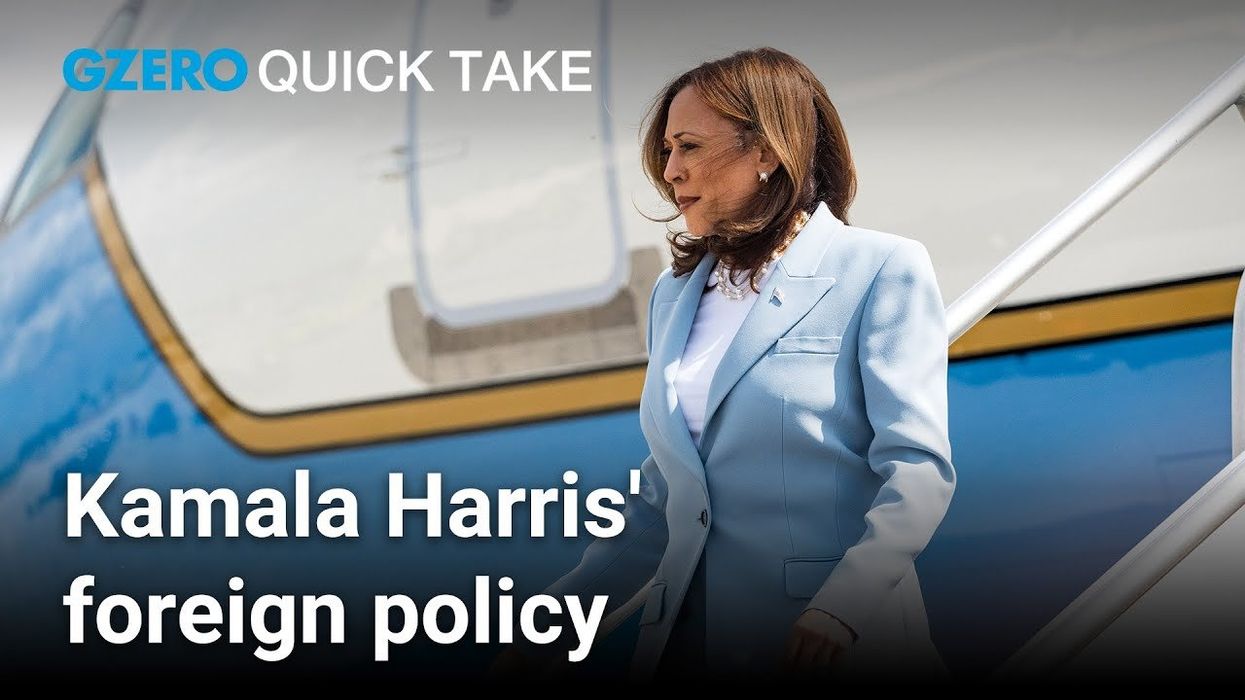
Kamala Harris on foreign policy
August 06, 2024
Global Stage LIVE from United Nations WATCH REPLAY
Ian Bremmer, political scientist and president of Eurasia Group and GZERO Media, shares insights on global political events.
Presented by

The first thing I should say, though, is that she does have a level of foreign policy exposure and experience, which is significant. So, it's not just a nominal conversation. We can talk about the meetings that she's had, the exposure that she's had, the experience that she's had in ways that should allow us to talk about her with more substance and depth. And first of all, the fact that she has served as vice president for a president that knows a lot about foreign policy, ran point on many foreign policy issues as vice president for the Obama administration, and before that ran the Senate Foreign Relations Committee has meant a lot of exposure for Kamala Harris. But also the fact that she sits in the presidential daily briefs every morning, that she's in the situation room when there are significant national security issues being discussed, she attends most of the meetings that Biden has with heads of state. Occasionally, she asks questions and participates; sometimes, she doesn't, but that's a lot. And in addition to that, she's also made a lot of trips herself, about 21 countries that she has visited as vice president, including five trips to Asia, four to Africa and the Middle East, and over 150 foreign leaders that she has met with herself. So, if you compare her to others, others talked about as potential Democratic party nominees or Republicans that were running against Trump, she actually has a lot more foreign policy exposure than them. And that's particularly important because, of course, when she became vice president, that wasn't the case at all. She had been a first-term senator, and before then a prosecutor and not someone that had had significant exposure to responsibility for of any sort for national security foreign policy. But now she certainly does. So that's the first point. That's the backdrop of all of this.
I've seen her now running three delegations of the Munich Security Conference for the United States, the most important national security event that the Americans attend. And that means meeting with, aligning policies with, all of the top US allies. Also, when she was running point, though Biden was also there, but she was very important because it was her back- hometown, California for the APEC Summit. And we spent a lot of time there when meeting with all of the APEC members and leaders that had come in. And that was particularly important for the meeting between Biden and Xi Jinping and trying to get that on a more stable trajectory without giving away the store for the Americans. The meeting that she led, the delegation for the Bletchley AI Conference, one of the more important for international, though not global, but international governance of AI, certainly among the US and its allies. So again, a lot of exposure.
So given all of that, where would I say there are significant differences? First and foremost, when I see Biden, I see someone who was very much someone that came of age during the Cold War and sees foreign policy actors in much more black and white. The idea of democracies versus autocracies was a Biden formulation, not a Biden administration formulation, a Biden formulation. A lot of his own advisors didn't like it. Vice President Harris certainly doesn't like it. It doesn't really reflect reality in the world in 2024, and it doesn't necessarily help the United States, which needs to have useful relations, and in many case does have very stable relations with countries that are hardly democratic themselves, and the United States is hardly a great example, a shining example of a functional representative democracy, especially in the context of its core allies in the G-7. Rather, I would say that ... and also in addition to that, Biden also sees the "Great Man" policy formulation, that you know, if you sit down with another great leader and you work a personal relationship, you can get things done. So a lot of the most important things are done bilaterally.
I would say that Kamala's inclinations are very much opposed to that, that they support rule of law and they support international norms and standards. Some of that is her prosecutorial bent and background. Some of that is just being much younger and coming of age in a very different post-Cold War time, much more multipolar and the Americans needing allies in multilateral structures, and also needing to work with countries that aren't allies in multilateral structures to get them to do the right thing. And frequently the American experience and policy is hypocritical. But if you want to uphold the right thing globally, you need to stand for those norms and you need to uphold those norms in institutions, even in places where occasionally the United States is really going to disagree on individual policy.
So that I think is a pretty big difference between the two. And I think that, for example, the vice president's approach on Russia is very much aligned with this, where Biden is like, "It is the evil Putin doing horrible things," and Kamala much more, "Sovereignty needs to be upheld." The policies are very aligned, but the reason for the policies, I think is a little bit different.
I think that Harris would not be inclined to push the Ukrainians for a shift towards negotiations in a way that I think Biden intrinsically would like to. Biden doesn't really trust Zelensky. The first time he met Zelensky when he was president, Zelensky was blaming Biden for not getting Ukraine into NATO, even though it wasn't in Biden's capacity to do so. There were lots of allies that were supported, and Zelensky's perspective was, "Yeah, but if you would pushed, it definitely would've happened." I think that Kamala Harris's view on Zelensky has been someone whose country has been wronged and their position needs to be supported because you have to uphold these norms and values. And certainly in that regard, when she met Ukrainian president Zelensky for the first time before the invasion and was delivering intelligence to him about the impending attack, that really helped forge a much warmer personal relationship between the two. And I think Zelensky is much more comfortable with a Harris than he has been or would be, would've been with Biden. So, that's interesting.
I would say that on China policy, they're very well aligned, especially when you talk about areas of common interest coordinating with allies on national security issues, which broadly include key strategic industries. The fact that the US has been able to bring down the temperature somewhat with China while maintaining and building strong relations across Asia is something that's important. Harris has made a lot of trips, meeting with President Marcos of the Philippines, that's a very strong relationship. She certainly feels that that's an area that the Americans need to pay a lot of attention to, need to prioritize. I would say the "pivot to Asia" concept is very strong under Harris in a way that perhaps less so under Biden and certainly not under Trump.
Maybe one of the biggest issues of differentiation is on Israel-Palestine. Very hard for Harris to talk about that because she's the vice president sitting, with Biden still running the policy, and Biden being very deferential to Netanyahu. I think that Kamala Harris would try to be considerably less so and would focus much more on the abrogation of human rights of the Palestinians while at the same time recognizing that Israel is the most important defense partner of the United States. That would lead to a lot more pressure. And I think that that pressure would be out of step with the US relationship with Israel over the past decades but much more aligned with where America's allies are with Israel going forward.
The big vulnerability that Harris has, of course, is on immigration and the border, and that is one that she is not going to be able to jettison. She had responsibility for the policy with the Northern Triangle. She was given that because Biden doesn't really have much background with immigration, and Harris is from California, and Biden expected she'd do a better job with that. She was generally seen as not doing a good job with that. And, of course, the numbers have been rising and rising and rising. Some of that is post-pandemic. Some of that is not paying enough attention to border policies that can work, and to security, and to get the resources that are necessary to process the cases, all of these things. And I suspect that Biden and Harris have come late to the recognition, the realization that talk is cheap when it comes to sanctuary cities, and you need to actually have a more effective border policy. And I think that she's going to be continually very vulnerable on that issue.
Final thing I'd say between Biden and Harris is that, again, as someone who's only 59, I say only that's not exactly young, but certainly in the context of Biden and Trump, it's quite young, does look more to the future in terms of setting foreign policy. That is part of why Harris has been more focused on Silicon Valley than Biden has been. And certainly, I've seen that with the prioritization of AI. I think that's also Harris's focus on Africa as the place where you're going to see the greatest demographic growth. Some of the greatest potential challenges if it's not addressed with the United States, that Chinese of course having a big lead in engaging economically, engaging commercially and having political leverage. But the United States wanting to do much more in terms of human capital, also in terms of climate. I think that comes much more naturally to Harris to focus long-term on what it means if the Americans don't take a leadership role with allies and with countries that are adversaries on climate than Biden has.
So there are, I think a lot of places where we can talk about differentiation. She's going to have to set out a lot of that in much clearer and stronger form than she's had the ability to as vice president. And the media is going to need to pay a lot more attention to it going forward because it hasn't really been a priority to cover it. But I do think that there is enough to begin with to start asking some good questions, and hopefully she's also going to be taking some significant interviews with media, which she hasn't done since Biden has dropped, to answer them.

Keep up with what’s going on around the world - and why it matters.