VIDEOSGZERO World with Ian BremmerQuick TakePUPPET REGIMEIan ExplainsGZERO ReportsAsk IanGlobal Stage
Site Navigation
Search
Human content,
AI powered search.
Latest Stories
Sign up for GZERO Daily.
Get our latest updates and insights delivered to your inbox.
Global Stage: Live from Munich
WATCH RECORDING
Quick Take
Ian Bremmer, political scientist and president of Eurasia Group and GZERO Media, shares insights on global political events.
Presented by

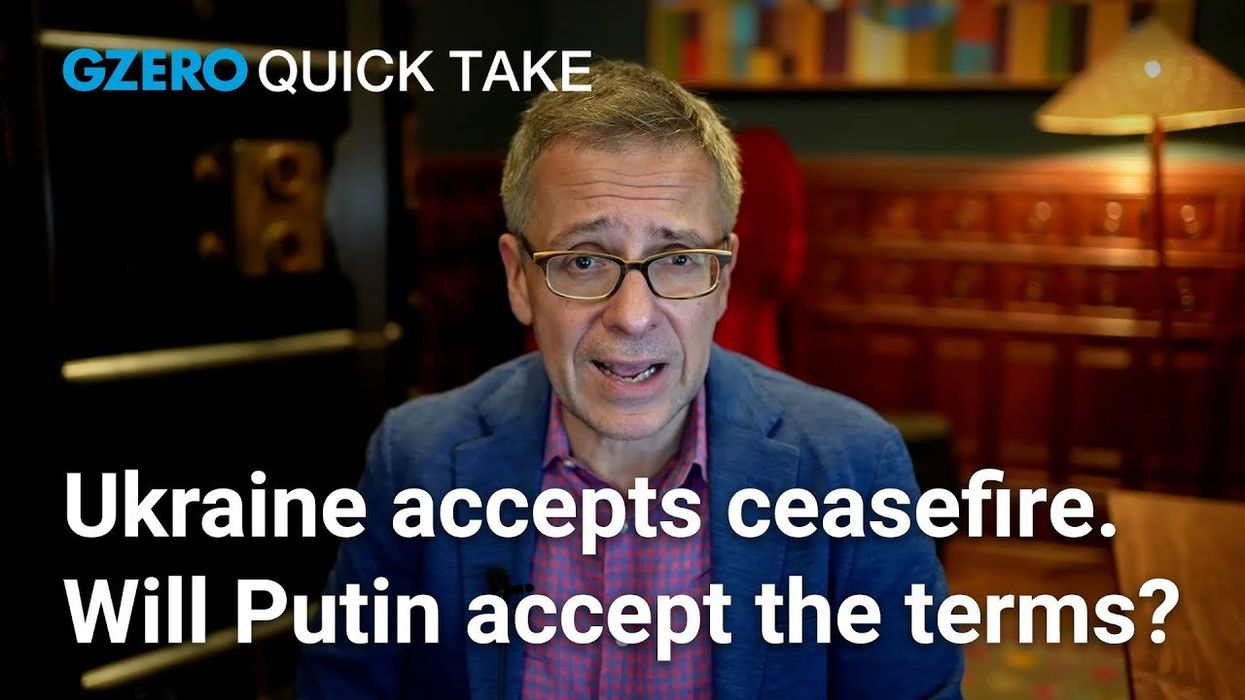
Ian Bremmer's Quick Take: A Quick Take on the back of the Riyadh meeting between the Americans and the Ukrainians, a very different reaction to when President Zelensky was visiting the White House just a week and a bit ago. Here we have a Zelensky emissary, senior delegation meeting with Rubio, secretary of State and National Security Advisor Mike Waltz, and coming out with a significant improvement in Ukraine's position.
First, an end of the suspension of delivery of US military aid and intelligence provision, which is critical for the Ukrainians being able to continue to defend themselves. And in return, Ukraine and the United States both announcing acceptance of terms for a 30-day, no condition ceasefire, end of the fighting exactly where it is right now. No territory changes, hands, no promises of anything beyond that. No guarantees about NATO, no promises not to join NATO, nothing like that. And now it goes to the Russians. And that is clearly not what the Russians wanted to hear.
Now, Zelensky played the cards he doesn't have much better since leaving the White House, saying he would indeed go ahead and sign a critical minerals deal, writing a letter apologizing to the American president for any misunderstandings when they had that meeting together in the Oval Office. But now, Zelensky is no longer an obstacle from Trump's perspective on the path to peace, he's accepted Trump's terms. I expect the Europeans will come out and support that 30-day cease ceasefire in very short order, and the question is for Putin.
Now, Putin is of course gaining territory. He has momentum, and so he doesn't have an awful lot of interest in accepting an immediate ceasefire right now, especially not with any strings attached to it. I mean, he has all sorts of strings he wants to attach to. It wants to ensure that Zelensky isn't president, wants to make sure that Ukraine can, at no point, ever join NATO, has broader conditions in terms of NATO not expanding, of the Americans pulling troops back from their rotations in Poland, in the Baltic states, all sorts of demands that Putin has. And furthermore, Putin has engaged with the United States, both indirectly, as we saw in Riyadh a couple of weeks ago, as well as directly, in a 90 minute phone call with President Trump. And while Ukraine was a part of those conversations, it wasn't the focus. The focus for Putin was a much broader conversation about realigning the Americans and Russians to work together, work together on broader security issues like the Arctic and on nuclear arms control, get the sanctions off that the United States has imposed against Russia and individual oligarchs, and generally normalized relations. And none of that is, at least as of right now, on the table for Putin.
What is on the table for Putin, right now, is accept a 30-day ceasefire, with the lines of territorial control being exactly where they are, including the occupation of a small amount of Russian territory incursed by the Ukrainians who have been fighting there. And I suspect that Putin really doesn't want to accept that. So if you're Putin, what do you do? Well, one thing you do is you try to see how fast you can actually get a face-to-face with Trump so that you don't just talk about that deal, but you put it in the context of a much broader deal and you keep the Europeans out of it, which of course is essential to any larger deal that the Americans and Russians cut because the Europeans continue to see Russia as their principal adversary, their principal enemy. Will he be successful in doing that?
Well, one open question will be, we just heard from Mike Waltz and Marco Rubio, but what are we hearing from Trump? Is Trump going to completely support everything they just said? Will he endorse this deal with no qualifiers and say that Putin now has to accept it? Because if he does, that gives less wiggle room for Putin. If he doesn't, and he talks about how this is a great opportunity and we want to have a better relationship, then it gives Putin a little bit of time. It also allows him to put conditionality on what, as of the Riyadh meeting, did not have any conditions.
So certainly for those of us following this very closely, a good meeting for the Ukrainians, a relief for the Europeans, that felt like they were about to have their guy in Kyiv thrown under a bus. There's some rehabilitation that's actually happened. And a very open question for Putin who is a tough negotiator and has shown no indication, heretofore, that he's interested in an immediate ceasefire. He is the one that stands to lose the most from accepting the terms as they just came out of Riyadh and it's very hard to imagine that he'll accept them by themselves, as they are. What are the consequences of that? That's what we're going to have to watch, play out.
Keep reading...Show less
More from Quick Take
Quick Take
Mar 03, 2026
Trump’s State of the Union address
February 25, 2026
Has US–Iran diplomacy reached its end?
February 23, 2026
Supreme Court blocks Trump’s tariff power
February 20, 2026
Why Trump is pushing to take Greenland
January 18, 2026
US response to Iran protests
January 12, 2026
Maduro ousted in US raid, a major win for Trump
January 03, 2026
GZERO Series

© 2026 GZERO Media. All Rights Reserved | A Eurasia Group company.
GZERO Daily: our free newsletter about global politics
Keep up with what’s going on around the world - and why it matters.