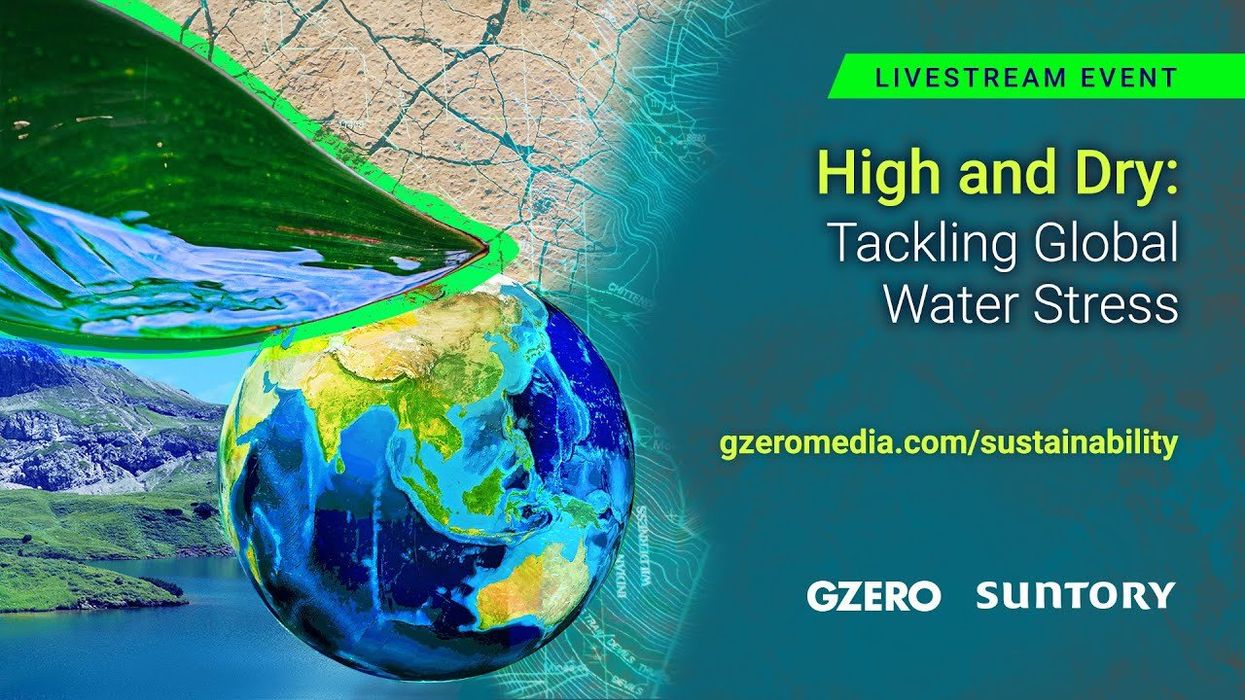
The global water crisis and the path to a sustainable future
November 29, 2023
Explore GZERO’s past virtual conversations, featuring global experts on the world's urgent issues.
Presented by
What would you do if you turned on the tap one day and nothing came out? By 2025, water scarcity is expected to affect about 50% of the world’s 8 billion people, and climate change is worsening the problem by changing global weather patterns.
That’s why this year’s COP28 climate summit, which kicks off Thursday in the United Arab Emirates, added water scarcity to the agenda, bringing it to the forefront of climate negotiations. In advance of the summit, the Sustainability Leaders Council - a partnership between Eurasia Group, GZERO Media, and Suntory - brought together leading experts and industry leaders to discuss the problem and possible solutions for a GZERO Live event.
Brian Richter, president of Sustainable Waters, framed the problem simply: Growing populations are straining fresh water sources by taking more water out faster than it can be replaced through natural processes like rainfall and snowmelt. Even in parts of advanced economies, like the arid western United States, farmers are struggling to adapt — and adapt they must.
“Irrigated farming is responsible for consuming about 90% of all the water that we use on the planet,” said Richter. “Anything that we can do to reduce that need, to grow our food, that's going to be very, very important.”
Efficiently using agricultural water will also help mitigate some of the adverse effects of heavy fertilizer use, which farmers can’t live without, according to Alzbeta Klein, director general of the International Fertilizer Association.
“Water is food,” she said. “What gives me a lot of hope is that the solutions actually exist. We know how to deliver plant nutrients through every drop of water and maximize the efficiency of every drop.”
Luckily, farmers are on board to change. Mike Nemeth, senior advisor of Agricultural and Environmental Sustainability at Nutrien, said he’s optimistic because of the “interest that I hear from the farming community about their willingness and desire to be part of water solutions – not just for their farm, not just for their area, but for the agri-food industry.”
And Shigeaki Kazama from beverage company Suntory, sponsor of the event, illustrated how the industrial sector can take the lead in innovating ways to recharge water sources. For over 20 years, Suntory has managed natural woodlands to recharge underground aquifers in the communities where it works.
“We now manage totally 22 forest areas that in total cover 12,000 hectares, which recharge twice the amount of groundwater that we take for our production in Japan.”
More intentional planning for water reuse can have a major impact, according to Colm Jordan of Indorama Ventures, which produces chemicals and associated products.
“We've managed to reduce water consumption by 90% in our facilities in Brazil by recycling the water, cleaning it, and using it again,” he explained.
Helping companies make those kinds of water-related shifts can mean big money for investors, too, said Manoj Jain, investment director at Unison Capital. “The material recovery, conversion of waste and plastic into fuel, desulfurizing the air, the flue-gases, all this is very profitable business,” he said. “We are investing in a circular economy, we are investing in the waste management, and that creates extremely positive social impact.”
Shari Friedman, Eurasia Group’s managing director for Climate and Sustainability, pointed out that companies can easily run afoul of local communities and the general public by failing to manage their water use responsibly.
“You're going to see some reputational risk in terms of water use because water is so integral to people,” she said. “If [a company is] taking it away or they're polluting a source, it's something that's incredibly visible.”
But while the private sector is making changes out of self-interest, governments are lagging well behind on the issue of water management.
James Dalton, director of the Global Water Programme at the International Union for Conservation of Nature, said, “roundabout 90% of global water policy is out of date” and urged governments to dust off the old laws and have a look at what can be done to future-proof the system.
“Most countries are 20 years behind where they need to be now on reforming water policy,” he said. “We need to be looking at water policy now for 20 years ahead so we can build the trajectories. That means that we're effectively 40 years behind.”
But Tanvi Nagpal water policy expert and a consultant for Tetra Tech says there’s a special opportunity in the US to correct historic policy errors thanks to the Biden administration’s Inflation Reduction Act, which has set aside money to replace dangerous lead pipes and update plumbing infrastructure.
“40% of all of the investment is going into disadvantaged communities,” she said. “These are communities that have faced water shortages or no sewage treatment or terrible quality water for a generation, and we can no longer ignore them.”
Watch the full discussion above, and don’t forget to subscribe to GZERO Daily to get the heads up about future conversations right in your inbox.








Keep up with what’s going on around the world - and why it matters.