Risks of Russia losing: Putin, Ukraine, and potential for escalation
April 18, 2022
Global Stage LIVE from United Nations WATCH REPLAY
Ian Bremmer, political scientist and president of Eurasia Group and GZERO Media, shares insights on global political events.
Presented by

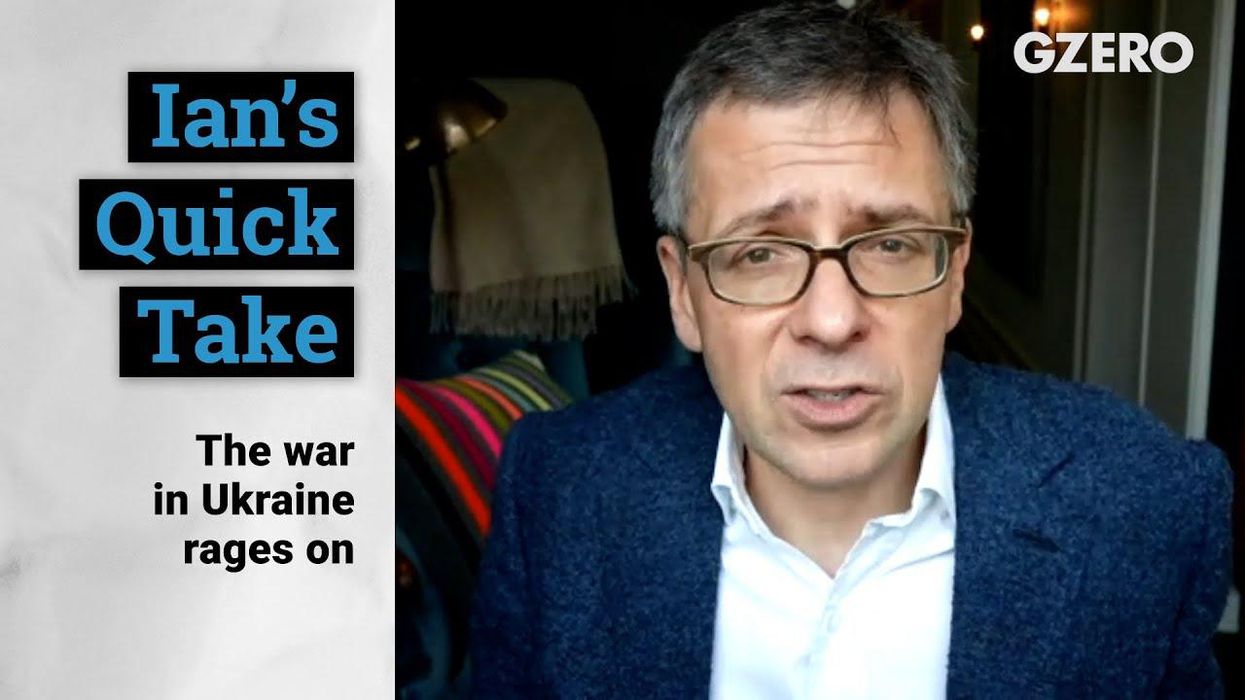
Hi everybody. Happy Monday. Ian Bremmer here and I have your Quick Take going back to Russia and Ukraine. We're almost two months into this war and I continue to be very pessimistic about where we are heading. Over the last few days, the biggest headline, I think, has been the sinking of the Moskva. This is Russia's carrier, its flagship of its Black Sea fleet. It is the worst naval combat loss that Russia has experienced since World War II at the hands of Ukraine, a country that doesn't even have a navy.
Initially, the Russian government said that it was just on fire. It was an explosion, but not that it was attacked. Then they pivoted quickly to saying it's attacked. But if you watch Russian state television focusing more on NATO and not Ukraine, "how could the Ukrainians with the Ukrainian missile take out this extraordinary Russian ship? No, it must be that we're fighting NATO itself. " And this has been a shift that we've seen from the Russians over the course of the last few weeks. The war is taking much longer than they had expected. Their initial efforts to, of course, take Kyiv, to overthrow the Zelensky government have all failed. And what you're seeing is a shift away from, "we're fighting Ukraine and denazifying that regime," and instead towards "the reason it's taking so long is because we're fighting all of NATO, that the West as a whole is fighting against us. And they're sending troops on the ground that they're not really admitting to. They're sending all this military equipment," which, of course, they are trumpeting. And indeed that the attack on this cruiser, which was purely at the hands of the Ukrainian military, nonetheless, the Russians are saying NATO is behind it.
Look, I mean, there is something to this. It is certainly true that NATO is providing a hell of a lot of weaponry now. And the level of weaponry has been increasing every week, both the amount, almost $3 billion in defense support, just from the United States and a lot from almost every corner of NATO. And also increasingly offensive weaponry.
So we're now talking about Switchblade drones, we're talking about helicopters, we're talking about tanks coming from a lot of different NATO countries and that plus intelligence support real-time on the disposition of Russian forces is making it easier for the Ukrainians to beat back the Russian invaders, both outside of Kyiv, but also even in terms of in the Black Sea and in Southeast Ukraine. The Russians are going to adapt their military strategy.
They've fought for 50 days now. But you'll remember, the war against Finland was 100 days before they won it. The Russians have staying power and willing to send more troops into the fight. And I think that the danger here is that the Ukrainians and the West increasingly believe that the Russians can indeed lose, but that only works, and obviously it's the outcome everyone would love to see, leave aside Putin, aside from the fact that he's not prepared to accept it. I mean, if he's not going to capitulate, if he's only going to continue to escalate, then what you really want is to freeze the conflict as opposed to force him into a corner and try to defeat him militarily because full defeat of Russia, militarily vis-a-vis Ukraine is really not doable.
Now what the Russians want right now, what they're looking for militarily on the ground in Ukraine, really, four things. First, they want to take all of the Donbas that they've recognized as independent. That is, frankly, two-thirds more territory than they had been illegally occupying from 2014 until the invasion started in February. They want a land bridge that they've, more or less, taken and this is why Mariupol is so strategically important for them. They continue to fight six weeks on, building to building inside Mariupol a land bridge between the Donbas connecting it with Crimea.
They want this city of Kherson, which is critical because that is what allowed the Ukrainians to cut off all the water to Crimea from the mainland once the Russians illegally annexed it. If they control Kherson, they'll have the control of that infrastructure. The Ukrainians will not. And finally some buffer territory to hold all of that territory comfortably. That's what the Russians are trying to accomplish in this phase two of their special military operations as they call it, a war, certainly.
Whether or not they can accomplish that by May 9th, which is Victory Day, increasingly I am skeptical. Increasingly I think they can only accomplish some of it. They'll have most of Luhansk, but probably not most of Donetsk at that point. And it's not clear whether they will be able to declare sort of victory, even in this second phase of battle by May 9th. Increasingly the Ukrainians are getting much more capacity and their morale is, of course, very high.
Then you also have the international front where it's much worse for the Russians on every front, because they're cut off economically from all of the advanced industrial democracies, which is where so much of the trade and export has gone, because there is so much expansive defense spending, as well as support of Ukraine, the Ukraine that is still held not by Russia, which is the vast majority of it. Because you're going to see so much more willingness to advance to forward deployed troops in the Baltic states, in Poland and Romania, Bulgaria, of course, Finland and Sweden, soon to be joining NATO.
All of this means that internationally Putin is losing and losing badly. So the big question is, therefore, you want Russia to lose, but how badly do you want them to lose? Or should I say, you want them to lose how badly? Do you want them to lose all the territory that they've taken in Ukraine from 2014? Because if you do, what happens if that makes them much more likely to use scorched earth tactics against Ukrainian cities and a lot more Ukrainian civilians die? What if it makes them much more likely to use chemical weapons or even tactical nuclear weapons as we've heard from President Zelensky himself warning over the weekend. Internationally, how much do you want the Russian economy to be destroyed given the actions that are being taken?
None of this is easy. I'm simply saying that it seems clear from a geopolitical position you obviously didn't want the Russians to take Kyiv. You didn't want them to overthrow Zelensky. But it's not clear that pushing them into a position where the only choices they have are capitulation or lashing out is a much more stable outcome, certainly for NATO. I understand why it's a more stable outcome potentially for Ukraine.
We're moving towards that scenario. Towards one where Putin has to make increasingly difficult and dangerous decisions and everything we've seen so far implies that he's willing to do that. In part, because there's very little downside for Putin himself. If his country's already been cut off economically by the G7, if he's already an international pariah from countries that aren't going to invade him directly, they are going to be deterred in terms of his nuclear capabilities from attacking Russia. But short of that, they'll do everything. Well, then what then prevents Putin from doing everything he can to ensure that Ukraine is not a viable country going forward?
That's a very good question that needs to be asked strategically by everyone in NATO that is engaged in this fight right now. I'm deeply sympathetic to providing enormous amounts of support to Ukraine, especially because this is not a proxy war that's being fought over Ukraine. This is Ukraine was invaded. They desperately want to defend their territory and they are begging the West for more support. So I get the ethical reasons to give the Ukrainians everything you can to help them keep their country.
But at some level there is a greater amount of risk that's taken if it looks like the Russians are in a position that they might actually "lose" and Putin doesn't have a backdown, Putin only has an escalation button. Anyway, something we're going to be watching closely over the course of the next several weeks as we near “Victory Day”, May 9th, which is going to be anything but for Putin, and as we see what this dynamic looks like, both between Russia and Ukraine and also between Russia and NATO more broadly.
So that's a little bit from me. Hope everyone's having a good week and I'll talk to you all real soon.
For more of Ian Bremmer's weekly analyses, subscribe to his GZERO World newsletter at ianbremmer.bulletin.com
Help us win a Webby Award for Ian Bremmer's Quick Take series! Vote here before April 21.


Keep up with what’s going on around the world - and why it matters.