Skip to content
Search

Latest Stories

Economy

China is open for business

Workers work on a production line at a silk workshop in Haian, Jiangsu province, China.

Workers work on a production line at a silk workshop in Haian, Jiangsu province, China.

Reuters
Make us preferred on Google

In an uncharacteristic acknowledgment of weakness, China on Sunday announced a plan to attract more foreign investment and boost its stagnating economy. The 24-point plan aims to improve the climate for FDI, which has taken a hit from the Communist Party’s unpredictable and occasionally hostile policies towards foreign companies.


New foreign investment in China fell to its lowest level in 25 years in the second quarter of 2023. At the same time, China’s economy is also suffering from deflation, local government debt, and a declining real-estate sector. For more on China’s economic woes, watch Ian Bremmer’s interview with Shaun Rein, founder and managing director of the Shanghai-based China Market Research Group, on this week’s GZERO World here and read our explainer here.

Beijing’s new plan targets key industries, such as biopharmaceuticals and telecommunications, offering tax deductions and incentives. It also makes it more convenient for foreign companies to apply for visas and residence permits.

But this comes at a time when foreign investors increasingly see China as an unsafe place to invest their money, especially since new anti-espionage laws give authorities sweeping authority to access and control foreign business data.

Meanwhile, US companies are pulling out of China in droves over fears for employee safety and amid rising tensions between Washington and Beijing after a series of US-based consulting firms were raided in China this spring.

We’ll be watching to see whether Beijing does anything to relieve these fears underlying the decline in Chinese FDI.
More For You

How AI offsets Trump’s tariffs...for now
- YouTube
AI may be doing more than driving hype—it’s helping prop up the US economy. Harvard economist and former IMF Deputy Managing Director Gita Gopinath says a surge in AI investment helped offset the economic drag from tariffs. “The positive effect that came from AI offset the negative effect that came from tariffs,” she explains, noting that the two [...]
The US economy has avoided the brunt of the Iran war...for now
- YouTube
As part of a larger conversation in the latest episode of GZERO World, Harvard economist and former IMF Deputy Managing Director Gita Gopinath breaks down the economic impact of the Iran war—and why the US is relatively insulated. So far, she says, the shock is modest compared to past crises. Global growth is expected to drop by about 0.3 [...]
Can anyone actually dethrone the dollar?
- YouTube
For 80 years, the US dollar has been the world's reserve currency. Its dominance was built on US economic strength, institutional trust, and the post-World War Two Bretton Woods system, which pegged global currencies to the dollar rather than gold. But today, the greenback is under pressure. The dollar shed about a tenth of its value in the first [...]
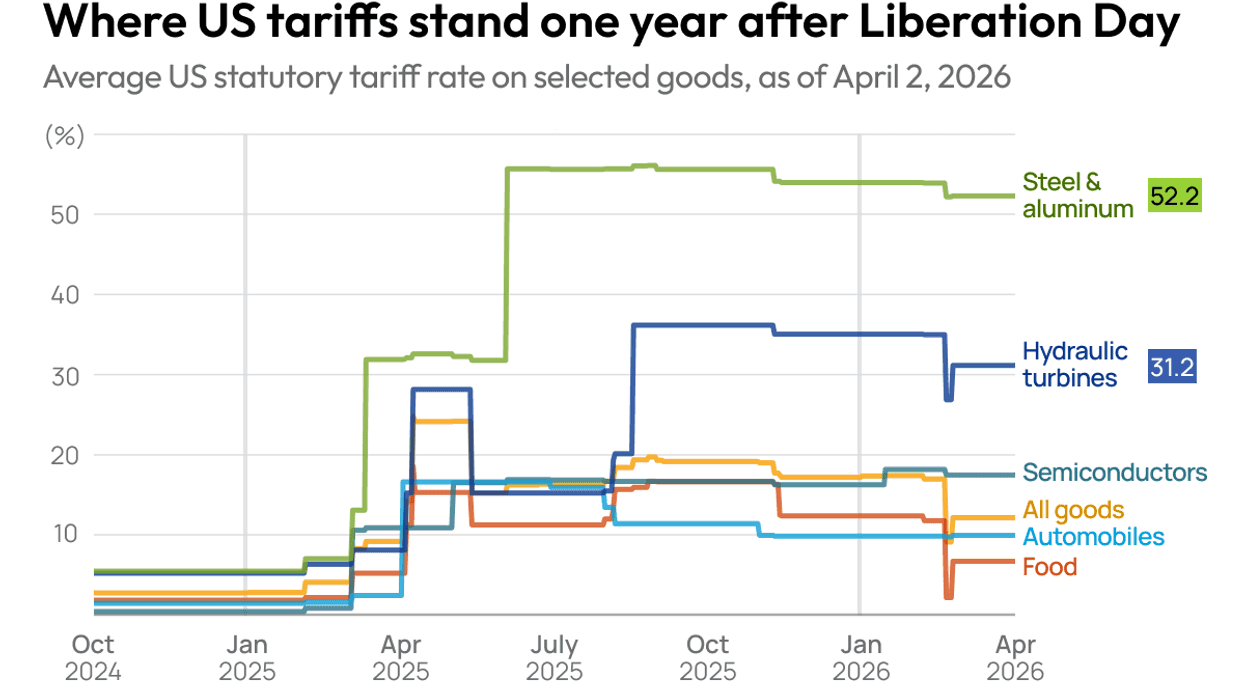
Where US tariffs stand one year after Liberation Day

Where US tariffs stand one year after Liberation Day

Natalie Johnson, Eileen Zhang
US President Donald Trump rattled the global economy when he announced tariffs on around 90 countries on “Liberation Day” one year ago today, but probably not in the way either supporters or critics first imagined. At its peak, the tariffs the US imposed were the highest in nearly a century, yet tariffs haven’t broken the global economy. They [...]