It's just a soccer game. Or maybe there’s more to it.
On Tuesday, underdog Morocco takes on 2010 champion Spain at the Qatar World Cup in what one might frame as a battle between “neighbors” in Africa and Europe, separated by barely 9 miles of the Mediterranean Sea and with a long-fraught political relationship that’s seen some recent twists and turns.
And there’s a bigger geopolitical story that goes beyond the two kingdoms.
Territorial disputes have always made Morocco-Spain ties, to put it mildly, complicated. Morocco resents Spain for not handing over the former Spanish colony of Western Sahara, which Rabat claims as part of its territory and is rich in fish and minerals.
Morocco also has a beef with Spain over Ceuta and Melilla, two centuries-old Spanish enclaves inside Morocco and the last vestiges of European sovereignty in mainland Africa. (Fun fact: 20 years ago, the two sides almost went to war over a rock in the Strait of Gibraltar inhabited by … goats.)
The bilateral tensions have two major spillover effects with EU-wide implications.
First, Morocco has been accused of weaponizing sub-Saharan African migrants when it tells its border guards to stand by and "let" asylum-seekers try to scale the border fences of Ceuta and Melilla, which is EU sovereign territory. Rabat does this whenever Spain triggers it over Western Sahara: In May 2021, Madrid had to deploy the army to help defend the border from an influx of thousands of migrants after the Spanish government allowed a leader of the Polisario Front — a militant group that seeks independence for Western Sahara — to get medical treatment in Spain.
This is not just a Morocco-Spain problem. Once the asylum-seekers are on EU soil, they are free to travel to other EU countries — potentially unleashing a migration crisis across the entire bloc.
Second, whatever happens between Morocco and Spain is closely watched next door in natural-gas rich Algeria, which backs the Polisario Front and has kept the border with its western neighbor closed since 1994 to protest Morocco’s partial “occupation” of Western Sahara.
In late April, the Algerians first threatened to cut off gas supplies to the Spanish after Madrid announced it would resell some of that gas to Morocco. And when PM Pedro Sánchez went a step further by ending Spain's long-held neutrality on Western Sahara to ward off another migrant crisis, Algeria responded by selling more gas to Italy. Algerian gas deliveries to Spain are now down by half from a year ago and the US has become Madrid’s top seller.
Algeria's strong pushback to Spain's pro-Rabat gestures is a heads-up to the EU: Kicking the Russian gas habit is not risk-free. The more leverage an alternative supplier gets, the more inclined it'll be to turn on a dime and move to kill a contract if political feathers get ruffled.
So, what’s the current state of bilateral ties and what does the future hold? “Spain and Morocco are now on a honeymoon, but this is only a parenthesis before the next crisis, which Morocco will decide when to launch,” says Ignacio Cembrero, a veteran Spanish journalist and expert on Morocco-Spain relations.
The next big development will come, he adds, when the Spanish government follows the US in recognizing Moroccan sovereignty over Western Sahara, as the Trump administration did in December 2020 in exchange for Rabat joining the US-brokered Abraham Accords. “That’s what Morocco wants.”
Back to the soccer ... on the pitch, Spain is the favorite. La Roja has a young squad led by FC Barcelona playmaker Pedri that excels at its signature tiki-taka passing game. Still, the Atlas Lions have plenty of talent too and will surely give their northern neighbors a run for their money.
Yet off the field, the stakes are higher for Morocco. If it wins and becomes the first Arab country to reach the World Cup quarter-finals, Moroccans will go crazy at home — and in Spain, where some 800,000 of them live.
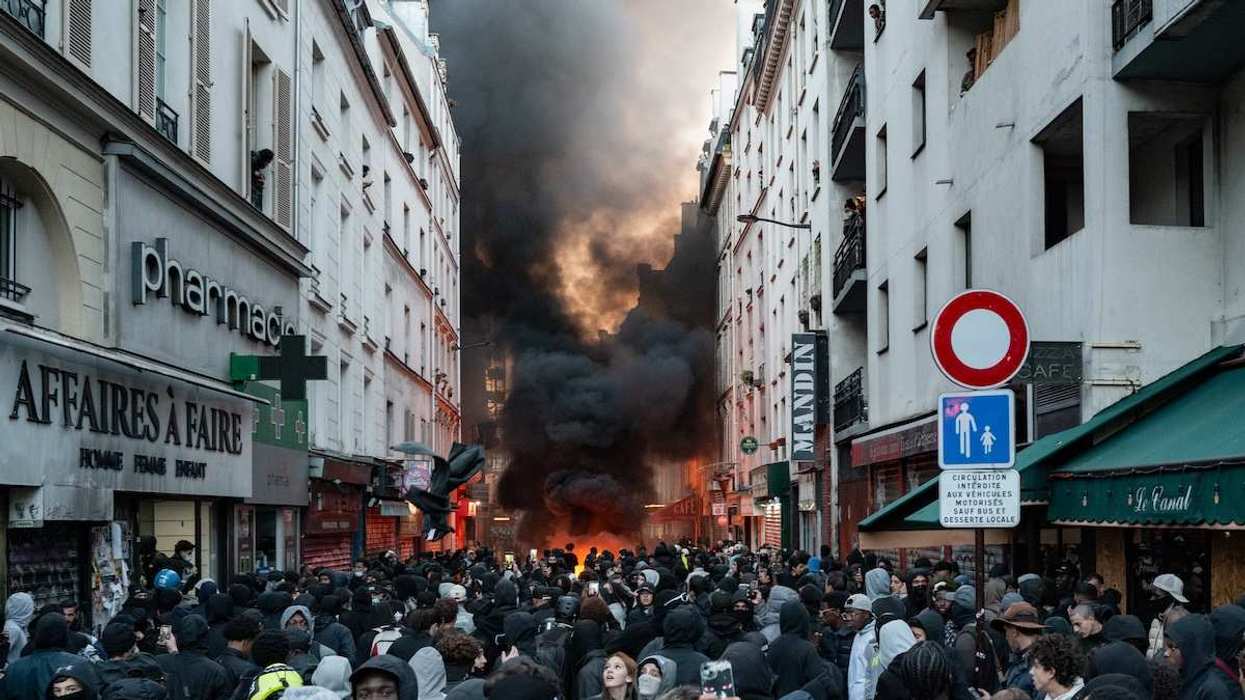
Let’s just hope the celebrations don’t turn into the violent riots that erupted across Belgian and Dutch cities when Morroco upset Belgium in the first round.This comes to you from the Signal newsletter team of GZERO Media. Sign up today.